
Picris aphid
Hyperomyzus picridis
Description
How to identify
The Picris aphid (Hyperomyzus picridis) is a member of the family Aphididae within the order Hemiptera. This aphid species is specialized in its feeding habits, primarily colonizing plants belonging to the Asteraceae family.
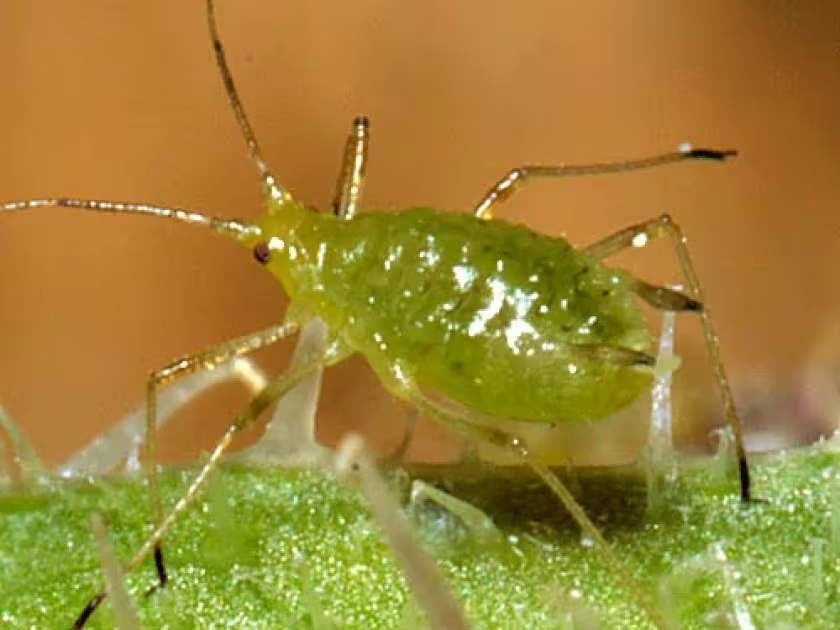
Adults and nymphs possess the typical aphid body structure, which is adapted for piercing plant tissues and extracting sap. Their coloration often ranges from light green to yellow, providing camouflage against the leaves of host plants.
The life cycle encompasses stages of eggs, nymphs, and adults. Reproduction occurs both through parthenogenesis (asexual) and sexual cycles, which allows the population to increase rapidly when environmental conditions are optimal.
Identification requires careful inspection of the undersides of leaves and flower buds, where these insects tend to aggregate. The use of a hand lens is essential to detect early infestations when aphid density is still low.
Morphological identification focuses on specific structures such as siphunculi and body hair patterns. Accurate taxonomic identification often requires microscopic analysis to distinguish this species from other related aphids.
What it damages
The primary hosts for this species include plants of the genus Picris and other members of the Asteraceae family. Damage is caused by the extraction of nutrient-rich sap, which significantly weakens the host plant.
As the aphids feed, they inject saliva into the plant tissues. This process disrupts the plant's metabolic functions, leading to stunted growth, leaf deformation, and a reduction in overall plant vigor and vitality.
Beyond direct mechanical damage, the Picris aphid acts as a potential vector for several plant viruses. The transmission of these pathogens often causes more severe damage than the sap depletion itself, leading to systemic infection.
Under favorable conditions, large colonies can form on young shoots. This leads to severe leaf curling and distortion, reducing the photosynthetic surface area and potentially causing premature leaf senescence.
The economic importance of the pest is linked to potential yield losses and reduced crop quality. Infested plants become more susceptible to other environmental stresses, such as drought or secondary fungal infections.
When it appears
Infestation usually begins early in the growing season, coinciding with the emergence of young shoots. Moderate temperatures and high humidity create favorable conditions for the rapid development of aphid generations.
In spring, nymphs emerge from overwintering eggs and begin feeding on primary host plants. The population grows steadily, reaching peak density in mid-summer when conditions for reproduction are at their best.
The species may exhibit host alternation, moving between different plant types during the season to maximize food resources. In autumn, the aphids return to primary hosts to lay eggs that will survive the winter.
Regular monitoring should be conducted throughout the growing season, especially during periods of fluctuating weather. Forecasting outbreaks requires understanding the local microclimate and its effect on aphid lifecycle speed.
Shorter generation times in warmer weather result in exponential population growth. Continuous monitoring helps identify the onset of mass outbreaks, allowing for timely intervention before economic damage occurs.
Signs of infestation
The first sign of infestation is the visual presence of insect colonies on the abaxial leaf surface. Aphids are often found clustered together, particularly near the leaf veins where sap flow is most abundant.
The presence of honeydew, a sticky excretion, is a key indicator of aphid presence. This substance provides a growth medium for sooty mold, which manifests as black fungal patches on the foliage.
Leaf curling, crinkling, and distortion are hallmark symptoms of Picris aphid feeding. The plant growth point may become stunted, and leaves may show signs of yellowing due to nutrient deficiency.
The presence of ants on a plant is a strong indicator of aphid infestation. Ants harvest honeydew and often protect aphid colonies from predators, making the management of the infestation more challenging.
In advanced stages of infestation, affected plants exhibit significant growth retardation and wilting. The overall appearance is one of decline, and the reduction in photosynthesis directly impacts plant yield and quality.
Control measures
Integrated pest management (IPM) strategies for the Picris aphid involve a combination of cultural and biological practices. Maintaining clean fields by removing reservoir weeds is essential for limiting population spread.
Biological control relies on encouraging natural predators such as ladybirds, lacewings, and hoverflies. These beneficial insects can effectively keep aphid populations below the economic injury level.
Chemical control is considered when populations exceed established economic thresholds. It is important to select insecticides that minimize impact on non-target species and pollinators, following all safety guidelines.
Rotating chemical products with different modes of action is vital to prevent the development of insecticide resistance within the aphid population. Application should be timed to coincide with high-risk stages of the plant's development.
- Regular field monitoring to detect early colony formation.
- Weed management to eliminate alternative host plants.
- Conservation of natural predator and parasitoid populations.
- Targeted use of systemic insecticides as a last resort.
Taxonomy
- Latin name
- Hyperomyzus picridis
- Order
- Hemiptera (bugs, aphids, leafhoppers)
- Family
- Aphididae
- EPPO code
- HYPEPI
Discussion
No discussions yet — be the first.