
Currant-lettuce aphid
Hyperomyzus lactucae
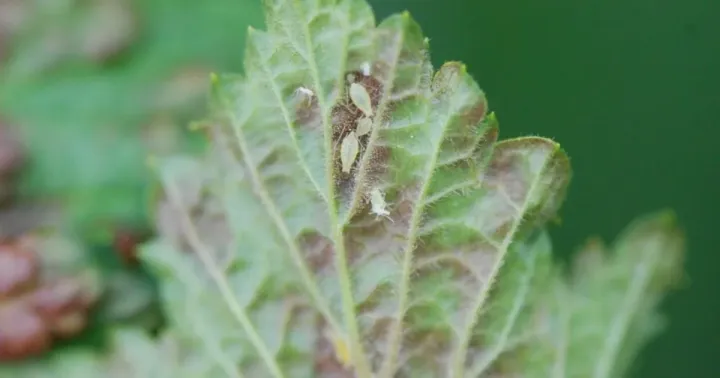
Description
How to identify
The currant-lettuce aphid, scientifically known as Hyperomyzus lactucae, belongs to the family Aphididae and is a common pest of berry shrubs.
Adult aphids are small, measuring approximately 2 mm in length, and are typically light green or yellowish-green in their coloring.
The key morphological characteristic is the presence of long siphunculi on the abdomen, which are slightly swollen at the distal end.
Winged forms, which appear during migration, have a distinctively darker head and thoracic region compared to the wingless forms.
The nymphs go through several developmental stages, resembling smaller, immature versions of the adult insects without wings.
What it damages
The primary host for this species is the blackcurrant bush, where the aphids colonize the young foliage during the early spring season.
During the summer months, the population migrates to secondary host plants, specifically various species of Lactuca (lettuce) and certain weeds like sow thistle.
Infestation on currants causes severe curling and yellowing of the leaves, which significantly impacts the plant's ability to undergo photosynthesis.
When colonies are dense, the growth of new shoots is stunted or distorted, leading to reduced vigor of the entire shrub.
This species is also recognized as a vector for various plant viruses, which poses a long-term threat to the health and yield of the currant plantation.
When it appears
The life cycle begins in early spring when eggs deposited on currant twigs during the previous autumn hatch into fundatrices.
Throughout May, the aphid population multiplies rapidly, establishing large colonies on the undersides of the developing currant leaves.
As summer approaches and the leaves become tougher, winged adults develop and migrate to their secondary hosts to continue the life cycle.
The aphid reproduces on secondary hosts such as lettuce or sow thistle throughout the summer, resulting in multiple generations.
In the autumn, winged migrants return to the blackcurrant bushes to mate and lay eggs, which serve as the overwintering stage for the pest.
Signs of infestation
The first signs of an infestation include the appearance of pale or yellowish spotting on the upper surface of the currant leaves.
As the aphid colonies feed, the leaves begin to curl and twist into dense clusters, providing a protected environment for the insects.
The presence of honeydew on the leaves often leads to the development of sooty mold, which manifests as black patches on the plant tissue.
Gardeners may observe increased ant activity on the bushes, as ants are attracted to the sugary secretions produced by the aphids.
- Severe leaf curling and yellowing.
- Stunted and distorted shoot growth.
- Sticky substance on leaves (honeydew).
- Black sooty mold growth on foliage.
Control measures
Cultural control practices include the removal of weeds like sow thistle from the vicinity of the garden to eliminate secondary host plants.
Encouraging natural predators such as ladybugs, lacewings, and hoverflies is highly effective for keeping aphid populations under control.
If chemical intervention is necessary, apply appropriate aphicides before the flowering stage to prevent harm to beneficial pollinators.
It is crucial to ensure that sprays provide thorough coverage of the leaf undersides where the aphids are primarily located during their feeding cycle.
Pruning and disposing of infested shoot tips during the early spring helps to drastically reduce the initial population and prevent further spread.
Taxonomy
- Latin name
- Hyperomyzus lactucae
- Order
- Hemiptera (bugs, aphids, leafhoppers)
- Family
- Aphididae
- EPPO code
- HYPELA
Discussion
No discussions yet — be the first.