
Currant lettuce aphid
Hyperomyzus
Description
How to identify
Hyperomyzus is a genus of aphids belonging to the family Aphididae. These insects are known for their distinct life cycle involving both primary and secondary host plants.
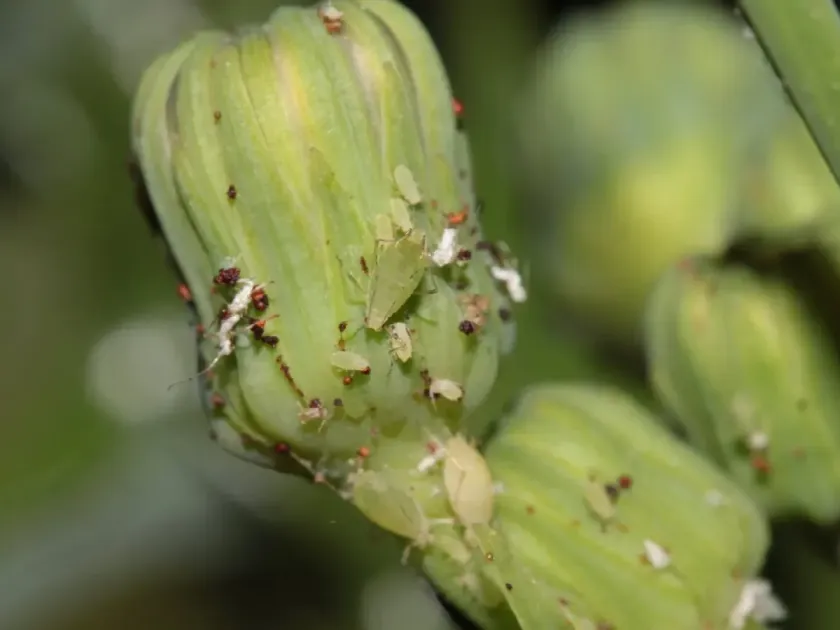
The apterous (wingless) adults are typically light green with a pear-shaped body, reaching 2-3 mm in length. They are characterized by long, slender siphunculi that are slightly swollen towards the apex.
Winged forms (alatae) have complex eyes and dark dorsal markings on the abdomen, which are distinct during the migration phase between host plants.
The population consists primarily of females that reproduce through parthenogenesis, allowing for rapid colonization of host plants during the spring and early summer.
Identification often involves checking the underside of leaves for clustered colonies, where individuals of various developmental stages coexist.
What it damages
The primary hosts for this species are Ribes species, particularly black currant. The aphids feed on phloem sap, leading to stunted shoot growth and leaf curling.
Beyond direct physical damage, these aphids are vectors for several viruses, including the currant reversion virus, which can render entire plantations unproductive over time.
Infested plants exhibit reduced vigor, which negatively impacts the development of fruit buds and significantly decreases berry yield and quality.
Heavy infestations cause the leaves to curl inward, creating protective micro-habitats that shield the aphids from predators and contact pesticides.
The secretion of honeydew encourages the growth of sooty mold, which impairs photosynthesis and reduces the overall health of the berry bush.
When it appears
The life cycle begins with overwintering eggs laid on the bark of one-year-old currant shoots, usually near the buds, ensuring survival through the winter.
In spring, as buds begin to burst, the eggs hatch into stem mothers, which initiate the first generation and establish colonies on the emerging foliage.
By late spring or early summer, winged migrants are produced in response to increasing temperatures and changing host quality, moving to secondary hosts like sowthistles.
In the autumn, sexual winged forms migrate back to the currant bushes to mate and deposit eggs on the shoots to complete the annual cycle.
The timing of these migrations is highly sensitive to spring temperatures; warmer springs typically lead to earlier and more severe infestations.
Signs of infestation
Early signs include subtle yellowing and curling of the leaf margins on the terminal shoots, which often go unnoticed in the initial stages.
The presence of ants patrolling the branches is a classic indicator, as they tend to the aphids to collect the sugary honeydew excreted during feeding.
Sticky residue on the foliage and the subsequent black powdery appearance of sooty mold are clear indications of a significant aphid presence.
Deformed, stunted shoots that fail to develop properly are a common consequence of long-term feeding by established colonies.
Visual inspection of the leaf undersides reveals the presence of both live aphids and cast-off white skins (exuviae) left behind after molting.
Control measures
Cultural control involves pruning and removing infested shoots during the season and eliminating secondary weed hosts, such as sowthistles, near the plantation.
Biological control can be effectively managed by encouraging natural predators such as lady beetles, lacewings, and hoverfly larvae in the garden ecosystem.
- Application of systemic insecticides before the flowering stage.
- Use of horticultural oils or insecticidal soaps for early-stage infestations.
- Dormant oil sprays applied in late winter to target overwintering eggs.
Monitoring programs using yellow sticky traps can help detect the arrival of winged migrants, allowing for timely intervention before colonies become established.
Integrated Pest Management (IPM) strategies emphasize combining biological monitoring with precise chemical applications to maintain aphid populations below the economic injury level.
Taxonomy
- Latin name
- Hyperomyzus
- Order
- Hemiptera (bugs, aphids, leafhoppers)
- Family
- Aphididae
- EPPO code
- HYPESP
Discussion
No discussions yet — be the first.