
Hymeniacidon
Hymeniacidon
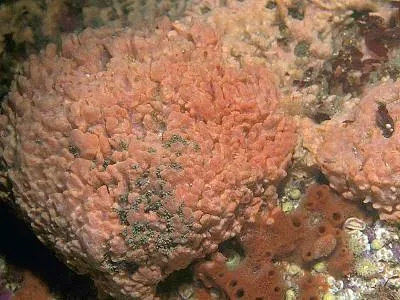
Description
How to identify
Hymeniacidon is a genus of marine sponges belonging to the phylum Porifera. Within the taxonomic classification, they are members of the class Demospongiae and the order Suberitida.
These organisms typically form encrusting or cushion-like growth patterns on rocky substrates. They are well-known for their vivid yellow or orange coloration.
The skeleton of these sponges is composed of silica spicules, which provide structural integrity. They possess a porous body design essential for effective water filtration.
Hymeniacidon species are found primarily in intertidal zones and rocky coastal areas. They are essential components of benthic marine ecosystems.
It is crucial to clarify that this genus is not an agricultural pest. They inhabit saltwater environments exclusively and do not interact with terrestrial crops.
What it damages
Hymeniacidon causes no damage to crops, vegetables, or fruits. As marine organisms, they are physically incapable of surviving or feeding on agricultural land.
Their diet consists of organic matter and microorganisms filtered from seawater. They lack any mechanisms to attack or parasitize land plants.
Categorizing them as pests is a major taxonomic error. Their only potential impact is on maritime structures or equipment if they colonize submerged surfaces.
Agricultural practices remain unaffected by the presence or population density of these organisms in the ocean.
There are no recorded instances of these sponges interfering with soil fertility or plant growth, as their biological environment is entirely distinct.
When it appears
The life cycle of Hymeniacidon is governed by oceanic currents and water temperature rather than agricultural planting seasons.
These sponges maintain an active, sedentary life throughout the entire year, provided environmental conditions remain stable.
Reproduction cycles are linked to marine biological triggers, often resulting in the release of larvae to settle on new rocky surfaces.
There is no correlation between crop development stages and the biological activity of these marine sponges.
Monitoring these organisms is the domain of marine biology researchers, as they follow schedules completely separate from farming calendars.
Signs of infestation
The presence of Hymeniacidon is indicated by the appearance of bright, colored patches on underwater rocks or coastal formations during low tide.
The surface texture is often slightly rough due to the exposed spicules. Visible pores or oscula, where water exits the body, are key identification features.
When removed from their natural water habitat, these sponges collapse quickly, which is a physiological reaction to the lack of hydrostatic support.
Identifying the specific species within the genus requires microscopic examination of the spicules by a specialist.
Their presence is a sign of a healthy marine habitat, as they are not pests and are not associated with any signs of crop blight or infestation.
Control measures
No protection measures are required against Hymeniacidon for agricultural purposes. It is not a threat to food security or plant health.
In cases where they interfere with human-made underwater structures, the use of anti-fouling coatings is a standard maritime practice.
Biological control in the ocean is handled by natural predators that feed on sponges, keeping populations in ecological balance.
Manual cleaning of maritime equipment is the only recommended approach if their colonization becomes problematic for underwater maintenance.
Agricultural intervention or the use of pesticides is strictly inappropriate and ineffective against these marine filter-feeders.
Taxonomy
- Latin name
- Hymeniacidon
- Family
- Halichondriidae
- EPPO code
- HMNCSP
Discussion
No discussions yet — be the first.