
Breadcrumb sponge
Halichondria panicea
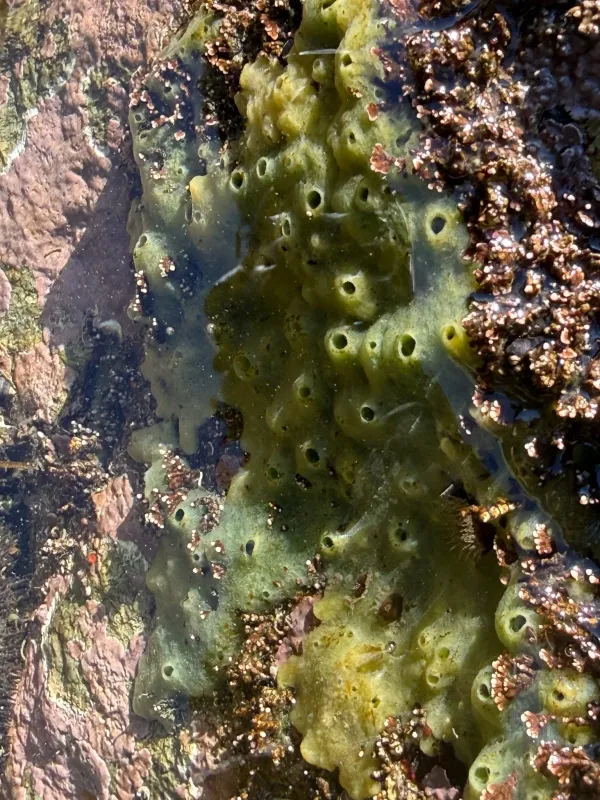
Description
How to identify
The breadcrumb sponge (Halichondria panicea) is a marine invertebrate classified within the phylum Porifera, class Demospongiae, order Suberitida, and family Halichondriidae.
The species is named for its visual resemblance to a piece of bread crumb, often forming encrusting or cushion-like structures on rocky substrates in the sea.
It displays various colors including greenish-yellow, white, or orange, depending on environmental conditions and the presence of symbiotic algae.
The sponge is a sessile filter feeder, meaning it remains attached to surfaces in marine environments and pumps water to extract nutrients.
It is strictly a marine organism and lacks the physiological capability to survive or feed on terrestrial plants.
What it damages
Halichondria panicea is not a crop pest and poses zero threat to agriculture, horticulture, or any plant production systems.
The common name "breadcrumb sponge" refers exclusively to its morphology; it has no functional relationship with bread grains or crops.
Agricultural crops are never targeted by sponges, as these organisms exist exclusively in saltwater habitats far from field environments.
No recorded cases exist of sponges damaging plant tissues, roots, or fruit, as their nutritional requirements are entirely met by marine microorganisms.
Any damage observed on crops is caused by terrestrial herbivores or pathogens, not by marine organisms like the breadcrumb sponge.
When it appears
The growth and life cycle of the breadcrumb sponge are dictated by marine seasonal oceanographic changes rather than agricultural cycles.
Sponges are year-round residents in their marine habitats and do not respond to planting, harvesting, or crop-rotation schedules.
Their activity patterns are linked to seasonal water temperatures and plankton availability, which are irrelevant to terrestrial farm management.
There is no "season of infestation" for sponges in an agricultural context because they do not exist within the agroecosystem.
Farmers should not consider this species when planning seasonal pest management or crop protection programs.
Signs of infestation
There are no symptoms of "sponge infestation" in crops, as the biological interaction between these two distinct worlds is impossible.
If plants are showing signs of distress such as leaf yellowing, wilting, or tissue decay, investigate common agricultural pests and diseases.
Insects like aphids, mites, or larvae, as well as fungal infections, are the true culprits behind common agricultural damage.
Visualizing a marine organism on a farm is practically impossible, so any suspected identification of this sponge on crops is a clear error.
Always rely on morphological descriptions provided by agricultural extension services when identifying real crop pests in your fields.
Control measures
No control measures are required for the breadcrumb sponge, as it is not a threat and does not inhabit cultivated lands.
Applying pesticides or any form of chemical control against this species is not only useless but potentially harmful to the local environment.
Focus your plant protection efforts on identified threats like weeds, insects, and soil-borne pathogens using integrated pest management (IPM) practices.
If you encounter misinformation labeling this sponge as a pest, refer to verified biological databases to clarify the nature of the organism.
Maintain standard agronomic practices to ensure crop health and ignore non-relevant marine species in your management strategies.
Taxonomy
- Latin name
- Halichondria panicea
- Family
- Halichondriidae
- EPPO code
- HLCNPA
Discussion
No discussions yet — be the first.