
Pasture fly
Hydrotaea irritans
Description
How to identify
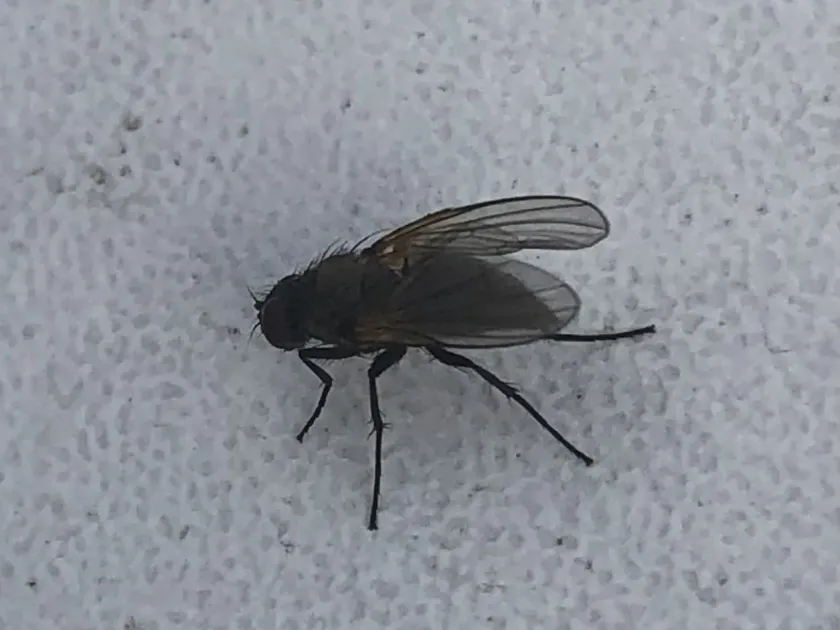
The pasture fly (Hydrotaea irritans) belongs to the Muscidae family within the order Diptera. These flies are medium-sized insects, typically measuring 6–8 mm in length.
Morphologically, they closely resemble the common house fly but possess a specialized mouthpart adapted for feeding on lachrymal and nasal secretions, as well as blood from small wounds.
Their body color is generally dark, ranging from greyish-black to a subtle metallic sheen. The wings are clear with characteristic venation patterns used in taxonomy.
The larvae are saprophagous, developing in manure or soil rich in decaying organic matter. They have a typical maggot-like structure and undergo three larval instars.
Development involves complete metamorphosis. Adults are diurnal, being most active on warm, humid, and calm days, which are ideal for their flight activity.
What it damages
This species is a significant nuisance and parasite of livestock, including cattle, sheep, and horses. They congregate around the eyes, ears, and nostrils of animals.
The primary damage is caused by the intense annoyance and stress inflicted on the animals, which significantly reduces grazing time and overall productivity.
Pasture flies act as mechanical vectors for various pathogens, including bacteria that cause summer mastitis and infectious bovine keratoconjunctivitis (pinkeye).
Animals affected by high populations of these flies exhibit reduced milk yield and slower weight gain. The skin lesions caused by scratching can also lead to secondary bacterial infections.
In severe cases, the constant irritation leads to behavioral changes, where cattle cluster together or move to less desirable pasture areas just to avoid the flies.
When it appears
The activity season of the pasture fly generally spans from late June through September, with peak population densities often observed in July and August.
Temperature and humidity are the primary drivers of their activity. They are most aggressive in warm, humid weather but become inactive during cold, rainy, or windy conditions.
There is typically one generation per year, although this can vary based on regional climatic conditions. Pupae remain in the soil as the overwintering stage.
As summer progresses, the population builds up, making mid-to-late summer the most critical period for livestock protection and fly management.
Daily activity typically ceases in the evening, when the flies migrate to nearby vegetation, such as shrubs and hedgerows, to seek shelter for the night.
Signs of infestation
Visible signs of infestation include restlessness in the herd, such as frequent head shaking, tail flicking, and attempts to rub against fences or trees to dislodge the flies.
Around the animal's eyes and nose, one might observe a damp appearance caused by excessive secretions, which further attracts the flies and creates a persistent cycle.
Lesions, abrasions, or raw spots on the skin are often present due to the constant irritation and the animals' attempts to groom themselves excessively.
A dense swarm of flies may be seen hovering around the heads of the cattle. The presence of these flies often correlates with outbreaks of conjunctivitis in the herd.
- Reduced grazing and ruminating time.
- Discharge from eyes and nostrils.
- Skin irritation and patchy hair loss due to rubbing.
Control measures
Control strategies rely on a combination of chemical and management practices. Insecticidal ear tags are a popular and effective method for cattle protection.
Topical treatments, such as pour-on or spray formulations containing pyrethroids, provide short-term relief and are essential during peak fly seasons.
Environmental management involves removing manure and trimming shrubs or hedges in pasture areas to reduce the habitats where flies congregate or breed.
Grazing strategies that avoid low-lying, humid areas or sheltered woodland edges during peak infestation times can help reduce the frequency of fly attacks.
Using fly traps containing attractants around the perimeter of the field can help suppress local populations, particularly in high-density livestock farming areas.
Taxonomy
- Latin name
- Hydrotaea irritans
- Order
- Diptera (flies)
- Family
- Muscidae
- EPPO code
- HYDTIR
Discussion
No discussions yet — be the first.