
Common hydra
Hydra vulgaris
Description
How to identify
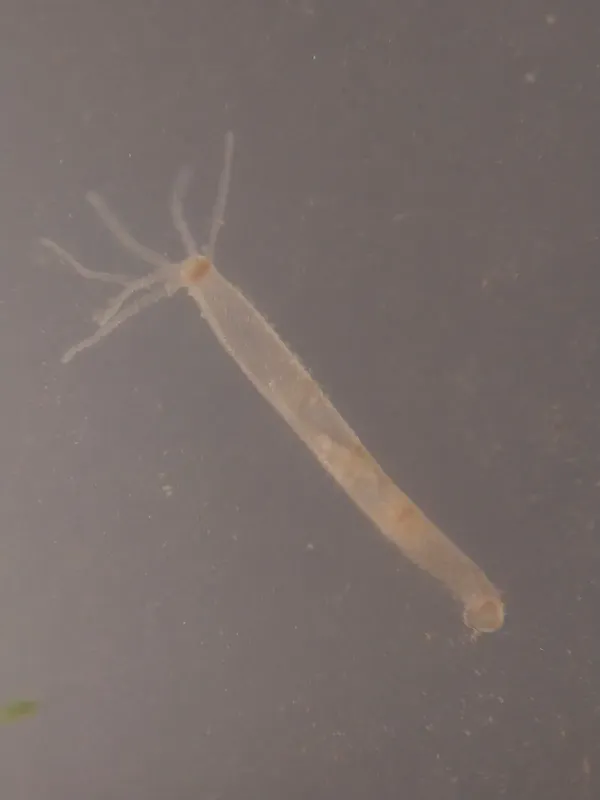
The common hydra (Hydra vulgaris) is a small freshwater polyp belonging to the phylum Cnidaria. It is widely distributed in stagnant and slowly flowing water bodies.
The organism has a tubular body with a ring of stinging tentacles used for capturing prey. It is a sessile creature, usually attaching to surfaces via a basal disc.
Hydra is known for its remarkable ability to regenerate. Even if fragmented, it can develop into complete organisms, making it a persistent organism in any environment.
They are predators that feed on small crustaceans, insect larvae, and sometimes even tiny fish, which they paralyze using specialized stinging cells called nematocysts.
In terms of appearance, they can range from transparent to brownish, depending on their diet and local environmental conditions.
What it damages
While Hydra vulgaris does not consume plant tissues directly, it causes significant indirect harm in agricultural settings like hydroponics or aquarium plant farming.
The nematocysts of the hydra can sting plant roots, particularly young and delicate ones, causing tissue irritation and necrosis that stunts overall growth.
By preying on the beneficial microfauna that helps maintain the water ecosystem, hydras often lead to increased bacterial activity and water quality deterioration.
When present in large numbers, hydra colonies can physically coat plant roots and irrigation lines, hindering nutrient uptake and water circulation.
In aquaculture, the presence of hydra is considered a direct pest issue because they compete for food and threaten the survival of larval aquatic organisms.
When it appears
The activity of the common hydra is highly dependent on temperature. Populations typically peak in the spring and summer when water temperatures are favorable.
During colder months or stressful conditions, hydra reproduce sexually and produce dormant, hardy eggs that can persist in the substrate for long periods.
In temperature-controlled greenhouse environments, hydra can remain active and reproductive throughout the entire year, posing a year-round threat.
The influx of hydra usually coincides with the use of untreated water from ponds or rivers, which serves as the primary vector for their introduction.
Rapid population growth is often triggered by an abundance of organic matter or a dense population of zooplankton within the system.
Signs of infestation
The most reliable sign of hydra infestation is the presence of small, jelly-like stalks on surfaces or plant roots that retract when disturbed.
A decline in the health of young seedlings, manifested by discolored or damaged root tips, often points to the presence of stinging polyps.
Observing a sudden disappearance or significant reduction in the population of beneficial micro-crustaceans is a common early indicator of hydra activity.
A slimy, translucent layer forming on the interior of pipes or filtration systems is a common sign of a well-established colony.
In severe cases, plants may appear wilted or stressed despite adequate nutrient levels, indicating root damage caused by the constant stings of the polyps.
Control measures
Physical removal through cleaning and scrubbing surfaces is effective for small-scale infestations but must be combined with water quality management.
Implementing UV sterilization systems in the water circulation loop is the most effective way to eliminate hydra and prevent their establishment.
Heat treatment is an excellent non-chemical control method; raising the temperature to 40°C for a few hours can effectively kill the hydra population.
Proper water filtration and the use of treated source water prevent the introduction of hydra eggs and adults into the agricultural system.
While some biological controls, such as certain fish species, are used in aquariums, caution is advised to ensure they do not interfere with the primary crop production.
Taxonomy
- Latin name
- Hydra vulgaris
- Family
- Hydridae
- EPPO code
- HDRAVU
Discussion
No discussions yet — be the first.