
Almond aphid
Hyalopterus amygdali
Description
How to identify
The almond aphid (Hyalopterus amygdali) is a small sap-sucking insect belonging to the family Aphididae, order Hemiptera, which poses a significant threat to Prunus species.
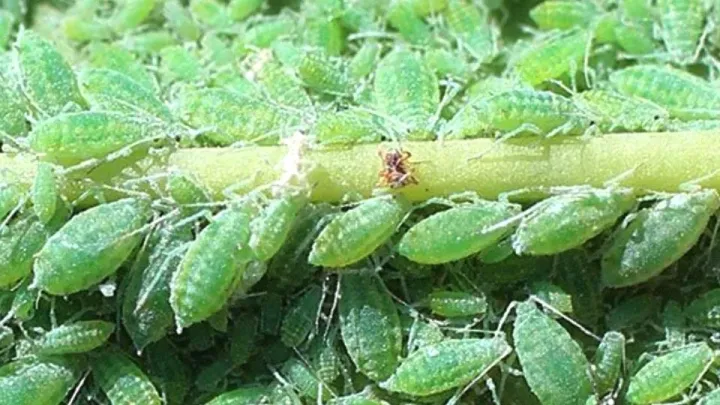
The insects are identifiable by their pale green color, often covered in a white, powdery wax layer that serves as protection against predators and desiccation.
They exhibit a heteroecious life cycle, which means they migrate between primary hosts (almond, peach, plum) and secondary hosts like reeds (Phragmites species) during the summer.
Reproduction is primarily asexual during the spring and summer, allowing for extremely rapid population explosions within a short timeframe.
The species is widespread in regions where stone fruit cultivation is prevalent and environmental conditions favor the growth of both host plants.
What it damages
The primary hosts include almond trees, but they also severely attack peach, apricot, and plum trees in commercial orchards.
Feeding occurs on the underside of leaves, where the aphids extract essential sap, causing the leaves to curl, yellow, and eventually drop prematurely.
The secretion of honeydew promotes the growth of sooty mold, which blocks sunlight from reaching leaf surfaces and hinders the plant's photosynthesis.
Young shoots often show stunted, twisted growth, which compromises the structure and health of the tree for the following season.
Severe infestations reduce the tree's vigor, making it more susceptible to secondary infections and winter damage.
When it appears
Winter is passed in the egg stage, with eggs firmly attached to the bark and buds of the host tree, remaining dormant until spring.
Hatching occurs as the buds begin to burst, and the emerging nymphs immediately begin colonizing the fresh green tissue of the plant.
Late spring is the period of peak colonization, where multiple generations are produced in quick succession by wingless females.
In mid-to-late summer, winged forms emerge to migrate to secondary hosts, such as reeds, to escape the heat and unfavorable conditions of the fruit trees.
Return migration to the almond or stone fruit trees takes place in autumn to lay overwintering eggs before the cold season arrives.
Signs of infestation
Curled and distorted leaves are the most common initial indicators of an almond aphid infestation during the early growing season.
The presence of a sticky, glistening honeydew layer on the leaves, which often turns black due to fungal colonization, is a clear sign.
Active ant trails traveling up and down the trunk are a reliable signal that aphids are present and being tended by ants for their honeydew.
Premature leaf drop in mid-summer significantly alters the canopy density and indicates high aphid density.
Visible colonies of pale, waxy insects on the lower leaf surface can be easily confirmed with a closer look during regular orchard scouting.
Control measures
Integrated Pest Management (IPM) is essential, starting with the removal of secondary hosts like reeds near the orchard to disrupt the life cycle.
Early-season applications of dormant oils can be highly effective in destroying overwintering eggs on the tree bark.
Systemic insecticides should be applied upon the first sighting of aphids to stop population growth before they cause significant damage.
Preserving natural predators like lady beetles, lacewings, and syrphid fly larvae is crucial for maintaining ecological balance in the orchard.
- Scout regularly for aphids on young shoots starting at bud break.
- Apply insecticides only when necessary and during safe hours for pollinators.
- Promote orchard health through balanced fertilization and adequate irrigation.
Taxonomy
- Latin name
- Hyalopterus amygdali
- Order
- Hemiptera (bugs, aphids, leafhoppers)
- Family
- Aphididae
- EPPO code
- HYALAM
Discussion
No discussions yet — be the first.