
Mealy plum aphid
Hyalopterus
Description
How to identify
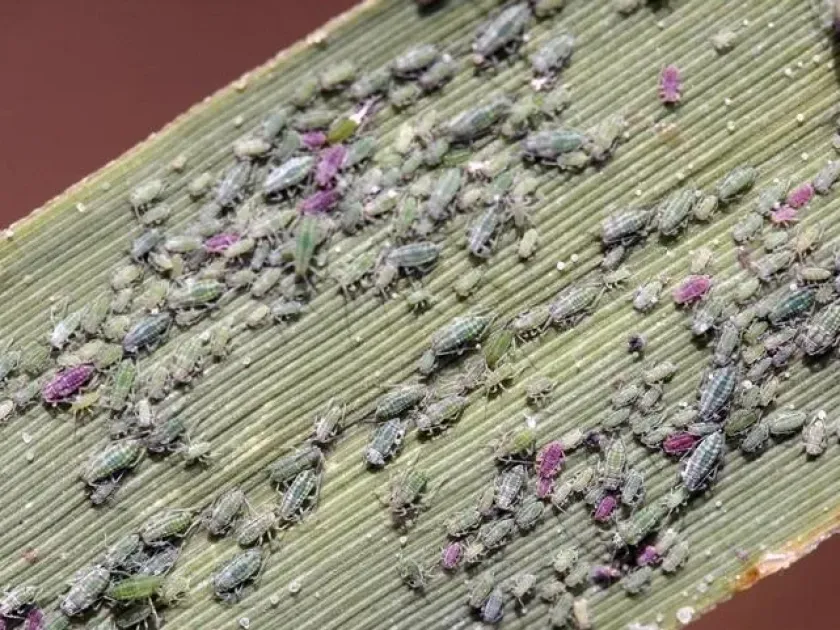
The mealy plum aphid (Hyalopterus pruni) belongs to the family Aphididae, order Hemiptera. It is a small insect, measuring 2–3 mm in length, with an elongated light-green body covered in a fine, whitish, powdery waxy secretion.
Adults occur in both wingless and winged forms. Winged individuals have transparent wings with distinct venation, which facilitates their active migration between primary and secondary host plants throughout the growing season.
Nymphs resemble the adults but are smaller and sexually immature. Colonies are typically found on the undersides of leaves, providing protection from direct sunlight, wind, and heavy rain.
The population grows rapidly due to parthenogenetic reproduction, which allows for the formation of large colonies in a very short timeframe. Correct identification of the insect's morphology is crucial for early detection in orchard settings.
A key diagnostic feature of this species is the heavy wax coating, which gives colonies a characteristic grayish or "mealy" appearance. This powder is often the first visible indicator of an infestation before the individual aphids are spotted.
What it damages
The primary hosts for the mealy plum aphid are plants in the Rosaceae family, specifically species within the genus Prunus, such as plums, apricots, peaches, and almonds. Infestations are occasionally observed on apples and pears.
During its complex life cycle, the aphid also utilizes intermediate hosts from the Poaceae family. Common reed (Phragmites australis) and some grass species serve as vital sites where the insects spend their summer migration period.
Significant economic damage occurs in orchards when the aphids colonize young shoots and foliage in large numbers. Because they feed heavily on stone fruits, populations can reach critical levels by mid-summer.
While damage to reeds and grasses during the summer is often overlooked, the presence of these intermediate hosts is essential for the insect's survival. Managing the proximity of water bodies with reeds is a key factor in long-term population suppression.
Agronomists must account for this host-alternating life cycle, as controlling aphids only on fruit trees is often insufficient if dense reed beds nearby act as a permanent reservoir for the infestation.
When it appears
The life cycle begins in spring when nymphs hatch from eggs overwintered near the buds of stone fruit trees. As the leaves begin to unfurl, the aphids start feeding on the plant sap.
By late spring and early summer, winged individuals emerge and migrate to reed plants. This migration marks the transition to the summer phase of their life cycle, where they reproduce on grass hosts.
In autumn, usually September to October, a reverse migration occurs as winged aphids return from the reeds to the fruit trees. Here, they mate and lay overwintering eggs in crevices of the bark and near the buds.
The rate of reproduction is heavily influenced by temperature and humidity. A warm, moderately humid spring provides ideal conditions for rapid nymph emergence and population expansion.
Understanding these migration patterns is essential for scheduling insecticide applications, ensuring that treatments are timed to intercept the most vulnerable life stages on both host types.
Signs of infestation
The primary symptom of an infestation is the curling and distortion of leaves on new shoots. The affected leaf tissue often turns yellowish and may die off prematurely due to the continuous depletion of sap.
Dense clusters of aphids covered in white waxy powder can be seen on the undersides of leaves. In severe infestations, the shoots become coated in honeydew, a sticky secretion produced by the aphids.
Honeydew serves as a substrate for the growth of sooty mold. This black fungal layer interferes with photosynthesis, weakening the tree and potentially reducing the quality and quantity of the fruit yield.
The presence of ants on the trees is another strong indicator of aphid activity. Ants "farm" the aphids for their honeydew and actively protect the colonies from natural predators like ladybugs.
In advanced cases, premature fruit drop occurs, and the tree's overall vigor declines. Growth is stunted, and the tree may fail to harden off properly before winter, increasing its susceptibility to cold damage.
Control measures
Effective management requires an integrated approach combining cultural and chemical tactics. A key preventive measure is the removal of reed beds in the immediate vicinity of orchards to eliminate the intermediate host.
Dormant-season spraying with mineral oil-based treatments in autumn or early spring is recommended to kill overwintering eggs, significantly lowering the initial population size for the upcoming season.
During the growing season, systemic insecticides should be used once the economic injury threshold is reached. These treatments must have prolonged residual activity to reach aphids hiding inside curled foliage.
Encouraging biological control agents, such as lady beetles, lacewings, and hoverflies, is a sustainable way to limit population growth. This necessitates a cautious approach to using broad-spectrum pesticides during the flowering stage.
- Establishing spatial buffers between orchards and reed-heavy wetlands.
- Regular pruning of root suckers to reduce colonization sites.
- Monitoring populations using yellow sticky traps.
- Targeting applications during migration windows using selective insecticides.
Taxonomy
- Latin name
- Hyalopterus
- Order
- Hemiptera (bugs, aphids, leafhoppers)
- Family
- Aphididae
- EPPO code
- HYALSP
Discussion
No discussions yet — be the first.