
Coriander aphid
Hyadaphis coriandri
Description
How to identify
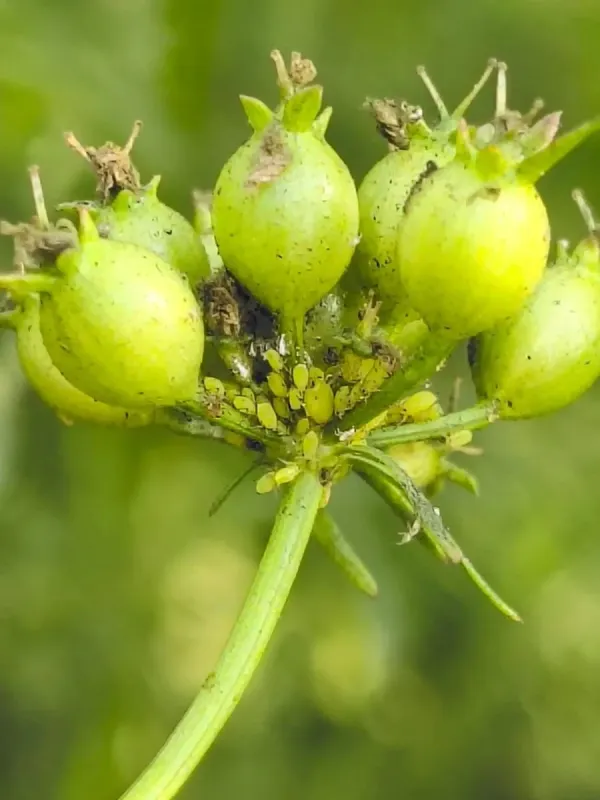
The coriander aphid (Hyadaphis coriandri) is a small insect belonging to the family Aphididae. Adults typically reach 2–2.5 mm in length and exhibit a light green color that allows them to blend in with their host plant.
The life cycle includes both wingless and winged forms, the latter being primarily responsible for moving between different plants and fields to establish new colonies.
Morphologically, they are identified by their soft, elongated bodies, antennae, and small tubes known as siphunculi located on the abdomen. Nymphs resemble miniature versions of the adults.
These aphids are most commonly found in tight clusters within the inflorescences or on the underside of young leaves, making them difficult to spot during early infestation stages.
Given their high reproductive rate, a small group of founding aphids can turn into a massive infestation within a few weeks under favorable weather conditions.
What it damages
This pest is a major threat to crops within the Apiaceae family, with coriander being the primary target, followed by fennel, dill, and cumin.
By sucking phloem sap from the plants, aphids weaken the host, leading to stunted growth, leaf curling, and overall reduction in plant vigor.
Heavy infestations on coriander result in deformed flowers and shriveled seeds, which significantly degrades the quality and quantity of the harvest.
Besides direct mechanical damage, they are notorious vectors for various plant viruses, which cause long-term systemic issues in the affected crops.
The economic loss in essential oil yield can be severe if control measures are not implemented during the critical stages of plant development.
When it appears
The pest begins its activity in early spring, synchronized with the warming of temperatures above 12–15 degrees Celsius.
The most vulnerable period for the crops is during the budding and flowering phase, where aphid colonies tend to reach their peak population density.
While extremely high summer temperatures can inhibit their growth, irrigation practices often maintain the high humidity levels that aphids prefer.
As the season progresses, they may migrate to alternate wild host plants to lay eggs for overwintering, preparing for the next cycle.
Regular scouting of fields starting from seedling emergence is crucial to catch the early onset of infestation before it spreads throughout the field.
Signs of infestation
Common signs of an infestation include the curling of young leaves, yellowing of shoots, and the presence of sticky honeydew secreted by the aphids.
This honeydew often attracts secondary infections, such as sooty mold, which covers the plant in a black layer and hinders essential photosynthesis.
Infected plants often attract large numbers of ants, which defend the aphid colonies to gain access to the sugary honeydew secretions.
Overall, the plants appear sickly, with growth points showing clear signs of deformity or arrested development.
- Deformed and curled leaves
- Presence of sticky, shiny residue on stems
- Black sooty mold covering plant parts
- Ant activity around the colony site
Control measures
Agricultural management should focus on removing weeds from the Apiaceae family that can serve as alternative host plants and infection reservoirs.
Biological control, utilizing natural predators like ladybugs, lacewings, and parasitic wasps, can effectively maintain aphid levels below the economic threshold.
If chemical intervention is required, systemic insecticides are the most effective against this species due to their ability to provide long-lasting protection.
It is vital to rotate insecticides with different modes of action to prevent the development of pesticide resistance in the local aphid population.
Applications should be timed to minimize impact on beneficial insects, ideally occurring early in the morning or late in the evening when pollinators are less active.
Taxonomy
- Latin name
- Hyadaphis coriandri
- Order
- Hemiptera (bugs, aphids, leafhoppers)
- Family
- Aphididae
- EPPO code
- HYADCR
Discussion
No discussions yet — be the first.