
Vine leaf miner
Holocacista rivillei
Description
How to identify
The vine leaf miner (Holocacista rivillei) is a minute moth belonging to the family Heliozelidae (shield bearer moths) and the order Lepidoptera. The adult moth is extremely small, with narrow wings covered in metallic scales, making it difficult to spot against the backdrop of the grapevine foliage.
The larval stage is the most destructive, as the larvae live hidden within the leaf tissues. By feeding between the epidermis layers, they create characteristic "mines" (tunnels) that are the primary symptom of infestation. The microscopic size of the larvae makes them nearly impossible to identify without professional equipment.
The life cycle undergoes complete metamorphosis, including egg, larva, pupa, and adult stages. Females lay eggs directly under the leaf cuticle. Once the larva finishes feeding, it cuts a small oval piece of the leaf to form a cocoon, which is a unique identification feature of this species.
This pest is prevalent in many viticultural regions worldwide. Depending on the local climate, the vine leaf miner can complete multiple generations per season, necessitating consistent monitoring of the vineyard throughout the growing months.
The population size is strongly influenced by local environmental conditions. Hot and dry summers often lead to higher pest density, which requires agronomists to increase surveillance and implement timely interventions to preserve the health of the canopy.
What it damages
The primary host for Holocacista rivillei is the common grapevine (Vitis vinifera). While occasionally found on wild grapes, cultivated varieties are the most susceptible due to their vigorous growth and dense canopy, which provides an ideal environment for the moth.
Damage manifests as intricate leaf mines where the larvae consume the parenchyma. This feeding activity disrupts the photosynthesis of the affected leaf sections, leading to localized yellowing and eventual necrosis of the damaged tissue.
Although the vine leaf miner does not feed directly on the grapes, the damage to the leaf surface is economically significant. A reduction in photosynthetic capacity leads to lower sugar accumulation in the berries and a weakened overall state of the vine during the ripening process.
In cases of severe infestation, premature leaf drop may occur. This negatively impacts the vine’s ability to harden off before winter, potentially leading to increased vulnerability to cold weather and poor development of fruit buds for the following season.
In organic viticulture, managing this pest is particularly challenging due to the limited range of effective chemical treatments. Integrated pest management strategies are essential to keep populations below the economic injury level without disrupting beneficial insect populations.
Signs of infestation
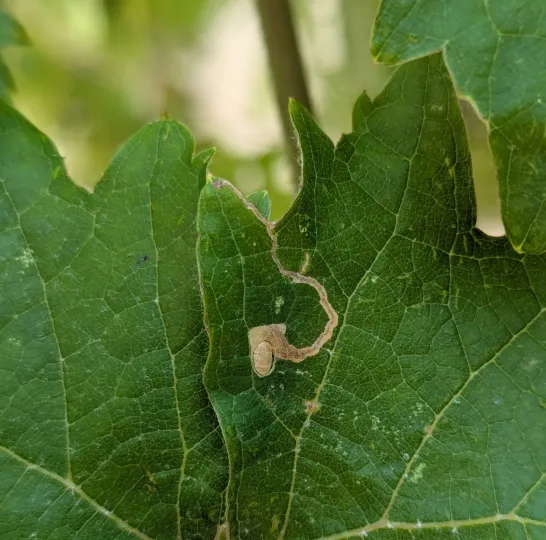
The initial visual sign of infestation is the appearance of small, circular or oval tunnels (mines) on the leaf surface. Inside these mines, dark, spiral-shaped lines of larval excrement are visible, which is a classic diagnostic feature for this specific leaf miner.
Unlike many other leaf miners, the vine leaf miner larva cuts a tidy oval patch out of the leaf tissue once it finishes feeding. This creates a distinct "window" or hole on the leaf, serving as a clear indicator that the larva has moved on to the pupal stage.
These small, dense cocoons are often found attached to the underside of leaves or on the bark of the vine canes. Because of their size and color, they are frequently overlooked during general vineyard inspections, yet they are vital to locate for population estimates.
With a magnifying glass, one can spot the microscopic oviposition punctures made by the female. These tiny necrotized dots eventually develop into extensive branching corridors as the larva grows, spreading throughout the leaf blade.
- Yellowing of leaf tissue in circular or elongated shapes.
- Presence of dark, spiral-patterned frass (excrement) within mines.
- Cleanly cut oval holes in the leaf surface.
- Small, dense cocoons visible on leaf undersides or vine bark.
Control measures
Effective control of the vine leaf miner relies on a combination of cultural and chemical methods. Good viticultural practice, such as the removal and destruction of infested foliage and vine prunings, is crucial for reducing the overwintering population of the pest.
Chemical applications are most effective during the period when larvae hatch from the eggs, before they burrow into the leaf tissues. It is vital to select insecticides that are systemic or have strong contact action while respecting harvest interval requirements.
Biological control programs often focus on encouraging natural predators and parasitoids that feed on leaf miner larvae. Maintaining biodiversity in and around the vineyard is a sustainable way to keep pest numbers in check and minimize the need for broad-spectrum chemical interventions.
Monitoring with pheromone traps is highly recommended to pinpoint the flight periods of the adult moths. This allows for precise timing of treatments, ensuring high efficacy while reducing the frequency of applications and lowering overall production costs.
Healthy, well-managed vines are inherently more resilient to pest pressure. Proper irrigation, balanced nutrition, and appropriate canopy management help the plant withstand minor levels of damage, ensuring that the impact on yield and fruit quality remains minimal.
Taxonomy
- Latin name
- Holocacista rivillei
- Order
- Lepidoptera (butterflies)
- Family
- Heliozelidae
- EPPO code
- ANTSRI
Discussion
No discussions yet — be the first.