
Holocacista
Holocacista
Description
How to identify
Holocacista is a genus of insects belonging to the order Lepidoptera and the family Heliozelidae. These tiny moths are often difficult to detect due to their small size and cryptic habits.
The adult moths are very small, usually measuring only a few millimeters in wingspan. They are often dark in color with a metallic sheen, which helps them camouflage against the bark of vines.
Their biological development involves a complete metamorphosis: egg, larva, pupa, and adult. The females lay eggs directly into the leaf tissue of the host plant.
The larvae are specialized leaf miners. They spend the majority of their feeding stage inside the leaf, protected by the epidermis of the plant tissue.
Due to their small size and secretive nature, identifying the pest relies primarily on observing the specific damage patterns they leave on host plants.
What it damages
The primary hosts of Holocacista are plants within the Vitaceae family, particularly cultivated and wild species of grapevines.
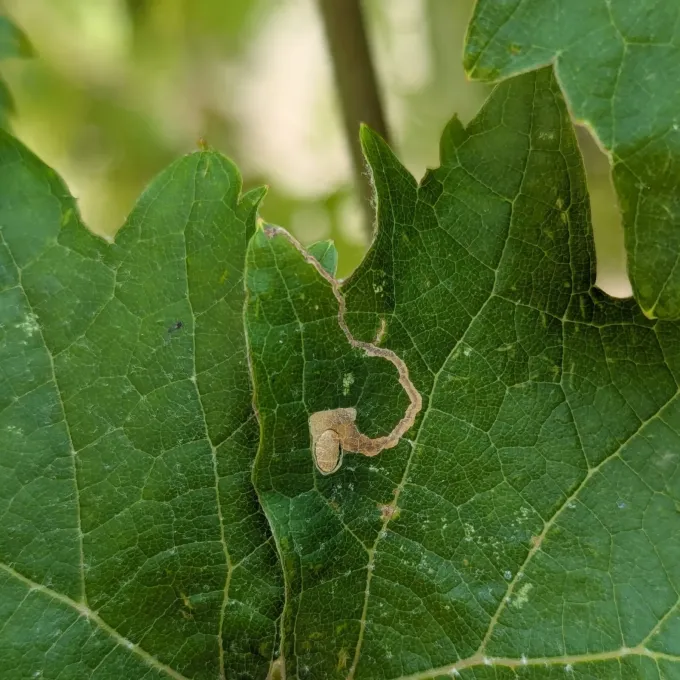
The larvae feed on the mesophyll of the leaves, creating distinct tunnels known as mines. They selectively consume the tissue between the upper and lower leaf surfaces.
Heavy infestations can lead to premature leaf yellowing, necrosis, and premature leaf drop, which impairs the plant's ability to produce energy through photosynthesis.
As a result, the sugar accumulation in the grapes is often reduced, and the overall vigor of the grapevine is compromised, affecting both yield and fruit quality.
If left unmanaged, persistent attacks can weaken the vines, making them more susceptible to environmental stress and secondary pathogen infections.
Signs of infestation
The most prominent sign of an infestation is the presence of leaf mines—winding or blotch-shaped tunnels that appear as pale or discolored areas on the leaves.
When held up against the light, the tunnels show characteristic excrement trails left by the larvae, confirming that the damage is caused by a living organism.
A unique sign of this pest's life cycle is the presence of small, oval-shaped cutouts in the leaf blades. The larvae cut these pieces to build cases for pupation.
These holes in the foliage eventually dry out and tear, leaving the leaves looking ragged or perforated, which is a classic indicator of a leaf-mining infestation.
Regular visual inspections of the canopy during the growing season are necessary to spot the early stages of mining before widespread damage occurs.
Control measures
Chemical control is most effective when targeted at the adult moth stage, specifically during the flight period to prevent egg-laying on the leaves.
Systemic insecticides are the preferred choice, as they are absorbed by the plant and can effectively reach larvae feeding inside the leaf mines.
Cultural control measures include the diligent collection and destruction of fallen leaves, as pupae often overwinter in the leaf litter beneath the vines.
Maintaining vine health through proper irrigation and nutrition helps the plants withstand the stress caused by the mining activity of the larvae.
- Monitoring moth populations using pheromone traps.
- Sanitation by removing and destroying heavily infested leaves.
- Encouraging natural predators and parasitoids in the vineyard ecosystem.
Taxonomy
- Latin name
- Holocacista
- Order
- Lepidoptera (butterflies)
- Family
- Heliozelidae
- EPPO code
- HOLKSP
Discussion
No discussions yet — be the first.