
Icterine Warbler
Hippolais icterina
Description
How to identify
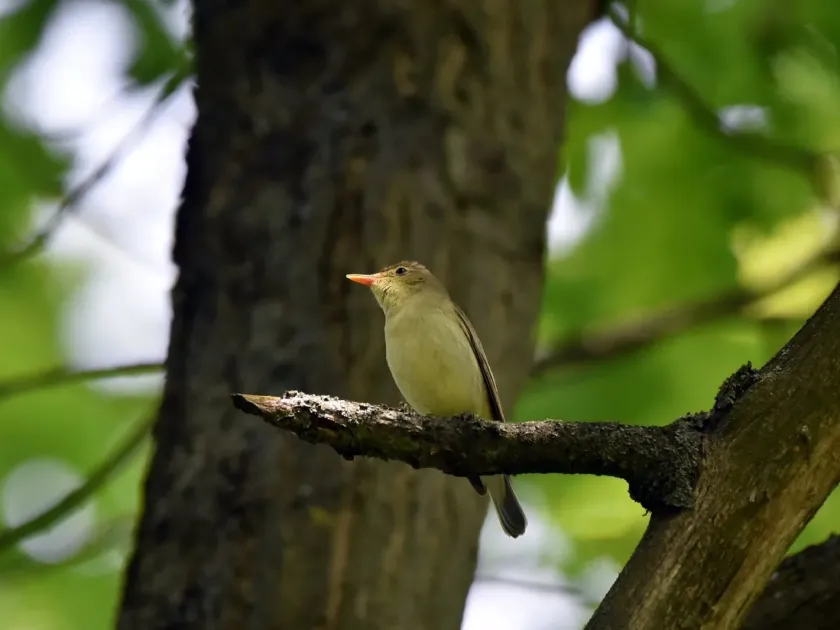
The Icterine Warbler is a small songbird belonging to the Acrocephalidae family. It is visually distinguished by its olive-green upper plumage and light yellow underbelly, which provides excellent camouflage within the dense foliage of trees.
A key feature of the species is its short but strong bill with an orange interior, specifically adapted for capturing mobile insects. Adult specimens typically reach 13-14 centimeters in length and are renowned for their complex, loud song, which often mimics the sounds of other local bird species.
This bird species is notoriously elusive, preferring to inhabit the canopies of deciduous trees, orchards, parks, and river floodplains. It is extremely active, constantly moving between branches to forage, which makes direct observation challenging for agronomists.
Systematically, the species belongs to the genus Hippolais. Unlike many ground-dwelling birds, Icterine Warblers rarely descend to the forest floor, preferring to spend their time in the upper layers of woody vegetation throughout the nesting season.
Mature birds form monogamous pairs for a single season, actively defending their nesting territory. Their presence is usually revealed by their versatile song, which consists of original trills mixed with skillfully imitated sounds of other birds in the vicinity.
What it damages
It is important to emphasize that the Icterine Warbler is not an agricultural pest. On the contrary, it is recognized as a highly beneficial insectivore that contributes to the significant reduction of harmful insect populations in orchards and gardens.
The bird's diet consists mainly of small invertebrates, including moth larvae, beetles, dipterans, and aphids. By actively consuming these insects, the warbler acts as a natural regulator of pest populations in fruit and berry plantations.
In rare instances, when animal protein sources are scarce, the bird may cause minor damage to soft berries, but this rarely leads to significant economic loss. The benefit gained from destroying thousands of pest larvae far outweighs these potential risks.
The agronomic significance of the species lies in maintaining biological balance within the agroecosystem. The presence of nesting pairs in an orchard can reduce the need for insecticide application during the early stages of tree development.
Intensive agriculture relying on chemical pesticides leads to a decline in bird populations. The absence of natural insect predators often triggers pest outbreaks, necessitating a holistic approach to garden management that includes avian conservation.
When it appears
The Icterine Warbler is a migratory species that returns to temperate latitudes in May, coinciding with the beginning of the growing season and the peak activity of insects. Their primary activity occurs from May to July, overlapping with the critical fruit-setting phase of trees.
The process of feeding nestlings requires massive amounts of food. June and July mark the peak efficiency of these birds as pest suppressors, as parents must perform hundreds of foraging flights per day to provide for their brood.
After the fledglings leave the nests in August, the birds begin preparations for their migration to Africa. During this time, their activity in orchards decreases as they relocate to woodland edges and thickets to build up fat reserves for the long journey.
Seasonal insect dynamics are directly correlated with the presence of the Icterine Warbler on a site. Optimal habitats for these birds are old orchards with dense canopy cover, which provide necessary food resources throughout the summer.
The species winters exclusively outside of Europe, meaning there is no influence on the local biocenosis during the cold season. Spring migration timing is highly dependent on temperature indicators and the speed of snowmelt in the breeding grounds.
Control measures
Attracting and conserving the Icterine Warbler is an effective method of biological garden protection. Agronomic practices should focus on creating a habitat suitable for successful nesting and foraging.
- Avoid the use of high-toxicity, broad-spectrum insecticides during the nesting period (May-June).
- Preserve old, spreading trees that provide suitable sites for cup-shaped nests.
- Establish protective shrub borders to provide cover and foraging ground for insectivorous birds.
- Minimize human disturbance and excessive noise in the orchard during incubation and feeding periods.
- Utilize selective biological agents that do not harm insectivorous bird species.
Maintaining high levels of biodiversity allows not only for the attraction of the Icterine Warbler but also for the formation of a self-regulating system of pest protection. It is advisable to avoid excessive weeding, as certain "weeds" serve as shelters for the birds' food sources.
In cases of specific pest outbreaks, when natural predators are insufficient, it is recommended to integrate biological control with appropriate agronomic techniques. This approach minimizes chemical exposure on produce.
Ultimately, the agronomist should view the Icterine Warbler as a partner. Promoting the population growth of this species is an essential component of sustainable agriculture and the ecological management of fruit production.
Taxonomy
- Latin name
- Hippolais icterina
- Family
- Acrocephalidae
- EPPO code
- HPPLIC
Discussion
No discussions yet — be the first.