
Great reed warbler
Acrocephalus arundinaceus
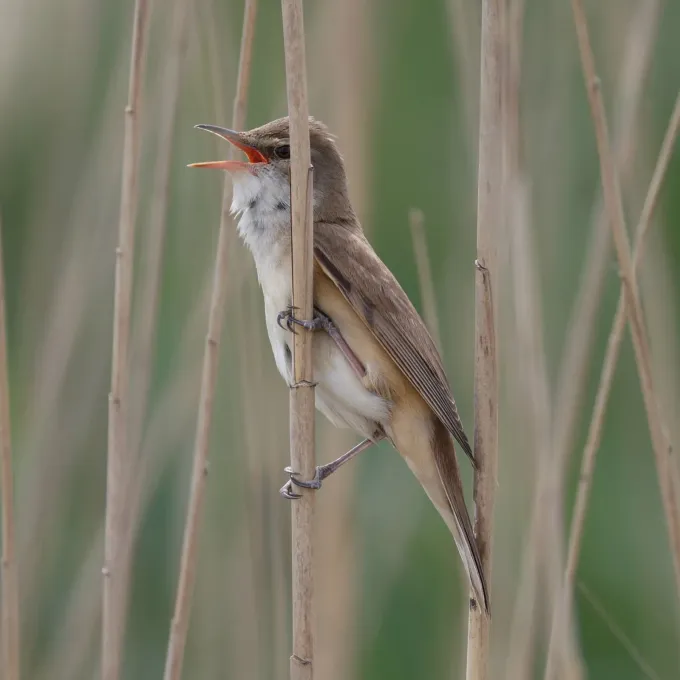
Description
How to identify
The Great reed warbler is a member of the Acrocephalidae family, known for being the largest warbler found within Europe and parts of Asia.
Physically, it is identified by its brown upperparts, buff-white underparts, and a noticeably heavy, strong bill used for hunting in marshlands.
These birds are exclusively associated with reed beds, lakeshores, and marshes, where they construct elaborate, deep cup-shaped nests attached to reeds.
They are famous for their loud, guttural, and repetitive songs that serve as the primary marker of their existence during the breeding season.
In the field, they appear highly energetic, constantly moving through vegetation with agility that allows them to remain hidden from predators.
What it damages
The Great reed warbler is generally not considered a significant agricultural pest as its diet is almost exclusively composed of insects and larvae.
Minimal damage to crops may occur when birds build their nests or forage, causing physical bending or breaking of stems in border areas near wetlands.
In industrial reed cultivation, there might be slight interference, but this is usually negligible compared to the ecosystem services provided.
The risk of damage is localized to small areas directly adjacent to their natural habitat, and large-scale crop loss is virtually unheard of with this species.
Farmers should view them as natural pest controllers that help suppress populations of harmful insects around the perimeters of fields.
When it appears
Great reed warblers are migratory birds that arrive at their breeding grounds in late spring, typically during April and early May.
The peak activity period involves mating and raising chicks throughout the summer months of June and July.
Migration back to sub-Saharan Africa occurs from late August to September as the environmental conditions change and food sources decrease.
During the breeding season, their presence is very stable and predictable, making it easy to identify their colonies early in the season.
Post-breeding, the birds become less active and elusive before their eventual departure, reducing their impact on the surrounding landscape.
Signs of infestation
The most prominent sign of their presence is the persistent, loud vocalization of the males during the early morning and evening hours.
Field inspection reveals characteristic deep cup nests woven firmly between vertical reeds or marsh plants, often positioned just above the water level.
Visual observation of birds repeatedly flying between the water edge and the field perimeter indicates the presence of a nesting colony.
Physical signs of damage, such as bent or crushed vegetation stalks, may be observed in high-density nesting zones near agricultural plots.
Increased insect-hunting behavior in the vegetation borders is a clear indicator that the birds are actively feeding in the vicinity.
Control measures
Chemical control measures against this species are neither appropriate nor legal, as the Great reed warbler is protected in many jurisdictions.
If management is necessary to protect specific crops, implementing habitat modification such as clearing unnecessary reed density is the most effective approach.
Visual deterrents or reflective strips can be placed in vulnerable areas to discourage nesting too close to sensitive crops without harming the birds.
Focusing on biological harmony is recommended, as the birds provide significant benefits by consuming agricultural pests that might otherwise damage the fields.
A balanced farm management plan that respects wildlife corridors while keeping fields clear is the best way to handle any potential interactions.
Taxonomy
- Latin name
- Acrocephalus arundinaceus
- Family
- Acrocephalidae
- EPPO code
- ACRKAR
Discussion
No discussions yet — be the first.