
Birch leaf miner
Heringocrania unimaculella
Description
How to identify
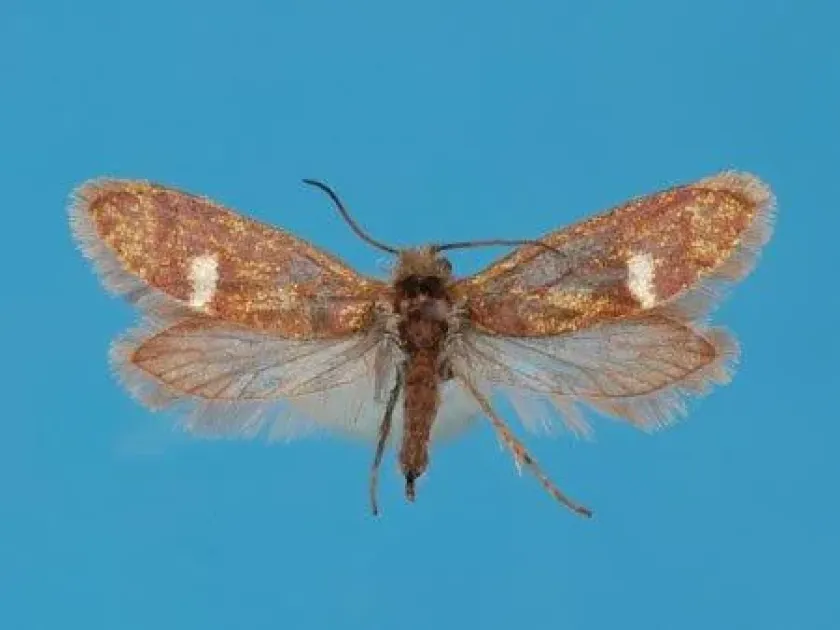
The birch leaf miner (Heringocrania unimaculella) belongs to the Eriocraniidae family. This small moth has a wingspan of approximately 10–12 mm, with metallic-colored forewings often displaying a faint light-colored spot.
Unlike many other moths, the adults emerge very early in the spring, often coinciding with the initial bud burst of birch trees. They are active during daylight hours and feed on nectar.
The larvae are apodous (legless) and possess a yellowish-white body. Their head capsule is well-developed, designed specifically for burrowing within the delicate layers of a leaf.
Systematically, this insect is a specialized phytophagous pest. Its life cycle is strictly synchronized with the phenology of its host plants, primarily various species of the genus Betula.
Identification is best achieved by examining the specific shape of the leaf mine, which is characteristic of the Heringocrania genus compared to other miners like Fenusa pusilla.
What it damages
The primary hosts are silver birch (Betula pendula) and downy birch (Betula pubescens). The larvae feed specifically on the parenchyma tissue located between the leaf epidermis layers.
Damage occurs in early spring, right when the new leaves are expanding. The larvae create mines that eventually cause the tissue to dry out, turn brown, and curl, reducing the leaf's aesthetic and photosynthetic capability.
Severe infestations can lead to partial defoliation. While healthy, mature trees can usually withstand moderate damage, repeated attacks over several years can stress the tree and weaken it against secondary pests.
The physiological stress from reduced photosynthesis during the critical spring growth period is the most significant long-term impact on the tree's health.
In ornamental urban settings or nurseries, the aesthetic damage is often the primary concern, as it ruins the appearance of the trees for several weeks each season.
When it appears
This species is univoltine, meaning it completes one generation per year. The adult moths emerge in early spring, often while the ground is still cool, to lay eggs on developing birch buds.
Larval development takes place throughout May. The larvae consume leaf tissue as they expand the mine, growing rapidly as the birch leaves reach their full size.
By early June, the larvae exit the leaves, drop to the soil, and bury themselves to construct a protective cocoon. This is where they remain for the duration of the summer.
Pupation occurs within the soil, and the insect stays in the pupal stage throughout the winter months, protected by the leaf litter and soil structure.
The spring emergence is highly dependent on ambient temperatures, which trigger the insect to leave the soil as a moth to restart the cycle.
Signs of infestation
The most recognizable symptom is the appearance of blotch-like mines on young birch leaves. These are often located near the base of the leaf, expanding towards the midrib.
A key diagnostic feature inside the mine is the presence of the larva's frass (excrement), which is deposited in a thin, continuous thread-like pattern, unique to this species.
Initially, the damage manifests as translucent, pale spots on the leaves. As the larva grows, these areas turn necrotic and brownish, making the damage visible from a distance.
Careful inspection of the leaves reveals the presence of the larvae or the empty shells of the mines after the larvae have departed for the soil.
Early spring scouting of birch foliage is the best way to detect the onset of an infestation before the larvae reach maturity and vacate the leaves.
Control measures
Cultural control is highly effective; removing leaf litter from under birch trees in autumn can help destroy potential pupation sites, reducing the population for the next spring.
Biological control methods include the use of Bacillus thuringiensis (Bt) sprays applied at the exact time of egg hatching, which can effectively reduce the larval population.
Systemic insecticides are effective because they are absorbed into the leaf tissue, ensuring that the larvae ingest the poison while feeding inside the leaf mine.
Maintaining tree vigor through proper watering and soil fertilization helps the tree tolerate and recover from leaf damage more efficiently.
Monitoring the adult moths with sticky or pheromone traps can help arborists time their interventions to ensure the most effective pest control results.
Taxonomy
- Latin name
- Heringocrania unimaculella
- Order
- Lepidoptera (butterflies)
- Family
- Eriocraniidae
- EPPO code
- HGOCUN
Discussion
No discussions yet — be the first.