
Eriocrania
Eriocrania
Description
How to identify
Eriocrania is a genus of moths belonging to the family Eriocraniidae, often referred to as archaic sun moths. These insects are small, with a wingspan typically ranging from 10 to 15 mm, and their wings are covered in metallic-colored scales.
Adult moths are primarily diurnal and are most active during the spring. They possess a vestigial mouthpart, meaning they do not feed as adults, focusing their entire lifecycle energy on reproduction and egg-laying on suitable host plants.
The larvae are small, legless caterpillars specialized for life within the leaf tissue. Their bodies are light-colored, allowing them to remain camouflaged while feeding inside the mesophyll of the host plant's foliage.
The life cycle is tightly synchronized with the early spring growth of deciduous trees. The insects typically overwinter as pupae in the soil beneath the host plant, emerging as adults just as the tree buds begin to open.
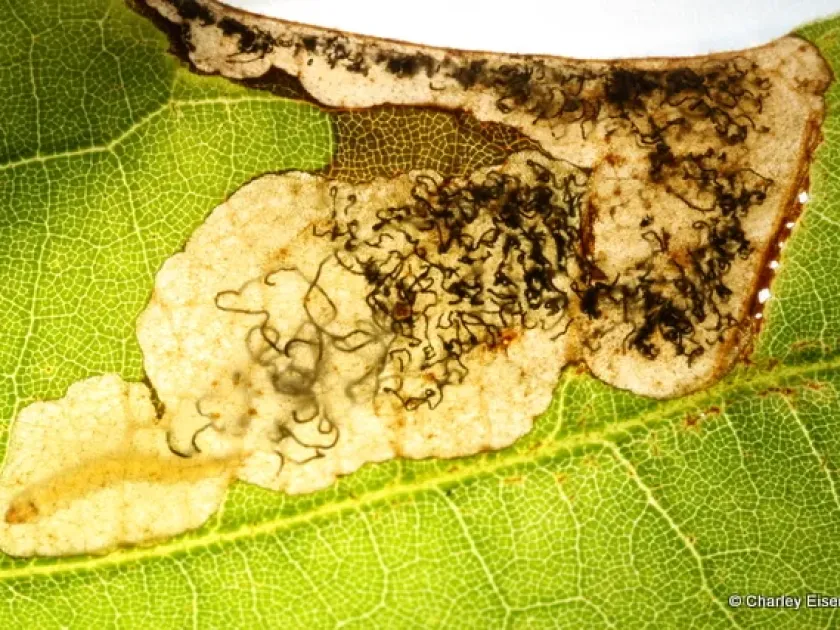
Taxonomists identify specific species of Eriocrania by analyzing the architecture of their leaf mines. The shape and pattern of the tunnels created by the larvae are distinct markers for these moths.
What it damages
Eriocrania species target various deciduous trees, with birch (Betula), alder (Alnus), and hazel (Corylus) being the most common hosts. They are particularly detrimental to young saplings and ornamental trees in nursery settings.
Once the eggs hatch, the larvae bore into the leaf and consume the parenchyma, leaving the upper and lower epidermis intact. This results in the formation of blotch-like mines that eventually cause the leaf tissue to wither.
Heavy infestations significantly reduce the photosynthetic capacity of the foliage. This causes the tree to lose energy, leading to stunted growth, reduced resilience to environmental stress, and a generally poor aesthetic appearance.
While mature, healthy trees often tolerate minor levels of infestation, small trees can suffer severe physiological stress. Frequent defoliation or leaf destruction in early spring drains the tree's vital resources.
The damage often creates entry points for secondary pathogens, such as fungi or bacteria, which can cause further degradation of the leaves and premature senescence of the affected foliage.
When it appears
Adult emergence typically occurs in early spring, often as soon as April. This timing is critical, as it aligns with the emergence of new foliage on host trees, which is essential for the survival of the next generation.
Females deposit eggs directly into the leaf tissue. Larval development begins shortly after, with mines appearing on the leaves by late spring. The feeding stage is relatively brief, lasting only a few weeks.
Once the larvae reach maturity, they exit the leaf mines and drop to the ground. They burrow into the soil to form a tough, silk-lined cocoon where they will pupate and wait for the following spring.
Eriocrania is univoltine, meaning it produces only one generation per year. Consequently, the window of risk for trees is concentrated within the spring months, making timing crucial for any necessary intervention.
Weather conditions in the early spring significantly dictate population size. A sudden cold snap can delay adult flight or kill young larvae, naturally suppressing the infestation levels for that season.
Signs of infestation
The primary symptom is the appearance of light-colored, translucent spots on the leaves. These spots are essentially "blister mines" where the internal leaf tissue has been hollowed out.
Inside the mines, one can usually observe thin, dark, thread-like trails, which are the excrement deposits of the larva. This is a telltale sign that distinguishes Eriocrania from other types of leaf miners.
As the larva grows, the mine expands. The foliage in the affected area becomes thin and papery, eventually turning brown and brittle. In severe cases, large portions of the leaf blade may be destroyed.
- Presence of translucent or white blotch mines on young leaves.
- Dark, winding frass (excrement) lines visible inside the mines.
- Yellowing, curling, or early drop of infected foliage.
Severely infested trees appear sparse or "lace-like." The damage is most visible during the peak of spring growth, making the tree look unhealthy and detracting from its landscape value.
Control measures
Controlling Eriocrania requires a proactive approach, primarily focusing on sanitation and the disruption of the pupal stage in the soil. Soil cultivation around the base of trees can expose and destroy overwintering cocoons.
In nurseries or high-value landscapes, systemic insecticides are the most effective method, as they are absorbed by the tree and kill the larvae feeding internally within the leaf tissue.
Biological control involves supporting local populations of insectivorous birds and predatory insects. These natural predators can significantly reduce the number of adult moths before they have a chance to lay eggs.
Removing and disposing of infested leaf litter can assist in sanitation, although it is less effective than soil management because the pupae remain in the ground rather than inside the fallen leaves.
Monitoring using pheromone traps is an excellent way to track flight activity. Once the flight peak is identified, targeted spraying can be timed to coincide with the most vulnerable stage of the insect's life cycle.
Taxonomy
- Latin name
- Eriocrania
- Order
- Lepidoptera (butterflies)
- Family
- Eriocraniidae
- EPPO code
- ERIRSP
Discussion
No discussions yet — be the first.