
Eriocrania sparrmannella
Eriocrania sparrmannella
Description
How to identify
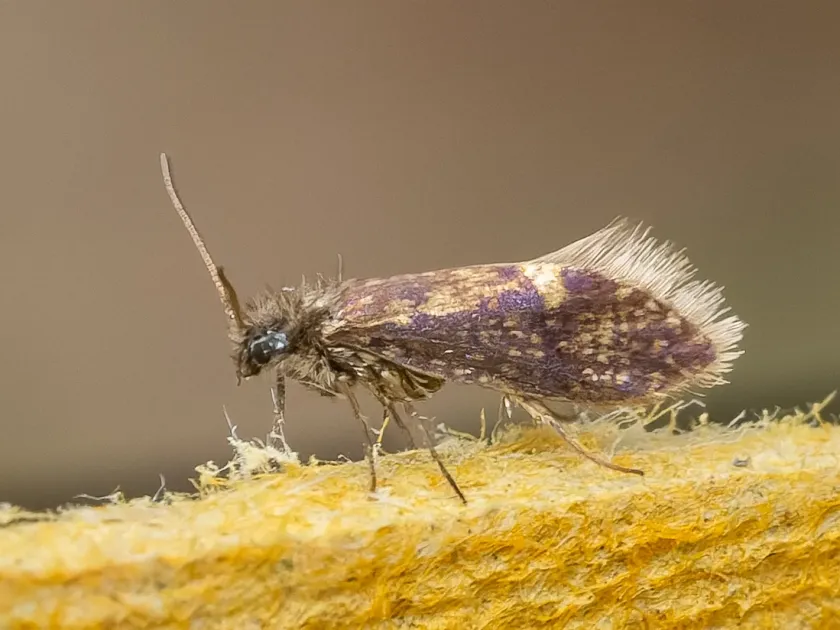
Eriocrania sparrmannella is a moth belonging to the family Eriocraniidae. The adult moth has a wingspan ranging from 10 to 12 mm.
The wings exhibit a distinct metallic bronze-violet sheen with small, irregular pale spots scattered across them.
The body is covered with dense, shaggy hair, which is a characteristic feature of this species.
The larvae are yellowish in color with a brown head, typically reaching about 8 mm in length when mature.
As a member of the primitive moths, it retains certain ancestral physiological traits in its adult stage.
What it damages
The primary host for this pest is the birch tree (Betula), specifically Betula pendula and Betula pubescens.
Occasionally, it may infest other trees within the Betulaceae family in forest ecosystems.
Damage is exclusively caused by larvae, which feed on the leaf parenchyma from inside the leaf tissue.
This internal feeding creates large, irregular blotch-like mines that disrupt the tree's photosynthetic activity.
Severe infestations can lead to premature leaf shedding and overall decline in tree health and vigor.
When it appears
Adult moths emerge in early spring, typically during April or May, synchronized with the budding of birch leaves.
Females insert their eggs directly into the young leaf tissue using a sharp ovipositor.
Larval feeding occurs from spring through early summer, typically concluding by the month of June.
Once feeding is finished, the larvae drop to the ground to pupate in the soil.
The species overwinters as a pupa within a tough cocoon located in the leaf litter or soil.
Signs of infestation
The most visible sign of infestation is the development of blotch mines on the birch leaves.
These mines begin as small patches and expand as the larva feeds, often turning brown over time.
- Small dark granules of frass visible inside the leaf mines.
- Visible discoloration of the leaves ranging from pale green to brown.
- Leaf deformation due to the loss of structural integrity of the parenchyma.
- Translucent appearance of the mined areas when viewed against light.
Heavily infested trees often exhibit a sparse, yellowish crown before the actual end of the season.
Control measures
Systemic insecticides applied during the early spring before bud burst can effectively control moth populations.
Cultural practices such as removing and composting infested leaf litter can significantly reduce the overwintering population.
Cultivating the soil around the base of birch trees can disrupt pupation and reduce the survival rate of the pest.
Biological controls, including entomopathogenic fungi, are useful in maintaining population balance in forest areas.
Regular monitoring with pheromone traps is recommended to track flight activity and time protective measures.
Taxonomy
- Latin name
- Eriocrania sparrmannella
- Order
- Lepidoptera (butterflies)
- Family
- Eriocraniidae
- EPPO code
- ERIRSA
Discussion
No discussions yet — be the first.