
Oak leaf miner
Dyseriocrania subpurpurella
Description
How to identify
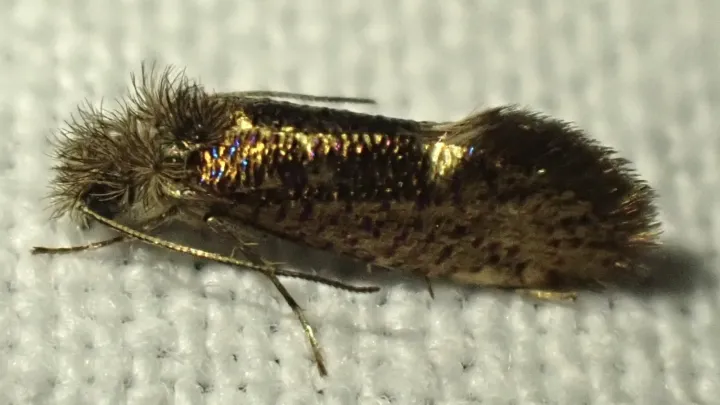
The Oak leaf miner (Dyseriocrania subpurpurella) is a member of the Eriocraniidae family, known as the archaic sun moths. Adult moths are quite small, with a wingspan ranging from 10 to 14 millimeters.
The forewings possess a beautiful metallic sheen, typically bronze or purple-gold, often marked with mottled patterns that help them blend into tree bark.
The larvae are specialized, legless creatures equipped with strong mouthparts designed for mining inside the leaf parenchyma. Their morphology is perfectly adapted to an endophagous lifestyle.
Eggs are laid by females directly into the tissue of developing leaves. This ensures that upon hatching, larvae immediately begin feeding within the protective structure of the leaf.
The species overwinter as pupae within a durable silk-lined cocoon buried in the soil, providing significant protection against winter frosts and predators.
What it damages
The primary host for this species is the pedunculate oak (Quercus robur). Occasionally, other oak species or related trees like hazel and hornbeam can be affected.
Damage is exclusively caused by the larvae, which feed on the internal leaf tissue, leaving the upper and lower epidermis intact. This feeding behavior disrupts the tree's photosynthetic efficiency.
Severe infestations can lead to premature leaf drop, which weakens the tree, particularly if the pest attack is repeated over several consecutive years.
In nursery and forest settings, the reduction of leaf surface area can hinder the growth rates of young saplings, making them more vulnerable to subsequent environmental stress.
Urban trees often suffer from aesthetic degradation, as the characteristic blotch mines make the foliage appear diseased and unhealthy during the growing season.
When it appears
Adult moths emerge early in the spring, usually during April. Their emergence is tightly synchronized with the budburst and the appearance of the first young leaves on oaks.
The species is univoltine, meaning it completes only one generation per year. The entire cycle is concentrated in the early spring months.
Larval feeding is intense but brief, occurring primarily throughout May. Once the larvae finish their development, they quickly vacate the mines to seek refuge in the soil.
Pupation takes place in the ground before the onset of summer. The pupae remain dormant in the soil for the remainder of the summer, autumn, and winter.
The timing of this pest makes it an early-season nuisance, as most damage is finished by the time the summer heat arrives.
Signs of infestation
The most visible symptom is the presence of blotch-like mines on the leaves, which start as small spots and expand as the larva grows.
Inside these mines, dark, linear patterns of frass (larval waste) are often visible, providing a clear indication of the larvae's feeding path within the leaf.
As the leaves mature, the mined areas turn brown and brittle. Often, the leaf surface becomes distorted or puckered around the damaged tissue.
Widespread mining makes the tree canopy look sparse or discolored, which is especially noticeable when multiple mines aggregate on a single leaf.
By holding an affected leaf up to the light, one can clearly see the outline of the mine and potentially the larva itself inside the transparent tissue.
Control measures
Systemic insecticides are effective when applied at the time of egg-laying or early larval emergence to ensure the chemicals are absorbed into the leaf tissues.
Biological control agents, such as parasitoid wasps that specifically target Eriocraniidae larvae, can help keep populations in check naturally within healthy ecosystems.
Cultural methods, such as disturbing the soil beneath infested trees in the autumn or winter, can expose pupae to predators and freezing temperatures, reducing the overwintering success rate.
In ornamental settings, disposing of heavily infested leaf litter can slightly reduce the overall pest pressure for the following season, though soil treatment is more critical.
Monitoring the adult flight period using pheromone traps allows arborists to time their control efforts precisely, ensuring maximum effectiveness and minimal environmental impact.
Taxonomy
- Latin name
- Dyseriocrania subpurpurella
- Order
- Lepidoptera (butterflies)
- Family
- Eriocraniidae
- EPPO code
- ERIRFA
Discussion
No discussions yet — be the first.