
Orange swift moth
Hepialus sylvina
Description
How to identify
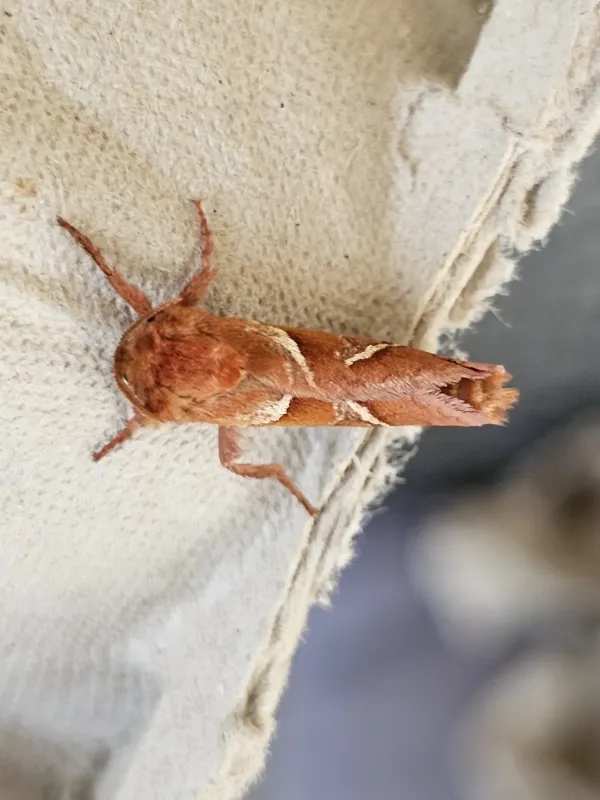
The orange swift moth (Hepialus sylvina) is a moth of the family Hepialidae. The wingspan of the adult ranges from 30 to 50 mm. The forewings are typically orange-brown, featuring two distinct white, angular markings that cross the wing.
The larvae, or caterpillars, are creamy-white with a distinct, hardened dark-brown head capsule. They possess several small, dark pinacula (wart-like structures) along their body, which helps in identifying them within the soil profile.
What it damages
This species is a polyphagous root feeder. The larvae primarily attack the root systems of various herbaceous plants, including hops, strawberries, grasses, carrots, and potatoes, as well as the roots of young woody saplings.
Larval feeding involves tunneling into the roots or completely severing them. This damage destroys the plant's vascular system, preventing the transport of water and nutrients, which eventually leads to chlorosis, stunted growth, and death of the plant.
When it appears
The life cycle of the orange swift moth spans two years. Adults are on the wing from late June through August. Females broadcast their eggs while in flight, dropping them onto the soil surface near the host plants.
Once hatched, the larvae descend into the soil to feed on roots. They remain in the soil for approximately two years before pupating. Larval activity peaks in the spring of their second year as they prepare for the final stages of growth.
Signs of infestation
The most common sign of infestation is sudden wilting, particularly during dry spells, as the damaged root system cannot support the plant's water needs. Affected plants often become loose in the soil and can be easily pulled up.
Physical examination of the root system often reveals tunnels and larvae hidden within the roots or in the immediate vicinity of the root zone. Often, one can find soil tailings or frass around the base of the plant stem.
Control measures
Cultural control includes maintaining clean fields by reducing weeds, which are often alternative hosts. Deep cultivation and soil turning during the autumn can help expose larvae to predators and desiccation by the elements.
For high-value crops, chemical control using soil-applied insecticides may be necessary to target larvae in the rhizosphere. Biological control options, such as using entomopathogenic nematodes (like Heterorhabditis spp.), are effective alternatives for controlling soil-dwelling larvae.
Taxonomy
- Latin name
- Hepialus sylvina
- Order
- Lepidoptera (butterflies)
- Family
- Hepialidae
- EPPO code
- HEPISY
Discussion
No discussions yet — be the first.