
Map-winged Swift
Hepialus fusconebulosus
Description
How to identify
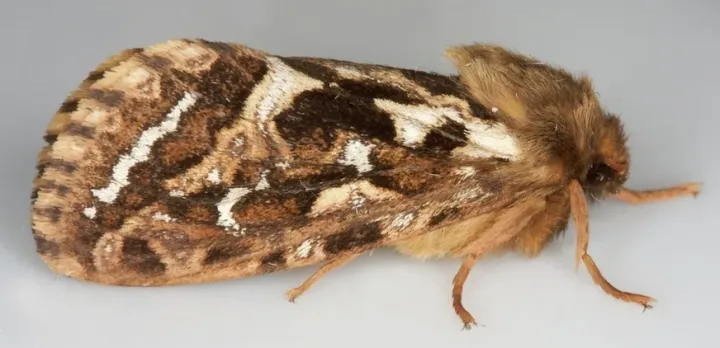
The Map-winged Swift (Hepialus fusconebulosus) is a moth belonging to the family Hepialidae. The adult moth has a wingspan of approximately 40–50 mm, with a distinctive mottled brown pattern that provides excellent camouflage on tree bark or vegetation.
The larvae, or caterpillars, are creamy-white to yellowish with a dark, hardened head capsule. They can grow up to 50 mm in length and possess scattered hairs along their cylindrical bodies, which are segmented with visible dark plates.
The life cycle of this species typically spans two years, which is a significant factor in its persistence within the soil. During this time, the larvae undergo multiple molts, feeding progressively on root structures.
Adult moths are nocturnal and active during the summer months. Females scatter eggs directly onto the soil or onto the bases of host plants, where the larvae later burrow after hatching.
The pupal stage occurs within a chamber formed in the soil, reinforced with silk and soil particles, which serves as a protective barrier against environmental stressors and predators.
##damage##The Map-winged Swift is known to infest a wide variety of plants, including ferns, strawberries, potatoes, and the roots of young woody plants or shrubs. The damage is exclusively subterranean, targeting the vital root systems.
Larvae feed by boring into roots and rhizomes, creating internal tunnels. This feeding activity disrupts the plant's vascular system, hindering the uptake of water and nutrients from the soil.
In strawberry cultivation, the damage caused by these larvae can lead to patchy field growth and significant yield loss as infested plants weaken or die entirely during the growing season.
Beyond direct root consumption, the tunnels created by the larvae often become entry points for secondary pathogens, such as soil-borne fungi and bacteria, which exacerbate the degradation of the plant.
Economic losses are often underestimated because the primary damage occurs beneath the surface, making it difficult to detect the pest until symptoms of plant decline become irreversible.
When it appears
The flight period for adult moths occurs during the summer, typically from June to July. This is the period when population monitoring using light traps is most effective for farmers.
Larval activity reaches its peak in the spring as soil temperatures rise. During this phase, caterpillars feed intensely to fuel their rapid growth before the next pupation cycle.
In the autumn, larvae tend to settle deeper into the soil or remain embedded in the root system, where they enter a semi-dormant state to survive the winter months.
Because the life cycle lasts two years, farmers must maintain vigilance over multiple seasons, as a lack of visible moths in one year does not guarantee the absence of feeding larvae in the soil.
Early season scouting for wilted plants helps in timing control measures before the larvae reach their most destructive, large-sized stages in the following year.
Signs of infestation
The most prominent sign of infestation is the unexpected wilting of the plant. Even with sufficient soil moisture, the plant appears stressed and eventually develops chlorotic foliage, indicating restricted root function.
Inspection of the root zone often reveals irregular tunnels inside the rhizomes or roots. Small piles of brown, granular frass (insect waste) are typically found near the entrance of these tunnels.
Silken webbing is often present in the soil around the base of the stem or within the larval galleries, as the caterpillars use silk to stabilize the soil walls of their tunnels.
In cases of severe infestation, the root system may become fragile or completely hollowed out, leading to the easy detachment of the plant from the soil with minimal force.
- Sudden wilting of healthy-looking plants.
- Tunnels found inside the root structure.
- Presence of fine, brown granular frass near the stem.
- Visible silken webs at the soil line.
Control measures
Deep cultivation and soil turning are effective mechanical methods to expose larvae to birds and harsh weather conditions, significantly reducing their population density in the topsoil.
Biological control using entomopathogenic nematodes or specialized fungi (such as Beauveria bassiana) can be applied to the soil to provide a natural, environmentally friendly suppression of the larvae.
Good agricultural practices, including weed management, are essential, as many common weeds can support the larvae, allowing them to survive and migrate to the primary crop.
Soil-applied insecticides may be used if the infestation threshold is reached, following strict adherence to local regulations and the product's safety label for specific crops.
Regular monitoring through physical examination of the roots and the use of evening light traps can provide early warnings, allowing for targeted intervention before large-scale damage occurs.
Taxonomy
- Latin name
- Hepialus fusconebulosus
- Order
- Lepidoptera (butterflies)
- Family
- Hepialidae
- EPPO code
- HEPIFU
Discussion
No discussions yet — be the first.