
Green ormer
Haliotis tuberculata
Description
How to identify
The green ormer, scientifically known as Haliotis tuberculata, is a marine gastropod mollusk belonging to the family Haliotidae.
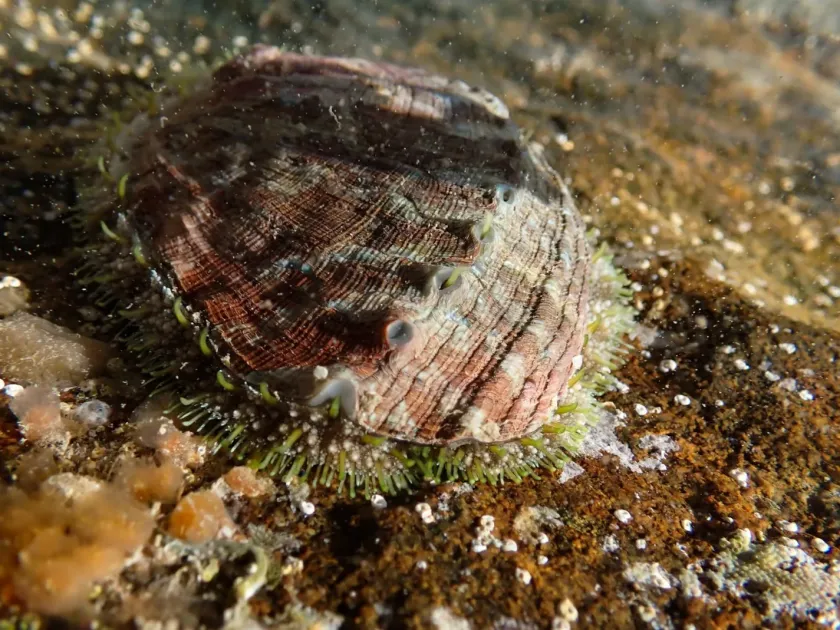
Its shell is flattened and oval-shaped, resembling an ear, with a series of respiratory holes along the shell's edge for water circulation.
The outer shell is typically camouflaged with algae or barnacles, while the inner surface displays a vibrant iridescent nacre layer.
These mollusks possess a large, muscular foot used for adhering firmly to rocky surfaces in intertidal and shallow subtidal zones.
As an exclusively marine organism, it is naturally distributed throughout the Mediterranean Sea and the eastern Atlantic Ocean.
##damage##The green ormer is not an agricultural pest, as its biological life cycle is strictly bound to saline marine environments.
It feeds primarily on seaweed and other marine algae by scraping them off rocks using a specialized feeding structure called a radula.
It does not interact with, feed upon, or damage any crops, vegetables, or terrestrial agricultural plants whatsoever.
From an agronomic perspective, this species poses zero threat to harvest yields or agricultural stability.
No economic damage occurs in the farming sector, as the mollusk is confined to aquatic habitats and cannot survive on land.
When it appears
The activity patterns of Haliotis tuberculata are largely governed by water temperature and the specific spawning periods occurring in summer.
They inhabit rocky substrates where light penetration allows for the continuous growth of the algae they consume.
During colder months, their metabolism slows significantly, leading to decreased movement and overall activity in their rocky niche.
Reproduction involves external fertilization, where eggs and sperm are released into the water column during suitable hydrological conditions.
The mollusk remains largely sedentary throughout the year, moving only short distances to secure sufficient grazing grounds.
Signs of infestation
Detection in the wild is typically achieved through underwater surveys of rocky reefs or finding discarded shells on the shoreline.
Characteristic grazing marks, in the form of parallel grooves on stones, indicate where the mollusk has been feeding on algae.
In mariculture environments, the density of individuals on submerged artificial substrates serves as an indicator of population size.
There are no signs of plant infestation or damage, as the species never interacts with vegetation outside of the marine ecosystem.
Observations of this species are restricted to marine biology studies and have no relevance to terrestrial plant pathology.
Control measures
No protective measures are required in agriculture, as the green ormer is not a pest and does not interfere with crop production.
In aquaculture, specialized management techniques are employed to support sustainable populations for commercial harvest.
Conservation efforts are sometimes necessary to prevent overfishing and maintain the ecological balance of their natural habitats.
Standard agricultural pesticides are completely ineffective and inappropriate for use near these marine organisms due to environmental regulations.
Management of this species is solely the concern of marine biologists and environmental agencies, not agricultural professionals.
Taxonomy
- Latin name
- Haliotis tuberculata
- Order
- Molluscs
- Family
- Haliotidae
- EPPO code
- HLTSTU
Discussion
No discussions yet — be the first.