

Pest · Lepidoptera (butterflies) · affects Apple, Winter wheat, Winter barley
Especially harmful
Pear fruit moth
Cydia pyrivora
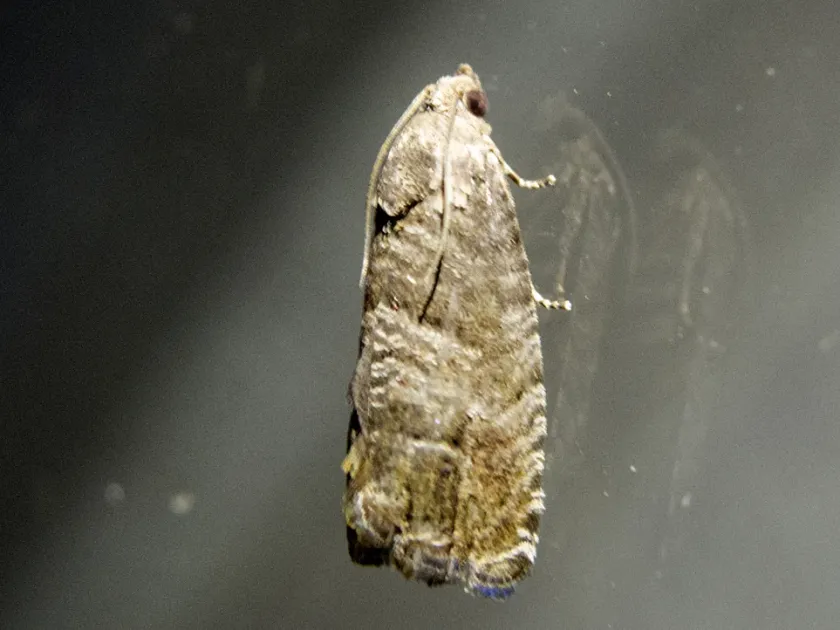
Description
How to identify
The pear fruit moth (Cydia pyrivora) belongs to the Tortricidae family of the order Lepidoptera. It is a small moth with a wingspan ranging from 17 to 20 mm, featuring greyish-brown wings that blend in with tree bark during the day.
The larval stage is the destructive one. Mature larvae are approximately 15–20 mm long, with colors ranging from creamy white to pink. The dark, nearly black head of the larva is a distinguishing feature used in entomological identification.
What it damages
This pest is a specialist that targets common pear trees. Unlike more generalist pests, Cydia pyrivora has a narrow host range, focusing almost exclusively on Pyrus species during the fruit development stage.
It does not attack crops such as fodder beet, winter barley, apples, peas, wheat, tomatoes, or grapes. Any damage observed on these plants is caused by different moth species, so protection efforts should be focused strictly on pear orchard health.
When it appears
The flight of adult moths typically begins during or immediately after the pear flowering period. The development of the population is synchronized with the physiological growth stages of the fruit.
The insect typically completes one generation per year. However, in warmer climates with extended growing seasons, a partial second generation can occur, which increases the risk of damage to late-harvest pear varieties.
Signs of infestation
The most visible sign of infestation is the entry point on the pear fruit, where frass (larval excrement) is often pushed out and mixed with sap. The fruits may develop dark, depressed spots as the larvae tunnel toward the core.
Infested pears often turn yellow prematurely and drop to the ground. Once a fruit is opened, the seed cavity is typically found to be destroyed, with the larva or its waste present, rendering the fruit completely unsuitable for storage.
Control measures
Integrated Pest Management (IPM) is essential. Using pheromone traps helps monitor moth populations and determines the optimal timing for insecticide applications, which must coincide with the hatching period of the larvae.
Cultural controls are highly effective. Collecting and destroying fallen fruit daily prevents the larvae from emerging and entering the soil to pupate. Additionally, tilling the soil under the tree canopy in late autumn helps destroy overwintering larvae.
In brief
8
Damages crops
Content graph
Damages crops · 8
Content graph
Connections · Pear fruit moth
Most often together:
Marketplace
Products · 5

Puska
Три Дельта Компані Інтернешнл, Гонконг, Китай.
Insecticides
1
0
·
1.9K
1 offer
7.76 €per 1 l
Buy


Raut
Три Дельта Компані Інтернешнл, Гонконг, Китай.
Insecticides
0
0
·
753
2 offers
0.89 €per 1 l
Buy

Biology
Taxonomy
- Latin name
- Cydia pyrivora
- Order
- Lepidoptera (butterflies)
- Family
- Tortricidae
- EPPO code
- LASPPY
Community
Discussion
No discussions yet — be the first.