
Guava aphid
Greenidea psidii
Description
How to identify
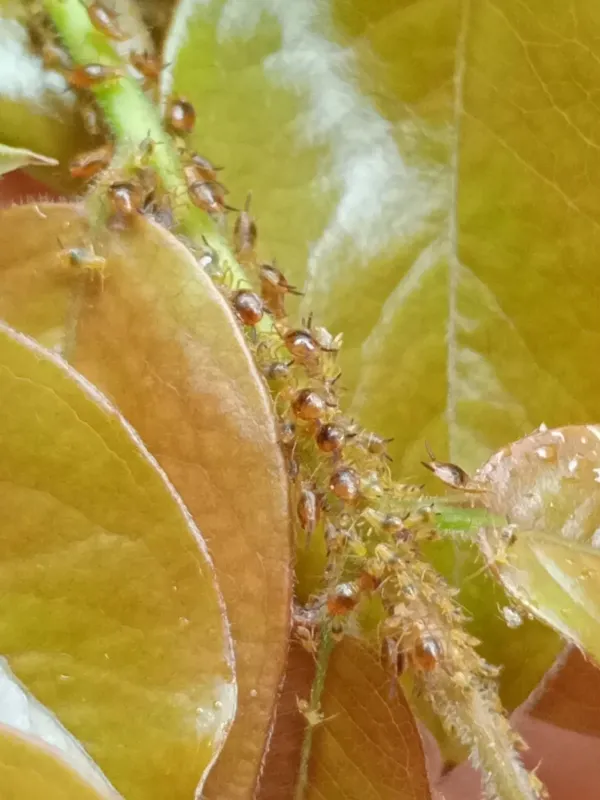
The guava aphid (Greenidea psidii) belongs to the order Hemiptera and the family Aphididae. It is characterized by its exceptionally long cornicles (siphunculi), which are a distinctive morphological trait of this species.
The adult aphids typically range in color from light brown to olive-green or reddish-brown. Their bodies are pear-shaped, measuring approximately 2 to 3 millimeters in length.
These aphids reproduce primarily through parthenogenesis, allowing populations to expand rapidly on the undersides of leaves and on tender shoots during favorable weather conditions.
The life cycle includes multiple nymphal instars, and the population often consists of both apterous (wingless) and alate (winged) forms to facilitate dispersal between host plants.
Large colonies are frequently attended by ants, which feed on the honeydew produced by the aphids and actively protect them from natural predators and parasitoids.
What it damages
The primary hosts for Greenidea psidii are plants in the Myrtaceae family, with guava (Psidium guajava) being the most economically significant crop impacted.
This pest is also found on other crops including tea plants, various tropical fruit trees, and ornamental woody species, where it can cause significant yield losses.
Damage is caused by the aphids feeding on the phloem sap of young, developing shoots and leaves, which saps the plant's essential nutrients and energy.
Heavy infestations can lead to stunted growth, leaf curling, and severe distortion of the foliage, ultimately reducing the overall vigor of the host plant.
Additionally, the honeydew excretion serves as a substrate for sooty mold, which blocks photosynthesis and reduces the market quality of the fruit and foliage.
Signs of infestation
Early symptoms of infestation include the curling and yellowing of young leaves, along with the presence of a sticky, glistening residue known as honeydew.
Inspection of the abaxial (lower) leaf surface usually reveals crowded clusters of aphids concentrated along the veins and petioles of the leaves.
Premature leaf drop and the presence of black sooty mold on the leaves and stems are clear indicators that the infestation has reached a severe level.
Increased activity of ants on the plant branches is a common indirect sign that a colony of aphids has established itself on the tree.
The tip of the growing shoots may stop elongating or become significantly deformed, indicating the direct physiological stress caused by the feeding insects.
Control measures
Cultural control methods involve pruning and destroying heavily infested plant parts and ensuring proper plant nutrition to maintain overall tree resilience.
Biological control includes preserving and augmenting populations of natural enemies such as ladybeetles (Coccinellidae), lacewings (Chrysopidae), and parasitic wasps.
Chemical control utilizing systemic insecticides is often necessary for significant infestations, as these products travel through the plant's vascular system to reach the feeding aphids.
Application of contact insecticides should be done carefully to ensure thorough coverage of the leaf undersides where colonies typically reside.
- Regular monitoring of orchard or garden plantations.
- Ant control measures to remove protection for aphid colonies.
- Rotation of different insecticide classes to mitigate the risk of resistance.
Taxonomy
- Latin name
- Greenidea psidii
- Order
- Hemiptera (bugs, aphids, leafhoppers)
- Family
- Aphididae
- EPPO code
- GREEPS
Discussion
No discussions yet — be the first.