
Gonocephalum hoffmannseggi
Gonocephalum hoffmannseggi
Description
How to identify
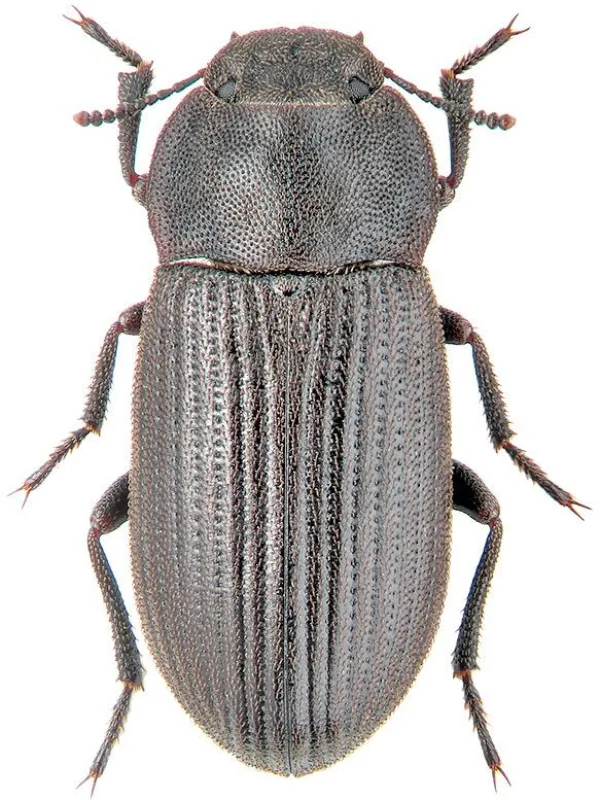
Gonocephalum hoffmannseggi is a beetle belonging to the Tenebrionidae family (darkling beetles). Adult beetles measure approximately 8–10 mm in length and are typically matte black or dark brown in color.
The elytra are densely covered in small tubercles and short hairs, giving the insect a rough, textured appearance. The head is tucked closely against the pronotum, a distinctive feature of this particular genus.
The larvae, commonly known as false wireworms, have a cylindrical body and a tough, chitinous exterior. This hardened skin allows them to navigate easily through compacted soil layers while feeding.
The life cycle includes a complete metamorphosis: egg, larva, pupa, and imago. The species is highly adapted to arid environments, making it a persistent resident in regions with low precipitation and warm soils.
Adults often congregate in areas with sparse vegetation or accumulated crop residues, which provide essential shelter from direct sunlight and predators during the hottest parts of the day.
What it damages
This species is a significant agricultural pest, particularly damaging to grain crops, legumes, and various industrial crops like sunflowers and corn. It primarily poses a threat during the germination and early seedling stages.
Adult beetles damage plants by gnawing on stems above the soil surface, leading to seedling collapse and mortality. This feeding behavior is particularly devastating to young, tender plants that haven't yet developed robust tissues.
Larvae feed underground, consuming planted seeds and pruning roots. This damage often goes unnoticed until the crop fails to emerge or shows large, irregular patches of missing plants across the field.
The pest's impact is compounded in drought conditions, as damaged seedlings struggle to recover due to water stress and a weakened root system that cannot efficiently absorb moisture.
Economic damage is defined by thinning stands, which often necessitates replanting efforts, significantly increasing production costs and reducing overall yield potential in the affected field sectors.
When it appears
Adult activity commences in early spring as soil temperatures rise to levels conducive to movement. The peak emergence of adults is typically observed throughout April and May.
During the peak of summer heat, adults may enter a state of estivation, retreating deep into the soil profile or hiding beneath organic debris to avoid desiccation until environmental conditions improve.
Developmental cycles are often extended, with multiple larval instars potentially present in the soil simultaneously. This biological trait makes it difficult to predict precise timings for population control measures.
Egg-laying usually occurs over several months in the spring. Females deposit eggs directly into the soil near potential food sources to ensure that emerging larvae have immediate access to nutrients.
As autumn approaches and temperatures drop, adults and mature larvae migrate to deeper soil layers below the frost line to overwinter successfully until the next planting season begins.
Signs of infestation
The first indication of an infestation is the appearance of gaps in the field where seedlings have failed to emerge or are rapidly wilting. Excavating the soil around these plants often reveals the larvae.
Visible feeding damage, such as jagged edges on stems or completely hollowed-out seeds, is a clear sign. In some cases, adult beetles can be found hiding in the soil immediately surrounding the injured plant.
During twilight or dawn, large numbers of adult beetles may be observed crawling on the soil surface. They are highly reactive to vibrations and will quickly burrow into the soil when approached.
Infestations are typically localized in drier areas of the field, such as ridges or slopes, where moisture levels in the seedbed might be suboptimal for rapid crop growth.
- Irregular patches of missing seedlings
- Presence of larvae in the root zone
- Gnawed stems at the soil line
- Hollowed-out seeds found during inspection
- Adult beetles active on the surface at dusk
Control measures
Integrated pest management begins with aggressive soil cultivation practices, which help disrupt the life cycle, destroy overwintering sites, and expose both larvae and adults to natural enemies.
Strict adherence to crop rotation and efficient weed management are essential, as they deprive the beetles of stable food sources and shelters throughout the growth period of the main crop.
Seed treatments using systemic insecticides are the most effective method to protect seeds and early-stage seedlings. This creates a protective chemical barrier that prevents larval and adult damage.
Soil monitoring using periodic excavations is crucial for assessing population density. Control actions, such as soil-applied insecticides, should only be implemented when the population exceeds economic thresholds.
In cases of severe infestation, targeted insecticide applications may be necessary. These should be performed in the late evening or night when the beetles are most active on the surface.
Taxonomy
- Latin name
- Gonocephalum hoffmannseggi
- Order
- Coleoptera (beetles)
- Family
- Tenebrionidae
- EPPO code
- GONAHO
Discussion
No discussions yet — be the first.