
Gonocephalum elderi
Gonocephalum elderi
Description
How to identify
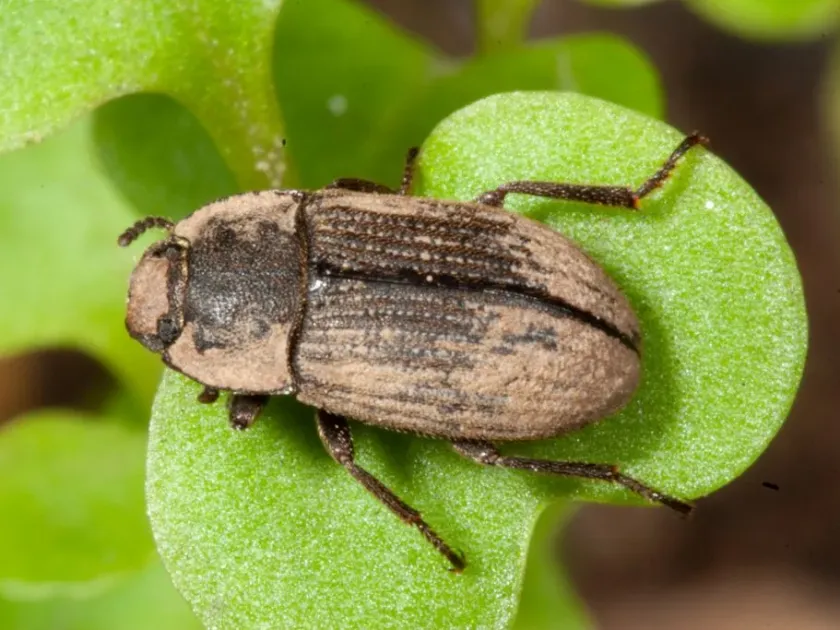
Gonocephalum elderi belongs to the Tenebrionidae family (darkling beetles), part of the Coleoptera order. Adult beetles measure about 7–10 mm in length and possess a matte, greyish-brown to black exoskeleton, perfectly suited for survival in arid climates.
The beetle’s body features a distinct sculpture: the elytra are marked with longitudinal grooves and covered in fine scales or hairs, providing an earthy appearance that acts as effective camouflage in soil debris.
The larvae are known as false wireworms. They have a tough, cylindrical, yellowish-brown body with a hardened cuticle, which grants them high resistance to extreme environmental conditions compared to softer larvae.
The entire life cycle is closely linked to the soil, where they spend most of their time. Females typically deposit eggs in moist patches or under plant residues, which is a crucial requirement for successful larval survival.
This species is highly resilient to temperature fluctuations and drought, making it a persistent threat in semi-arid and agricultural regions where other pests struggle to maintain high populations.
What it damages
Gonocephalum elderi is a polyphagous pest that damages a wide array of crops, including cereals (wheat, barley), maize, sunflowers, and various vegetable crops.
The larvae, living beneath the soil surface, primarily damage crops by feeding on the roots and chewing through stems at or below the ground level, which leads to plant thinning and crop failure.
Adult beetles primarily target above-ground organs, especially during seed germination and seedling emergence. They chew through stems, cotyledons, and buds, often destroying entire fields shortly after planting.
Damage intensity increases significantly in dry years when natural food sources diminish, prompting beetles to migrate in large numbers into crop fields in search of succulent young seedlings.
Damage caused by this pest leaves plants highly susceptible to secondary infections by soil-borne pathogens and fungi, which exacerbate the damage and lead to further losses.
When it appears
Pest activity begins in early spring as soon as the soil warms up. Beetles emerge from their overwintering sites to feed on weeds and early cultural crop seedlings.
The peak of damage coincides with the germination and active seedling growth phases, which are the periods when plants are most vulnerable to soil-dwelling pests.
During the peak of summer, high temperatures and low soil moisture may cause beetles to burrow deeper into the soil for a short diapause, though rainfall often triggers a return to active feeding.
In autumn, adults engage in additional feeding before hibernation, often damaging the root systems of winter crops, which helps them accumulate energy for the winter months.
Overwintering occurs in the soil, where both adults and larvae remain protected from freezing temperatures by organic matter or compacted soil clumps.
Signs of infestation
The first indicator of infestation is the appearance of patchy areas or "gaps" in the fields, where seedlings appear wilted or fail to emerge entirely.
Close inspection of affected plants often reveals signs of gnawing on roots or stems, typical of the damage inflicted by false wireworms or the beetles themselves.
The presence of adult beetles in the topsoil or under crop residues during morning and evening inspections is a clear sign that the field is at risk of significant damage.
Seedling damage is usually localized around the crown or root collar, showing irregular chew marks that prevent the plant from absorbing nutrients and water.
Increased weed density on the field and its borders often serves as a reservoir for this pest, providing it with a safe haven before cultural crops are planted.
Control measures
Crop rotation is the fundamental preventive measure, as it disrupts the pest's life cycle and prevents the build-up of populations in specific fields over time.
Deep tillage or thorough soil cultivation during the beetle's pupation phase is highly effective, as it mechanically disrupts the insects and exposes them to natural predators.
Consistent weed management is essential for restricting the available food supply, preventing the pest population from exceeding economic injury levels.
In high-risk areas, the use of insecticide-treated seeds provides necessary systemic protection during the critical window of germination and early development.
- Application of soil-applied insecticides during planting.
- Use of toxic baits in areas with documented mass migration of beetles.
- Optimizing planting dates to ensure crops grow past the vulnerable stage as quickly as possible.
Taxonomy
- Latin name
- Gonocephalum elderi
- Order
- Coleoptera (beetles)
- Family
- Tenebrionidae
- EPPO code
- GONAEL
Discussion
No discussions yet — be the first.