
Gohieria mite
Gohieria
Description
How to identify
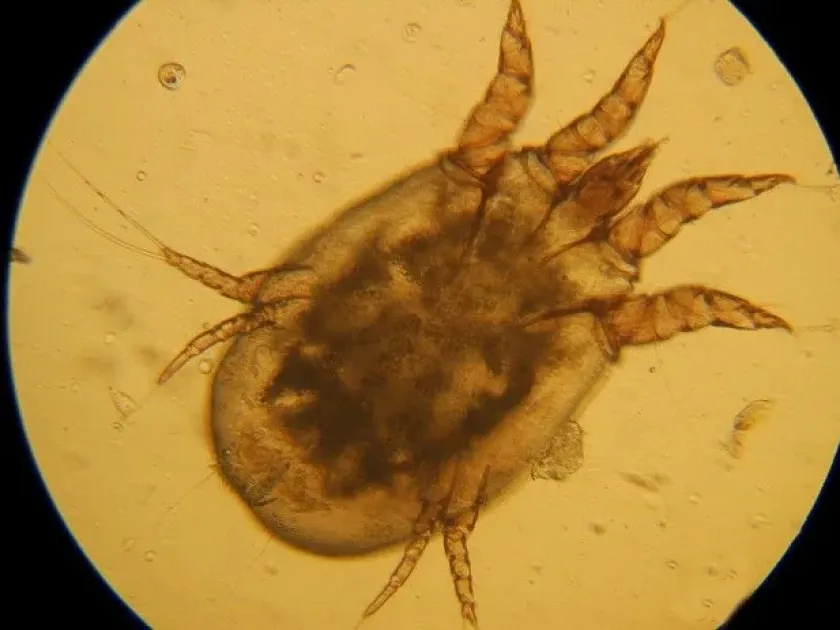
The Gohieria mite (Gohieria fusca) belongs to the Glycyphagidae family within the order Acariformes. It is a microscopic arachnid characterized by a yellowish-brown body covered in sparse, long setae.
Adult mites measure approximately 0.3–0.4 mm in length. These pests are relatively slow-moving and exhibit high sensitivity to ambient humidity, preferring shaded and damp micro-environments within storage facilities.
The life cycle encompasses stages from egg to larva, protonymph, deutonymph, and adult. Under ideal conditions, such as temperatures of +20...+25°C and moisture levels exceeding 15%, a generation can develop in just 2–3 weeks.
A crucial biological adaptation of this species is the formation of hypopi—a dormant, highly resistant life stage that allows the mite to survive adverse conditions like desiccation or food scarcity.
Dissemination typically occurs through contaminated dust, transport packaging, machinery, or the movement of infested grain batches between storage silos.
What it damages
The primary economic damage is caused to stored food products, particularly cereals, legumes, and various processed goods like flour, bran, and dried fruits.
The mites feed on the nutrient-rich parts of the kernels, significantly reducing grain weight, nutritional value, and viability of seed material intended for planting.
Large infestations lead to "heating" of the grain bulk, which creates favorable conditions for secondary mold growth and rapid degradation of the entire stored mass.
The presence of mite carcasses, exuviae, and feces contaminates the products, making them unsuitable for human or animal consumption due to foul odors and potential health risks.
Infested products often develop a distinct honey-like or sweetish odor, which is a clear indicator that the quality of the batch has been severely compromised.
Signs of infestation
An early sign of infestation is the presence of fine, dust-like particles on the surface of grain piles, which, upon magnification, reveals active mite colonies.
The development of a musty, sweet smell in storage areas is a common indicator that the mites have reached high population densities and are damaging the stored goods.
Heavily infested grain may start clumping together, making aeration and standard cleaning operations difficult to perform effectively.
Visual inspection of bags and warehouse walls often reveals a greyish or whitish film, which consists of mites and their cast-off skins.
Laboratory analysis of grain samples is the most reliable method for detecting mites in the early stages, using sifting techniques and microscope observation.
Control measures
Rigorous moisture control is the most effective preventative measure; maintaining grain moisture content below 13–14% prevents the mites from establishing a population.
Regular sanitation of warehouses, including the removal of grain residues and dust, is essential to eliminate breeding grounds and prevent cross-contamination.
In case of severe infestation, fumigation using approved acaricidal agents is required to eliminate the pest across all stages of the life cycle within the grain mass.
Cooling the grain bulk to temperatures below +10°C significantly slows down the metabolic activity and reproductive rate of the mites, effectively suppressing an outbreak.
- Drying grain to safe storage moisture levels.
- Utilizing sealed storage containers to exclude pests.
- Consistent monitoring of temperature and moisture in silos.
- Sanitizing transportation equipment to avoid introduction.
Taxonomy
- Latin name
- Gohieria
- Order
- Mites
- Family
- Glycyphagidae
- EPPO code
- GOHISP
Discussion
No discussions yet — be the first.