
Domestic grain mite
Glycyphagus domesticus
Description
How to identify
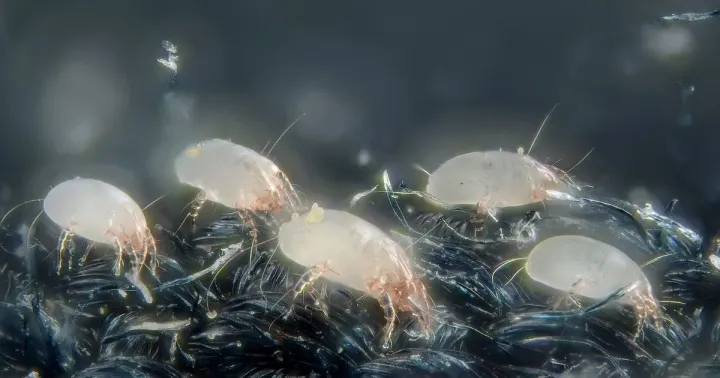
The domestic grain mite (Glycyphagus domesticus) is a member of the order Acariformes and the family Glycyphagidae. It is a microscopic organism, appearing as a translucent, whitish, or yellowish speck, which makes it extremely difficult to detect without magnification.
Adult mites reach a size of approximately 0.3–0.5 mm. A distinctive morphological feature of this species is the presence of long, feathery setae (hairs) covering the body, which facilitate movement through loose substrates like grain or flour.
The life cycle encompasses the egg, larva, protonymph, deutonymph (hypopus), and adult stages. The hypopus stage is a specialized developmental phase acting as a survival mechanism; in unfavorable conditions, the mite enters this dormant state to withstand food scarcity or low humidity for long periods.
Reproduction is highly dependent on environmental conditions, requiring relative humidity levels above 65% and moderate temperatures. The optimal range for rapid population growth is between 20°C and 25°C.
These mites have a high reproductive rate, completing their life cycle in just 3–4 weeks under ideal conditions. This rapid biological progression allows them to colonize vast quantities of stored products in a very short time.
What it damages
The domestic grain mite causes severe damage to various agricultural products. Primary targets include cereals such as wheat, barley, and oats, as well as processed food items like flour, dried cereals, and animal feeds.
Beyond grains, the mite infests dried fruits, oilseeds, nuts, mushrooms, and spices. Infested products often develop a characteristic sweet, honey-like odor, which is a telltale sign of heavy mite infestation and their metabolic waste accumulation.
Damage occurs primarily through the consumption of the grain germ, which drastically reduces seed viability. Furthermore, the product becomes heavily contaminated with feces, molted skins, and dead mites, rendering it unsafe for human consumption.
Mite activity leads to the self-heating of grain piles. The moisture generated by these colonies fosters the growth of mold and fungi, which can ruin large storage facilities and cause total loss of product quality.
In addition to economic damage, Glycyphagus domesticus is a potent allergen. Workers in grain storage facilities are at risk of developing dermatitis and respiratory issues from inhaling dust containing mite fragments and excreta.
Signs of infestation
The most immediate sign of an infestation is a distinct, sweet, or honey-like smell emanating from the grain silo or storage room. A fine, dusty layer on the surface of grain piles often indicates a massive presence of mites.
When examining the product with a hand lens, one can observe minute, light-colored moving specks. If the grain or flour appears clumped or has a grayish, dusty appearance, it strongly suggests a high level of mite activity.
A critical indicator is an localized increase in the temperature of the grain mass. Mite colonies generate heat, and finding hot spots within a cool grain silo is a primary sign of an active infestation that needs urgent management.
Damaged grains lose their natural shine and look hollowed out. The destruction of the embryo is often visible upon closer inspection, leaving the grain kernel empty and susceptible to further fungal infection.
In storehouses, mites tend to congregate in corners, wall cracks, and machinery gaps. These areas often show a brownish, dusty accumulation that, when disturbed, confirms the presence of a colony.
Control measures
The most effective strategy for managing grain mites is strict humidity control. Maintaining grain moisture levels below 13% creates an environment where mites cannot survive or reproduce, effectively preventing infestations.
Pre-harvest sanitation is essential. All storage facilities must be thoroughly cleaned to remove old grain residues, dust, and debris, which serve as reservoirs for mites between storage seasons.
When an infestation is confirmed, the following control methods should be implemented:
- Aeration and mechanical cooling of the grain mass below 5°C to halt mite reproductive cycles.
- Fumigation of infested grain and storage spaces using approved phosphine-based treatments.
- Deep cleaning and disinfestation of empty warehouses using certified acaricides.
- Screening and cleaning of incoming grain using high-efficiency separators to remove dust and initial mite populations.
To ensure long-term protection, storage facilities must be sealed to prevent the entry of rodents and birds, which act as vectors for mites, and regular sampling should be conducted to detect early signs of infestation.
Taxonomy
- Latin name
- Glycyphagus domesticus
- Order
- Mites
- Family
- Glycyphagidae
- EPPO code
- GLYCDO
Discussion
No discussions yet — be the first.