
Broad-horned flour beetle
Gnatocerus maxillosus
Description
How to identify
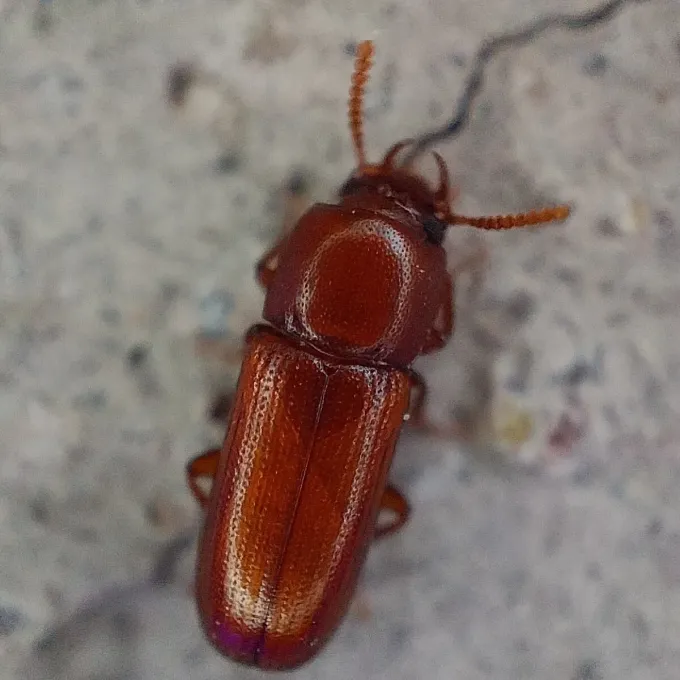
The broad-horned flour beetle belongs to the family Tenebrionidae, order Coleoptera. It is a small insect, typically measuring about 3–4 mm in length.
The body is elongated and reddish-brown to dark brown in color. The surface is finely punctate, which is a distinctive feature of many tenebrionid beetles.
The adult males are easily recognized by their prominent, upward-curved, horn-like mandibles, which give the species its common English name.
The antennae feature a distinct club at the end, consisting of several terminal segments, a diagnostic characteristic for identifying this specific pest.
Larvae are cylindrical, yellowish-white, and can reach up to 6 mm in length. They have three pairs of thoracic legs and possess a scattered covering of fine hairs.
What it damages
This beetle is a significant pest of stored agricultural products, commonly found in warehouses, flour mills, and grain processing facilities.
They primarily infest cereal grains, flour, processed grain products, bran, as well as dried fruits, vegetables, and various oilseeds.
Both adults and larvae bore into individual grains, consuming the germ and endosperm, which significantly reduces the nutritional value and germination rate of seeds.
Infested products become heavily contaminated with excrement, cast larval skins, and webbing, rendering the grain unsuitable for human or animal consumption.
In humid conditions, the presence of these beetles promotes the growth of mold and fungi, which can lead to heating of the grain mass and further spoilage.
When it appears
The broad-horned flour beetle is a thermophilic species that thrives in temperatures between 20 and 28 degrees Celsius.
In heated storage facilities, such as grain silos or flour mills, the beetle can reproduce throughout the year without entering diapause.
The duration of the life cycle is highly dependent on ambient temperature and moisture levels; under optimal conditions, a generation can develop in 40–50 days.
Females lay their eggs directly into the food source, such as grain dust or cracked kernels, ensuring that newly hatched larvae have immediate access to food.
Activity peaks during warmer months, when rising indoor temperatures accelerate metabolic rates and facilitate rapid population growth.
Signs of infestation
The first signs of infestation include the presence of small beetles in stagnant areas of the warehouse where grain dust and debris accumulate.
Surface webbing and clumped flour or grain particles are common indicators of larval activity within the product mass.
Close inspection of grains may reveal small, irregular holes or hollowed-out portions caused by larval feeding, alongside fine dust and frass.
A musty or rancid odor emanating from a grain batch often suggests a large-scale infestation and subsequent microbial contamination.
For early detection, technicians should use pheromone-based traps or conduct regular sieve analysis of grain samples collected from various depths.
Control measures
The primary control strategy involves strict warehouse hygiene, including the regular removal of spilled grain, dust, and debris that harbor beetle populations.
Reducing the moisture content of stored grain to below critical levels significantly inhibits larval growth and slows down the overall development of the species.
- Aeration and cooling of the grain mass to below 10 degrees Celsius.
- Sealing of storage structures to facilitate effective fumigation.
- Application of contact insecticides to empty warehouse surfaces.
- Regular cleaning and sanitation of transport belts and elevators.
Fumigation with phosphine-based products is the most effective method for eradicating beetle populations within enclosed spaces when performed by professionals.
Ongoing monitoring of grain temperature and moisture levels allows for early identification of hotspots, preventing the spread of the pest to other storage units.
Taxonomy
- Latin name
- Gnatocerus maxillosus
- Order
- Coleoptera (beetles)
- Family
- Tenebrionidae
- EPPO code
- GNATMA
Discussion
No discussions yet — be the first.