
Broad-horned flour beetle
Gnatocerus
Description
How to identify
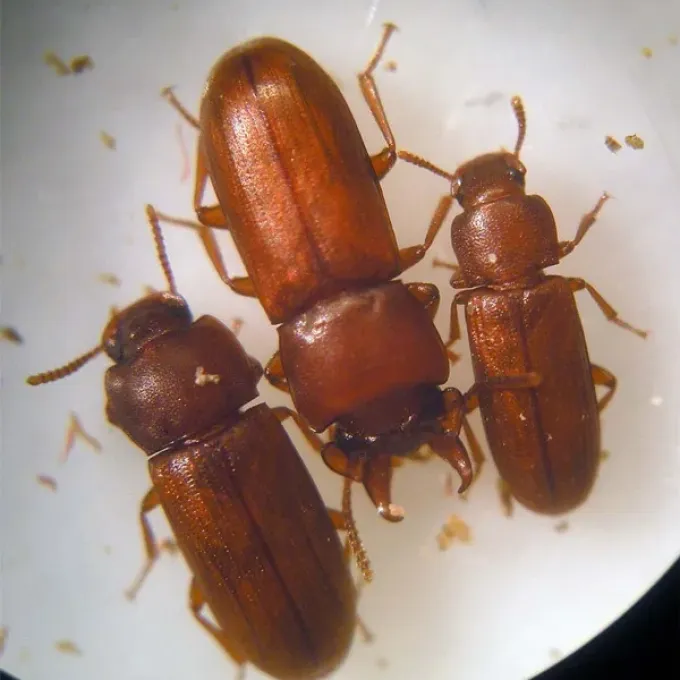
The broad-horned flour beetle (lat. Gnatocerus cornutus) is a small, common beetle belonging to the Tenebrionidae family, known as a serious stored-product pest.
Adult beetles are typically 3.5 to 4.5 mm long and possess a reddish-brown to dark brown coloration throughout their bodies.
Males are easily identified by their prominent, curved mandibles which resemble horns, serving as a distinct morphological feature for this species.
The insect has an elongated, flattened body covered with fine punctures, giving it a somewhat shiny appearance under bright light.
Larvae are worm-like, pale yellow or white in color, and feature a darker head capsule, growing up to 7 mm in length before pupation.
What it damages
This species is considered a secondary pest, meaning it primarily feeds on processed grain products rather than sound, intact kernels.
Commonly infested products include wheat flour, cornmeal, bran, various cereals, dried vegetables, and diverse stored pantry items.
Because they cannot penetrate tough, whole grain, they congregate in dusty areas, broken grain particles, or items already damaged by other pests.
The primary damage results from the consumption of the product and the contamination of the grain with frass, larval skins, and webbing.
Large infestations lead to significant economic loss as the contaminated products develop an unpleasant odor and become unsuitable for human use.
When it appears
In heated warehouse environments or mills, the broad-horned flour beetle breeds continuously throughout the year with no seasonal pause.
The optimal temperature range for rapid development and population growth is between 22 and 26 degrees Celsius at moderate humidity levels.
The life cycle from egg to adult takes approximately 40 to 60 days, heavily influenced by the nutritional quality of the food source.
Development slows significantly when temperatures fall below 15 degrees Celsius, though the beetles are capable of surviving in cooler conditions.
Multiple generations can occur annually in favorable indoor environments, making rapid detection essential for effective inventory management.
Signs of infestation
Initial infestation signs include the clumping of flour or grain products caused by the larval webbing, creating visible mesh-like structures.
Infested goods often develop a distinct musty or foul smell, which is an indicator that the product has been processed by the insect's life cycle.
Adult beetles are often spotted on the surface of grain bags, near milling machinery, or in crevices of storage room walls.
Finding cast-off larval skins and dead adults within a bag of flour is a clear sign that a breeding population is well-established.
Sifting grain samples through fine-mesh sieves is a highly effective monitoring technique to confirm the presence of both larvae and adults.
Control measures
Effective management begins with rigorous warehouse sanitation, including the regular removal of grain dust and spilled materials from cracks.
Keeping storage areas dry is crucial, as lower moisture levels make food sources less attractive and hospitable to the beetles.
Chemical control involving authorized fumigants or residual insecticides is recommended for heavy infestations in milling and storage facilities.
Implementing airtight storage solutions prevents the cross-contamination of products and limits the ability of beetles to move between batches.
- Regular inspection of incoming grain stocks
- Use of pheromone traps for beetle monitoring
- Thorough cleaning of elevator boots and milling equipment
- Maintaining low humidity in storage environments
Taxonomy
- Latin name
- Gnatocerus
- Order
- Coleoptera (beetles)
- Family
- Tenebrionidae
- EPPO code
- GNATSP
Discussion
No discussions yet — be the first.