
Glyptotendipes
Glyptotendipes
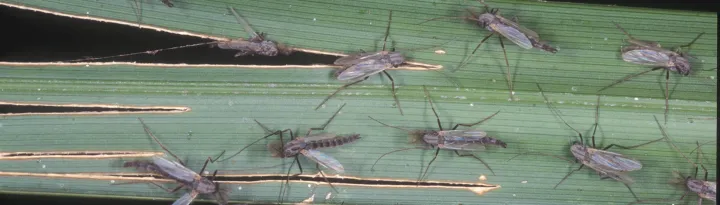
Description
How to identify
Glyptotendipes belongs to the family Chironomidae (non-biting midges) within the order Diptera. Adult individuals are delicate midges that do not feed and live only for a short time, focusing exclusively on reproduction.
The greatest threat to agricultural crops comes from the larvae of this insect. They have a characteristic worm-like body, colored red due to high hemoglobin content, which allows them to survive in oxygen-deficient environments.
Externally, the larvae resemble bloodworms, ranging from 10 to 20 millimeters in length. Their head capsule is well-defined and sclerotized, enabling the larvae to move actively and feed on organic debris or plant tissues.
The insect's life cycle is closely tied to the aquatic environment. Females lay eggs in water in the form of gelatinous masses, attaching them to submerged objects or plant stems.
Development passes through four larval instars. The speed of the cycle depends on water temperature: during the summer, one generation can complete development in 2 to 4 weeks.
What it damages
The primary agricultural concern regarding this insect is rice cultivation. The larvae damage young sprouts, seeds, and roots of the crop directly within flooded rice paddies.
In addition to rice, Glyptotendipes can infest various hydrophilous plants and water bodies adjacent to agricultural land, creating a reservoir for the pest population.
Outbreaks are frequently recorded when field flooding practices are compromised and large amounts of undecomposed organic matter accumulate in the water, serving as a primary food source.
The larvae can also damage hydraulic structures by boring tunnels into wooden components or cleaning filters if the population density reaches critical levels.
Economic losses result from reduced plant density, the necessity of replanting, and the costs associated with chemical treatments of the water environment.
Signs of infestation
The first sign of infestation is the appearance of characteristic gelatinous egg masses on the water surface or at the base of young plants.
One may observe the wilting or yellowing of young rice sprouts that have been fed upon by larvae in the root collar or tillering node zone.
Inspecting the submerged parts of plants reveals aggregations of larvae that construct tube-like dwellings made of silt particles and mucus.
Above areas of mass emergence, swarms of adult midges resembling clouds can be observed, especially during evening hours in calm weather.
Affected field areas often appear as patches with significantly lower crop density due to the destruction of seedlings by the larval population.
Control measures
An effective agrotechnical control method is thorough field preparation, including leveling the soil and removing plant debris before flooding.
Managing the timing of water flooding helps disrupt the insect's life cycle by depriving females of attachment sites for egg masses during critical crop growth phases.
In cases of high infestation, insecticides based on organophosphorus compounds or insect growth regulators approved for aquatic use are applied.
Maintaining water quality is crucial: using flow-through irrigation makes it difficult for larvae to attach and feed on the crops.
Biological control involves supporting natural populations of predatory dragonfly larvae and fish, which actively consume chironomid larvae in rice paddies.
Taxonomy
- Latin name
- Glyptotendipes
- Order
- Diptera (flies)
- Family
- Chironomidae
- EPPO code
- GLYESP
Discussion
No discussions yet — be the first.