
Gambusia
Gambusia
Description
How to identify
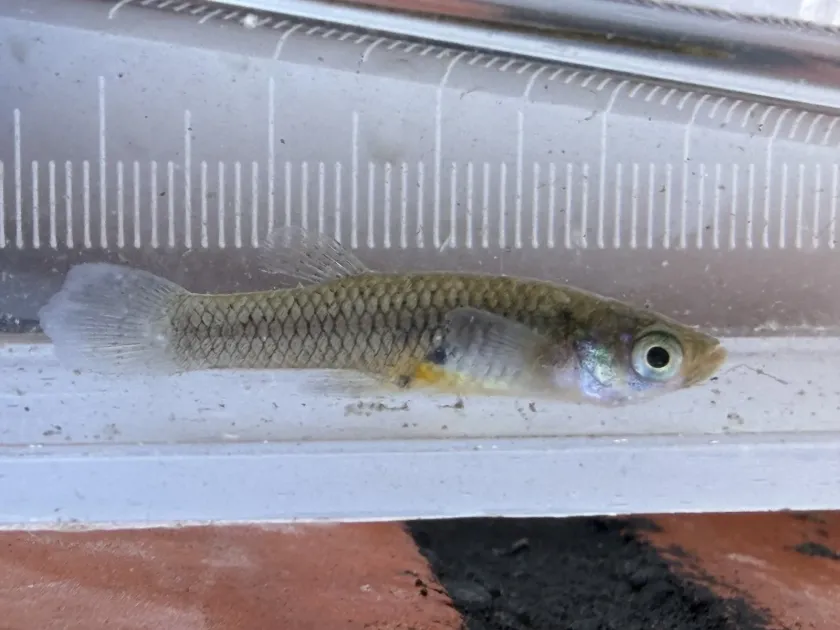
Gambusia, commonly known as mosquitofish, belongs to the family Poeciliidae in the order Cyprinodontiformes. These small freshwater fish are known for their extreme hardiness.
Adult females reach up to 7 cm in length, while males are significantly smaller, usually not exceeding 4 cm. They possess an olive-gray body with a distinct dark spot under the eye.
Males feature a gonopodium, a specialized anal fin used for internal fertilization. This reproductive strategy contributes to their high survival rate and rapid population growth.
They prefer still or slow-moving waters where dense vegetation provides both shelter from predators and abundant feeding grounds for their diverse diet.
Being livebearers, they produce large numbers of offspring, which allows them to colonize new environments faster than most egg-laying fish species.
What it damages
In an agricultural context, Gambusia is often categorized as an invasive species rather than a direct pest to crops, yet it poses a threat to irrigation ecosystems.
They aggressively outcompete native fish species for food and space, often leading to the collapse of local aquatic biodiversity in irrigation ditches and reservoirs.
Gambusia destroys populations of native amphibians by consuming their eggs and tadpoles, which disrupts natural pest control cycles within the surrounding farmland.
By consuming zooplankton, they inadvertently trigger algal blooms, which negatively affect water quality, leading to maintenance issues in irrigation infrastructure.
Their introduction into aquaculture systems often results in decreased productivity due to intense food competition with more valuable fish species.
When it appears
The activity period for Gambusia begins in early spring when water temperatures rise above 10–12 degrees Celsius, triggering reproductive behavior.
Summer provides optimal conditions for rapid metabolic rates and high reproductive success, allowing several generations to flourish throughout the warmer months.
As water temperatures drop in autumn, the fish move towards deeper or more thermally stable areas of the water body to survive the colder season.
During winter, they enter a state of reduced activity, although they can withstand cold temperatures better than many other non-native species.
The species exhibits high environmental resilience, surviving both heat waves and cold snaps, which ensures its persistence across diverse climatic regions.
Signs of infestation
Presence of Gambusia is characterized by large, active schools of small fish visible near the surface in shallow, vegetated areas of water systems.
A notable decrease in the number of tadpoles, dragonfly larvae, and native small fish is a strong indicator of an established Gambusia population.
Increased turbidity or the presence of filamentous algae often signals that the natural balance of the aquatic ecosystem has been disrupted by this invasive species.
Visual identification of the fish during netting shows a uniform population, indicating a successful displacement of other native aquatic organisms.
Their erratic swimming and tendency to congregate in shallow margins near human-made water structures are classic signs of their occupation.
Control measures
Biological control remains the most effective strategy, involving the introduction of native predatory fish that feed on Gambusia fry and juveniles.
Physical exclusion methods, such as fine-mesh screens on irrigation intake pipes, prevent the migration of these fish into sensitive agricultural zones.
Mechanical management, including the regular removal of aquatic weeds, reduces the availability of essential nursery habitats, thereby limiting population density.
Chemical eradication is strictly regulated and generally avoided due to the risks of environmental contamination and harm to non-target species in connected water systems.
- Regular monitoring of water channels for invasive species presence.
- Restoration of natural predator-prey dynamics within irrigation networks.
- Prevention of accidental transfer through shared water infrastructure.
Taxonomy
- Latin name
- Gambusia
- Family
- Poeciliidae
- EPPO code
- GAMBSP
Discussion
No discussions yet — be the first.