
Fucellia maritima
Fucellia maritima
Description
How to identify
Fucellia maritima belongs to the family Anthomyiidae, order Diptera. This small fly resembles a common housefly but is ecologically associated with coastal zones and seaweed deposits along shorelines.
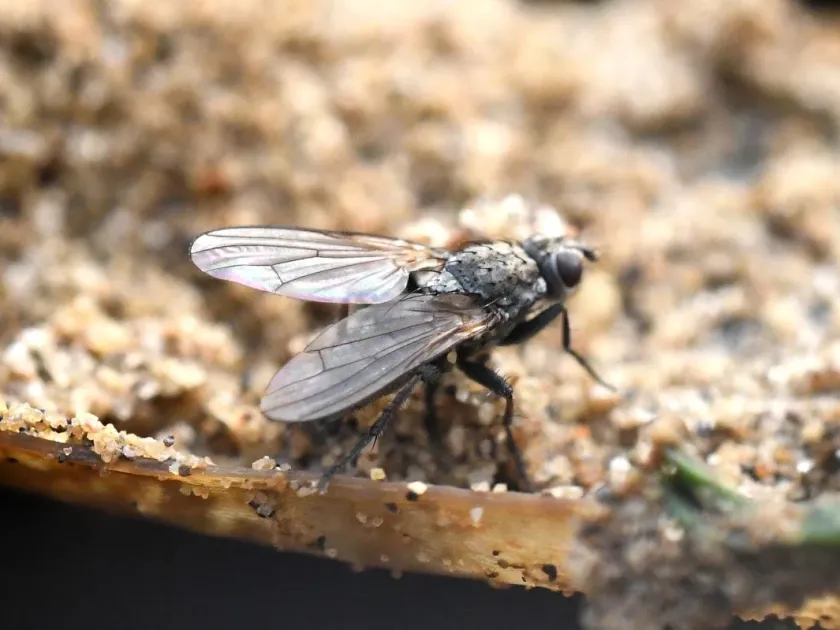
Adult flies are greyish with characteristic body pubescence. The head features well-developed compound eyes, typical for anthomyiid flies. The wings are clear with distinct venation characteristic of the family.
Larvae are typical dipteran maggots, cylindrical in shape, without a distinct head or limbs. The body is creamy white or yellowish, segmented, with visible posterior spiracles used for respiration.
As a halophilic species, its development is closely tied to marine algae deposits. However, under certain conditions, these flies can migrate into adjacent agricultural plots causing crop damage.
The life cycle undergoes complete metamorphosis: egg, three larval stages, puparium, and adult. It primarily overwinters as a puparium in the soil or within decaying vegetation matter.
What it damages
The primary damage is caused by the larval stage, which acts as a saprophage but can shift to feeding on plant tissues. In coastal regions, vegetable crops near the shore are at high risk.
The larvae primarily attack roots and the lower parts of stems in cruciferous and root vegetables. They tunnel into the plant tissues, leading to decomposition and tissue rot.
Crops susceptible to infestation include cabbage varieties, carrots, beets, and radishes. Damage is particularly severe on young seedlings, as they are most sensitive to mechanical disruption.
The damage severity increases with the application of raw organic fertilizer, which attracts females for oviposition. Infested areas become entry points for secondary bacterial or fungal rot infections.
Beyond direct damage, larval presence in the root zone causes growth retardation, leaf yellowing, and frequent plant death due to the destruction of the plant's nutrient uptake system.
When it appears
Adult activity occurs throughout the growing season, starting from late spring until early autumn. The peak flight of the flies correlates with increasing average daily temperatures.
Higher population densities are observed during wet weather, which favors larval survival. Multiple generations of the pest can occur throughout the warm summer months.
Oviposition takes place in the root zone of plants or directly within piles of decomposing organic matter. Optimal conditions include moderate air temperatures and moist soil.
By autumn, larvae migrate deeper into the soil for pupation. During this period, damage to above-ground plant parts decreases as the primary feeding phase has concluded.
Monitoring for this pest should be conducted from May through August, utilizing yellow sticky traps positioned around the perimeter of the field or garden.
Signs of infestation
The first sign of infestation is wilting of the leaves at the base of the rosette, especially during the morning or evening. The plant appears stressed despite adequate soil moisture levels.
When inspecting the root collar, characteristic tunnels or cavities made by the larvae are visible. Affected tissue becomes darkened and mushy, often emitting a distinct odor of decay.
Small larval excrement may be visible on the soil surface surrounding the base of the plant. Inside the tunnels, whitish maggots reaching 6–8 mm in length are often found.
Secondary signs include the appearance of dark lesions on stems that quickly spread upwards. If an infested plant is pulled, the root system is often found to be heavily chewed or destroyed.
- Yellowing and wilting of the lower leaves.
- Softening and rotting of the root collar.
- Presence of maggots in the soil around the roots.
- Stunted growth compared to nearby healthy plants.
Control measures
The primary control measure is maintaining good crop rotation and spatial isolation of gardens from coastal areas with seaweed deposits. Eliminating plant debris from the site is essential.
Deep autumn tillage is an effective agrotechnical practice that destroys pupation sites by exposing them to freezing temperatures during the winter months.
Using row covers or floating horticultural fleece during peak fly flight periods prevents females from laying eggs on crops. This is the most ecologically friendly management approach.
Avoiding the application of raw manure directly near crops is recommended, as it attracts adult flies. Instead, use well-composted, heat-treated organic matter to reduce attractant levels.
If populations reach economic threshold levels, use soil-applied insecticides or root-zone treatments specifically approved for vegetable crops, ensuring compliance with local application regulations.
Taxonomy
- Latin name
- Fucellia maritima
- Order
- Diptera (flies)
- Family
- Muscidae
- EPPO code
- FUCLMA
Discussion
No discussions yet — be the first.