
Fucellia
Fucellia
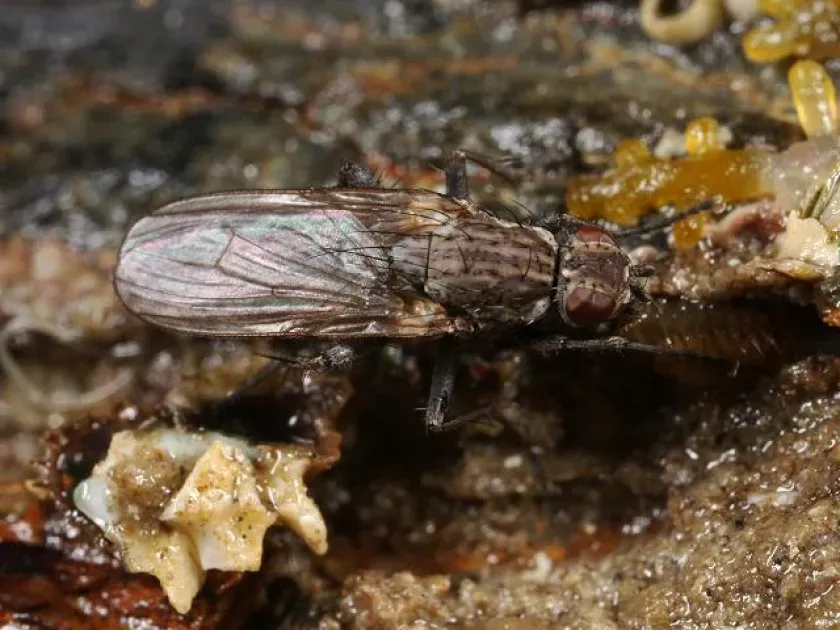
Description
How to identify
Fucellia is a genus of flies belonging to the Anthomyiidae family within the order Diptera. These flies are commonly found in coastal environments where they play a role as scavengers.
Adult flies are typically gray or brown, with bodies covered in coarse bristles, which helps them survive in windy and exposed coastal habitats near water sources.
The most widely recognized species is Fucellia fucorum. Their morphology is highly adapted to walking on damp surfaces and decomposing organic matter where they lay their eggs.
Identifying this pest in an agricultural context requires differentiating them from other common dipterans by their strict habitat preference near decaying seaweed or wet soil.
Their role in nature is primarily that of decomposers, but under specific environmental conditions, they can become problematic for nearby agricultural plantations.
What it damages
The damage caused by Fucellia is generally indirect, occurring when the flies transition from feeding on organic waste to attacking young plant tissues, especially in greenhouses.
Larvae living in the soil may feed on the tender roots or stems of crops, which can cause significant stunted growth or death in young seedlings.
Vegetable crops planted in low-lying, damp areas near coasts or water reservoirs are most susceptible to larval feeding, which can weaken the entire root system.
Feeding injuries often lead to secondary bacterial or fungal infections, resulting in the rotting of stems and roots, which severely compromises the yield.
While often overlooked in large-scale farming, in localized organic or intensive farming, Fucellia can cause notable losses in seedling emergence and plant vigor.
When it appears
The population activity of Fucellia is highly dependent on environmental conditions, specifically temperature and the availability of decaying plant matter at the shore.
Activity usually peaks during late spring and summer months when temperatures are optimal for the rapid development of multiple generations of the fly.
Overwintering occurs in the pupal stage, typically buried in the soil or protected within dense layers of seaweed and plant debris until the following spring.
The life cycle is closely linked to tide cycles and weather patterns that wash up organic matter, providing fresh substrates for the flies to reproduce.
As autumn approaches and temperatures drop, the metabolic rate of the flies decreases, and the population enters a state of diapause for the colder months.
Signs of infestation
The first sign of an infestation is often a noticeable increase in the number of small gray flies hovering near wet soil or piles of decaying organic matter.
Plants affected by the larvae may show signs of yellowing leaves and general wilting, as the root system is unable to provide adequate nutrients and water.
Closer examination of the base of the plant stem often reveals feeding tunnels or necrotic spots caused by larvae, sometimes accompanied by a foul-smelling rot.
- Sudden wilting of young seedlings.
- Presence of small white larvae in the soil around the root crown.
- Development of dark, slimy rot at the base of the plant stem.
Monitoring the soil surface during irrigation cycles can help detect the presence of adults or larvae before they cause widespread damage to the crop.
Control measures
Sanitation is the most effective control measure: removing and composting or burying decomposing organic debris prevents the flies from establishing a breeding ground.
Cultural practices, such as deep tilling after harvesting, help to disrupt the overwintering pupae and reduce the population size for the next growing season.
Using physical barriers like fine-mesh row covers can prevent adult flies from reaching the soil surface to lay eggs, which is highly effective for sensitive crops.
In cases of severe infestation, targeted application of biopesticides or approved insecticides may be necessary to manage the larval stage in the soil.
Regular monitoring with sticky traps helps agronomists track the population density and decide on the most appropriate timing for intervention strategies.
Taxonomy
- Latin name
- Fucellia
- Order
- Diptera (flies)
- Family
- Muscidae
- EPPO code
- FUCLSP
Discussion
No discussions yet — be the first.