
Beech scale
Fagiphagus imbricator
Description
How to identify
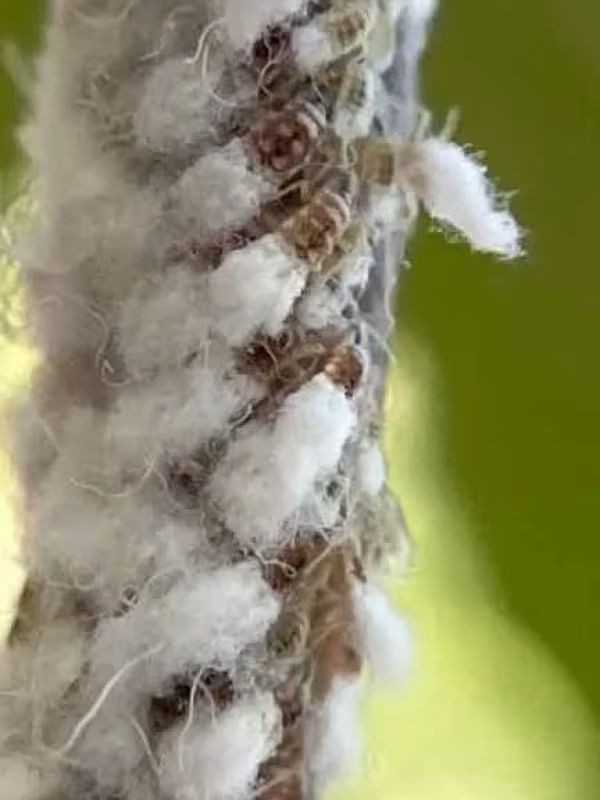
Beech scale (Fagiphagus imbricator) is a small insect belonging to the Cryptococcidae family. Adult females are sessile and covered in dense, white, wax-like filaments that resemble cotton or wool.
These waxy secretions act as a physical shield against environmental stressors and predators. The first-instar nymphs, known as crawlers, are highly mobile, yellowish, and possess legs, allowing them to migrate across the bark to establish new feeding sites.
The species is a specialist feeder, exclusively targeting trees of the genus Fagus. Proper identification usually requires an examination of the microscopic structures hidden beneath the thick waxy coating.
Because the adults lack functional limbs, they remain permanently attached to the bark once they reach maturity. This sedentary nature makes them rely entirely on the sap flow of the host tree for their entire life cycle.
The taxonomic classification of this insect is distinct, though it is frequently confused with other related scale species that may also infest European or American beech trees.
What it damages
The primary host is the European beech (Fagus sylvatica). The pest colonizes the trunks and larger branches where the bark provides sufficient protection and access to nutrient-rich phloem.
By feeding on the tree's sap, the insects cause continuous physiological stress. This depletion of vital nutrients significantly weakens the tree, making it more susceptible to environmental extremes and secondary infestations.
Infested areas often develop cracks and fissures in the bark. These wounds facilitate the entry of pathogenic fungi, which can lead to severe bark necrosis and the formation of deep lesions on the trunk.
Over several years, heavy infestations disrupt the hydraulic integrity of the tree. This often leads to crown dieback, thinning foliage, and eventually the death of entire branches or the entire tree.
Economic damage involves the degradation of timber quality and the loss of ornamental value in landscaping. The presence of the pest reduces the tree's overall growth rate and long-term viability.
When it appears
The life cycle of the beech scale is heavily influenced by seasonal temperature changes. Most individuals overwinter as second-instar nymphs, tucked away in the deep crevasses of the tree bark.
Activity resumes in early spring when temperatures consistently remain above the development threshold. The nymphs begin feeding and developing into adult females as the weather warms.
The crawler stage, which occurs in early to mid-summer, is the critical window for spread. During this phase, the insects actively crawl over the bark, often being carried by wind to neighboring trees.
Autumn triggers a slowdown in biological processes. The insects prepare for the dormant period, thickening their protective waxy layers to withstand winter temperatures.
Environmental factors, particularly mild winters and cool, humid springs, favor the survival of the population, whereas extreme cold or excessive drought can regulate the scale numbers.
Signs of infestation
The most prominent sign of infestation is the appearance of white, cotton-like patches on the bark. These patches are clusters of insects and their heavy waxy secretions.
Closer inspection reveals the presence of scale insects directly attached to the bark surface. If the wax is rubbed away, one can see the small, sessile bodies of the females.
Affected trees may display premature leaf yellowing or stunted leaf growth. This is a direct consequence of the vascular damage caused by the insects feeding on the tree's internal fluids.
The presence of sooty mold—a black, powdery fungus growing on the sticky honeydew excreted by the scale—is a strong indicator that a significant colony is present on the trunk.
Severe infestation symptoms include bark splitting, localized tissue necrosis, and a general thinning of the canopy, which signals that the tree is in advanced stages of stress.
Control measures
Control is challenging due to the protective wax covering that makes the insects resistant to many standard topical insecticides. Systemic treatments are usually more effective.
Application of systemic insecticides that are taken up by the tree's vascular system ensures that the pest consumes the toxin while feeding. This provides a more thorough control than contact sprays.
Dormant oil applications in early spring can be highly effective. The oil coats the bark and smothers the overwintering nymphs, significantly reducing the population before the growing season starts.
Sanitation is crucial; removing and properly disposing of heavily infested branches or severely damaged trees can prevent the spread of crawlers to healthy parts of the stand.
Maintaining tree vigor through proper watering and soil management is the best long-term preventive measure, as healthy trees possess better natural defense mechanisms against scale attacks.
Taxonomy
- Latin name
- Fagiphagus imbricator
- Order
- Hemiptera (bugs, aphids, leafhoppers)
- Family
- Aphididae
- EPPO code
- PARPIM
Discussion
No discussions yet — be the first.