
American grass leafhopper
Exitianus exitiosus
Description
How to identify
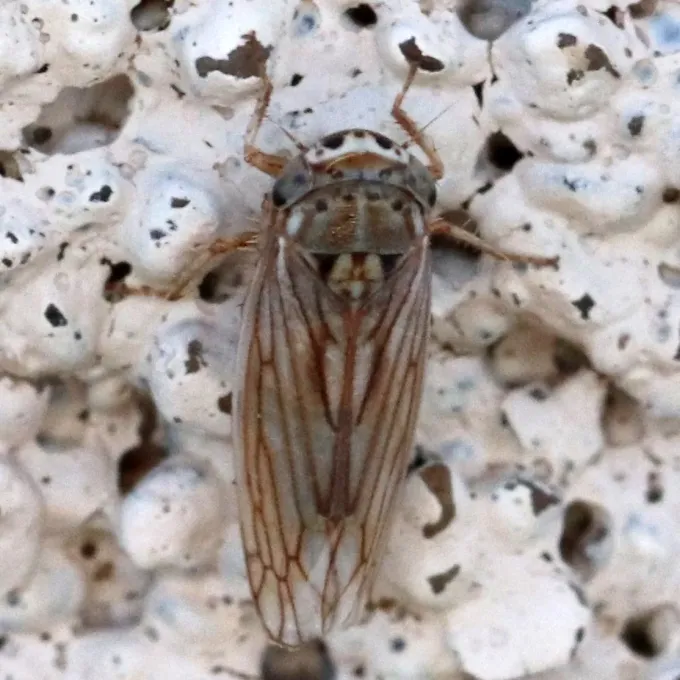
The American grass leafhopper (Exitianus exitiosus) is a member of the order Hemiptera and the family Cicadellidae. Adult insects typically measure 4–5 mm in length and feature a slender body with brownish-yellow to brown coloration, often marked with dark patterns on the head.
They possess specialized hind legs adapted for jumping, which is a characteristic trait of most leafhopper species. Their wings are transparent with prominent venation, held tightly over the abdomen when at rest, creating a streamlined appearance.
Nymphs resemble smaller, wingless versions of the adults. Throughout their development, they progress through several instars, gradually increasing in size and developing distinct wing pads until they reach maturity.
Accurate field identification is challenging due to their small size, high mobility, and morphological similarity to other related leafhopper species. Reliable species confirmation usually requires microscopic examination of male genitalia.
These pests are cryptic in nature, preferring the underside of leaves or the dense lower canopy of host plants, which makes them difficult to detect during standard scouting procedures.
What it damages
The primary host range includes cereal crops such as wheat, barley, oats, and corn, alongside various wild grasses. These wild hosts often act as primary reservoirs for both the insects and the pathogens they carry.
Feeding is achieved through piercing-sucking mouthparts that penetrate the plant tissue to extract sap. This depletion of nutrients causes stress, growth retardation, and overall decline in plant vigor.
The most severe impact arises from their role as vectors for plant viruses and phytoplasmas. By injecting contaminated saliva into the vascular tissues, the leafhopper spreads diseases that can cause significant yield loss even when insect density is low.
Infested plants often display symptoms such as chlorosis, stunted growth, and distorted foliage. In severe cases, particularly with young plants, the damage can lead to premature death or a complete failure to produce a harvestable head.
The economic harm is compounded by the rapid spread of viral infections across the field, making the leafhopper one of the most critical threats to grain production in certain temperate regions.
When it appears
The American grass leafhopper completes several generations within a single growing season. Overwintering typically occurs as late-stage nymphs or adults in protected environments, such as perennial grass fields or accumulated leaf litter.
Emergence in the spring is triggered by the rise in ambient temperatures. Once active, the insects migrate to early-season cereal crops, establishing initial populations that multiply rapidly as conditions improve.
Adult flight periods span through the summer, with population peaks frequently coinciding with the vegetative stages of cereal development. Warm and humid conditions are optimal for both survival and rapid reproduction.
During mid-summer, a secondary migration often occurs as populations shift towards corn and other late-planted crops. This period represents the highest risk window for the transmission of secondary plant diseases.
As autumn approaches and major crops are harvested, the insects relocate to volunteer grains, weeds, and field margins to prepare for their winter dormancy, ensuring the cycle continues into the next year.
Signs of infestation
Initial signs of an infestation often include the appearance of localized yellowing or white stippling on leaf surfaces, caused by the localized destruction of chlorophyll during feeding.
Plants affected by leafhopper-transmitted viruses frequently exhibit deformation, such as leaf curling or severe stunting of internodes, which gives the crop an irregular, patchy appearance in the field.
The presence of the insect can be confirmed by disturbing the vegetation; adults will react by jumping or taking short, rapid flights. The use of yellow sticky traps is a standard and highly effective monitoring tool.
Viral infection patterns, such as yellow dwarf symptoms or mosaic patterns, spreading outward from field edges or specific hotspots, are clear indicators of vector activity like that of the American grass leafhopper.
Sticky secretions, known as honeydew, may be found on the undersides of leaves or on the soil surface, providing a substrate for the growth of sooty mold, which further interferes with the plant’s photosynthetic capacity.
Control measures
Managing the American grass leafhopper requires an integrated pest management (IPM) approach. The most effective preventative measure is the rigorous control of weeds in and around fields to eliminate alternative food sources.
Strategic crop rotation and ensuring sufficient spatial separation between cereal fields and permanent pastures or forage crops can significantly reduce immigration rates.
Chemical control involving systemic insecticides is often necessary during peak population surges. Treatment timing is critical, with early-season applications offering the best protection for young plants against viral transmission.
Developing and utilizing resistant or tolerant crop varieties remains a key long-term goal to reduce reliance on insecticide applications while maintaining high production yields.
- Implement regular field scouting using yellow sticky traps.
- Ensure the prompt destruction of crop residues after harvest.
- Use systemic seed treatments to protect seedlings during the early stages.
- Balance nitrogen fertilization to avoid excessive succulent growth that attracts leafhoppers.
Taxonomy
- Latin name
- Exitianus exitiosus
- Order
- Hemiptera (bugs, aphids, leafhoppers)
- Family
- Cicadellidae
- EPPO code
- EXITEX
Discussion
No discussions yet — be the first.