
American elm aphid
Eriosoma americanum
Description
How to identify
The American elm aphid (Eriosoma americanum) is a specialized insect species within the family Aphididae. It is primarily recognized as a pest that affects elm trees in North America and other regions.
The insect possesses a complex life cycle, migrating between its primary host, the American elm, and secondary hosts like the serviceberry (Amelanchier). This host alternation is a key biological characteristic of the species.
Adult aphids produce a distinctive white waxy secretion that covers their bodies, giving them a cottony or woolly appearance. This substance serves as a defense mechanism against environmental stressors.
Systematically, it is a member of the order Hemiptera. These insects are classified as sap-sucking pests, which rely on the vascular tissues of their host plants for nutrition.
The identification is usually confirmed by the presence of characteristic leaf structures that the aphids induce on the host plant during their feeding stage.
What it damages
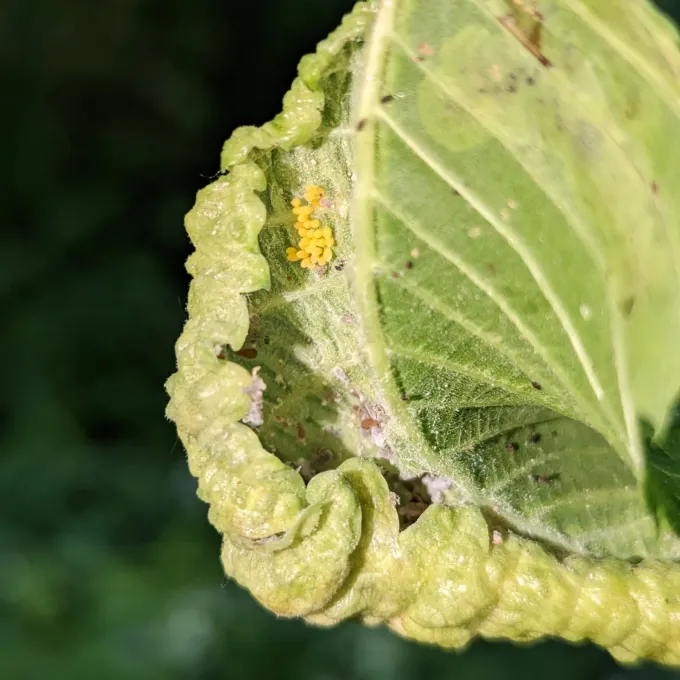
The primary damage is inflicted upon the American elm (Ulmus americana). Aphids feed on the sap of young leaves, causing them to curl lengthwise, creating a structure known as a gall.
By shifting to secondary hosts during the summer, the aphids can impact the roots of various plants, causing stress to the plant's vascular system and nutrient uptake efficiency.
Severe infestations on elm trees cause premature yellowing of the leaves, resulting in early leaf drop, which diminishes the aesthetic appeal and photosynthetic capacity of the tree.
In nursery settings, persistent aphid activity can significantly retard the growth of young saplings, leading to economic losses and structural weaknesses in the trees.
Repeated damage over several seasons may leave the trees more susceptible to secondary pests and various pathogens, undermining the overall health of the forest or garden.
Signs of infestation
The most prominent sign of an infestation is the longitudinal curling of leaves on the elm, which forms dense, elongated galls that turn brown or yellowish over time.
Inside these curled leaves, one can find clusters of aphids covered in white, woolly, waxy material, which is a hallmark of the Eriosoma genus.
The presence of honeydew on the leaves and branches is a significant indicator. This sticky residue often attracts ants and promotes the growth of black sooty mold.
Active ant trails leading up the trunk and branches of the elm tree are often a secondary signal, as the ants protect the aphid colonies for the sake of the honeydew.
Visual inspection of the underside of the leaves in late spring and early summer will reveal the colonies, which often appear as fuzzy white patches.
Control measures
Systemic insecticides are the most effective chemical control method. They should be applied early in the season before the leaves have fully curled, ensuring the chemical reaches the target.
Sanitation is a vital cultural practice. Pruning and destroying the curled leaf galls during the early stage of the infestation can significantly reduce the local aphid population.
Promoting a healthy garden ecosystem by encouraging natural predators like lady beetles, lacewings, and syrphid fly larvae can keep the aphid numbers below economic damage thresholds.
Monitor nearby serviceberry trees to interrupt the life cycle, as removing or treating these secondary hosts can prevent the aphids from returning to the elms the following season.
- Inspect elm foliage early in the spring.
- Apply systemic insecticides during the bud-break phase.
- Manually remove and destroy infested leaf galls.
- Maintain tree vigor through proper fertilization.
Taxonomy
- Latin name
- Eriosoma americanum
- Order
- Hemiptera (bugs, aphids, leafhoppers)
- Family
- Aphididae
- EPPO code
- ERISAM
Discussion
No discussions yet — be the first.