
Woolly apple aphid
Eriosoma
Description
How to identify
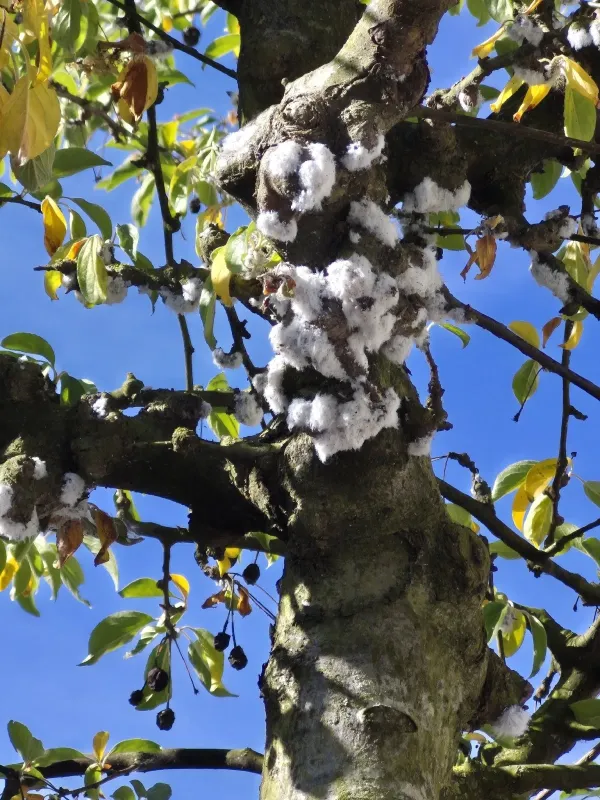
The woolly apple aphid (Eriosoma lanigerum) belongs to the order Hemiptera and the family Aphididae. It is characterized by the presence of a white, waxy, wool-like secretion covering its body.
The common name "woolly" refers to this waxy coating, while the scientific name reflects the species' ability to form colonies on apple trees.
When these insects are crushed, they exude a red fluid, which is a distinctive diagnostic feature identifying them from other aphid species.
They overwinter as nymphs in cracks in the bark, at pruning sites, or on the roots of host trees. In warmer regions, they do not require an alternative host to complete their life cycle.
The reproductive potential is immense, with a single female capable of producing numerous offspring, leading to rapid population growth during the summer.
What it damages
The primary host for this pest is the apple tree. It can occasionally be found on pear, mountain ash, and hawthorn, causing similar types of damage.
By feeding on the phloem sap of young shoots, branches, and roots, the aphids inject toxins that cause the plant tissues to swell and form galls.
These galls eventually crack and split, creating entry points for fungal pathogens such as Nectria canker, which can be even more destructive than the aphids themselves.
Severe infestations weaken the tree significantly, leading to reduced vigor, stunted growth, and a substantial decrease in fruit yield and quality.
Root infestations are particularly insidious, as they cause overall tree decline and, in some cases, can lead to the death of young, vulnerable trees.
When it appears
Activity begins in early spring as temperatures rise, typically coinciding with the start of sap flow in the apple trees.
Population density peaks during the mid-summer months of June and July, when conditions for rapid reproduction are optimal.
As autumn approaches and temperatures drop, the aphids move into protected areas on the tree to overwinter until the next season.
Multiple generations occur throughout the growing season, which necessitates consistent monitoring and timely management interventions.
Effective management requires checking the orchard regularly from the tight cluster stage until harvest, paying close attention to pruning wounds.
Signs of infestation
The most visible sign of an infestation is the presence of white, cotton-like masses clustered on branches, shoots, and around pruning scars.
Close inspection revealing red fluid upon physical disturbance of the cottony mass is a definitive indicator of Eriosoma lanigerum.
The development of abnormal, tumor-like swellings (galls) on the bark is a sign of long-term colonization by the pest.
- Stunted or deformed growth of new shoots.
- Premature yellowing and shedding of leaves.
- Visible cracks and lesions on the tree bark near colonies.
In cases of root infestation, the tree may show signs of general stress, nutrient deficiency symptoms, and reduced overall canopy density.
Control measures
Good orchard sanitation, including the removal of infested shoots and cleaning of rough bark, helps to reduce the overwintering population.
Avoid excessive use of nitrogen fertilizers, as they stimulate succulent growth that is highly attractive to aphids.
Biological control using the parasitoid wasp Aphelinus mali is highly effective and remains a cornerstone of integrated pest management in apple orchards.
Chemical control involving systemic insecticides is often necessary when populations reach thresholds that threaten the health of the tree.
When applying pesticides, thorough coverage is essential to penetrate the waxy protective layer of the aphids and ensure effective contact.
Taxonomy
- Latin name
- Eriosoma
- Order
- Hemiptera (bugs, aphids, leafhoppers)
- Family
- Aphididae
- EPPO code
- ERISSP
Discussion
No discussions yet — be the first.