
Blueberry aphid
Ericaphis scammelli
Description
How to identify
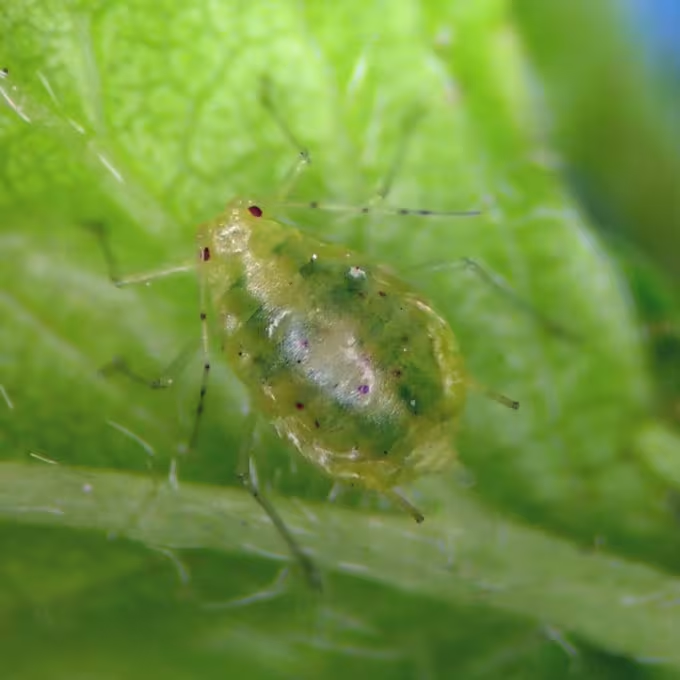
The blueberry aphid (Ericaphis scammelli) is a small insect belonging to the order Hemiptera and the family Aphididae.
Adult aphids are typically yellowish-green in color, providing excellent camouflage against the foliage of host plants.
This species is highly specific to the Vaccinium genus, making blueberries its primary host.
The life cycle involves multiple generations per season, with wingless forms dominating during periods of high colony stability.
When colonies become overcrowded, winged adults develop to facilitate migration to adjacent bushes, ensuring the spread of the population.
What it damages
The primary damage is caused to highbush blueberry and wild blueberry plants due to continuous sap extraction.
By piercing the leaf tissues, aphids remove vital plant nutrients, which can lead to stunted growth and reduced vigor.
In addition to direct feeding, the blueberry aphid is a documented vector for plant viruses, including blueberry necrotic ring blotch virus.
Heavy feeding causes leaves to curl and become misshapen, negatively impacting the plant's ability to perform photosynthesis effectively.
The accumulation of honeydew can lead to secondary problems, such as the growth of sooty mold, which further degrades plant health.
When it appears
Activity begins in the early spring as the plant breaks dormancy and new buds start to open.
Populations tend to peak during the late spring and early summer when environmental conditions are optimal for rapid reproduction.
The aphid remains active throughout the growing season, with multiple generations overlapping as the summer progresses.
As autumn approaches, the aphids produce overwintering eggs, which are typically laid in the crevices of the bark or near bud scales.
Monitoring should be most intensive from bud break until the fruit reaches the stage of maturity to ensure early detection.
Signs of infestation
The most visible symptom of an infestation is the curling and distortion of the youngest terminal leaves.
Observation of sticky honeydew residues on the surface of the leaves is a strong indicator of an active aphid colony.
- Dark sooty mold development appearing on leaves coated in aphid honeydew.
- Increased presence of ants patrolling the branches, as they tend to aphids for food.
- Visible yellowing of foliage and poor development of new shoots.
Inspecting the undersides of the leaves provides the most accurate assessment of the infestation levels in the orchard.
Control measures
Cultural control practices, such as removing heavily infested shoots and proper orchard sanitation, help reduce the overall population.
Encouraging natural predators, such as lady beetles, lacewings, and syrphid flies, is a critical component of integrated pest management.
When thresholds are exceeded, targeted chemical control using systemic or contact insecticides may be necessary.
It is vital to rotate different chemical classes to prevent the development of resistance in aphid populations over time.
Applications must be thorough, ensuring that the spray covers the underside of the leaves to reach the colonies directly.
Taxonomy
- Latin name
- Ericaphis scammelli
- Order
- Hemiptera (bugs, aphids, leafhoppers)
- Family
- Aphididae
- EPPO code
- ERIHSC
Discussion
No discussions yet — be the first.