

Orchard spider mite
Eotetranychus pruni
Description
How to identify
The Orchard spider mite (Eotetranychus pruni) is a member of the Tetranychidae family. It is a tiny arthropod, typically measuring less than 0.5 mm in length.
These mites are generally greenish-yellow or light amber in color, though overwintering females may appear reddish-orange, making them cryptic against bark.
The life cycle progresses through the egg, larva, protonymph, deutonymph, and adult stages. The speed of development is heavily dictated by ambient temperature.
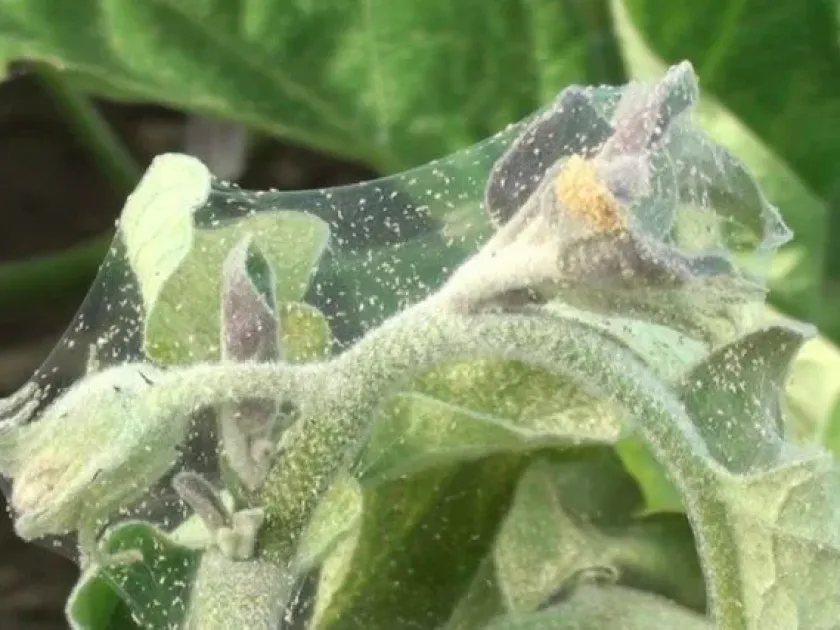
They are primarily known for their ability to colonize the underside of leaves, where they build delicate silken webs to protect themselves and their eggs.
Microscopic examination or the use of a high-magnification hand lens is often necessary to distinguish this species from other spider mite variants found in the orchard.
What it damages
As the name suggests, Eotetranychus pruni is primarily a pest of stone fruits, particularly plums, though it affects a wide range of Rosaceae species.
Significant infestations can occur on cherries, peaches, apricots, and sometimes apple trees, depending on the ecosystem and proximity to primary hosts.
The mites feed by piercing leaf cells with their mouthparts and extracting cellular contents, which directly destroys chlorophyll and impairs photosynthesis.
Damage symptoms begin with mottled leaves, progressing to bronzing and eventual necrosis. Severely infested trees may suffer from premature defoliation.
This physiological stress reduces the tree's vigor, lowers fruit yield, and negatively affects the quality and size of the harvest.
When it appears
The mites overwinter as fertilized, inactive females tucked away in bark crevices or protected spots beneath the tree canopy.
Activity resumes in early spring as temperatures rise. The mites migrate from their overwintering sites to the developing buds and young leaves.
Throughout the growing season, multiple generations overlap, with peak activity occurring during the hottest and driest summer months.
Wind dispersal is a primary method for the mites to spread between trees, as they can travel on silken threads across the orchard.
As autumn approaches and photoperiod decreases, the population begins to decline as females move to sheltered areas to enter diapause for the winter.
Signs of infestation
Visual identification starts with the appearance of tiny chlorotic stippling on the upper surface of the leaves, resembling faint white or yellow pinpricks.
Upon closer inspection, the undersides of the leaves show fine webbing, often containing a mixture of mites, eggs, and cast skins.
Over time, the foliage turns a dull bronzed or grayish color, losing its natural luster and becoming brittle to the touch.
A simple field test involves tapping a branch over a white sheet of paper; the presence of small, moving "dots" indicates an active mite population.
Tree-level symptoms include reduced canopy density and stunted shoot growth, which become increasingly apparent as the summer progresses.
Control measures
Effective management requires an integrated pest management (IPM) strategy that prioritizes non-chemical methods alongside targeted treatments.
- Maintain tree health through proper irrigation and nutrition to help trees withstand mite feeding pressure.
- Encourage natural predators such as predatory mites, lacewings, and ladybirds, which can significantly control populations.
- Use dormant oil sprays in late winter to suffocate overwintering females hiding in bark crevices.
- Apply selective acaricides when monitoring threshold levels are exceeded, ensuring proper coverage of the leaf undersides.
- Practice good sanitation by removing and composting fallen leaves, which may harbor eggs and dormant mites.
Content graph
Connections · Orchard spider mite
Most often together:
Marketplace
Products · 2

Biology
Taxonomy
- Latin name
- Eotetranychus pruni
- Order
- Mites
- Family
- Tetranychidae
- EPPO code
- EOTEPR
Community
Discussion
No discussions yet — be the first.