
Apple leafhopper
Empoasca maligna
Description
How to identify
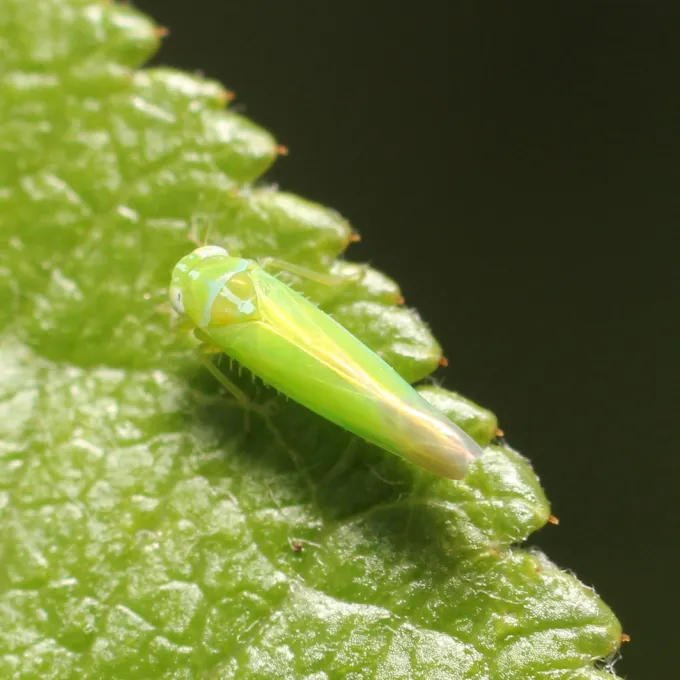
The apple leafhopper (Empoasca maligna) is a small insect belonging to the family Cicadellidae within the order Hemiptera. Adult insects measure approximately 3 to 4 mm in length and exhibit a distinct pale green or yellowish-green coloration.
These insects are highly agile, characterized by their ability to jump and fly quickly when disturbed. This makes monitoring and visual inspection in orchard settings quite challenging for orchardists.
Nymphs resemble smaller, wingless versions of the adults. They progress through several developmental stages (instars) before reaching maturity, gradually growing in size and developing wing pads.
Eggs are typically deposited by females beneath the bark of young shoots. This cryptic placement provides essential protection against environmental stressors and potential predators during the winter months.
In professional settings, entomologists identify this species by examining their morphology and observing their rapid, sideways movement on leaf surfaces when approached.
What it damages
While the primary host is the apple tree, this pest also targets other Rosaceae family members. Young orchards and nursery saplings are particularly susceptible to infestation and subsequent growth stagnation.
The insects feed by piercing leaf tissues and extracting cellular sap. This feeding activity disrupts the plant's photosynthetic process and leads to a loss of cell turgor pressure in the foliage.
Heavy infestations result in leaf yellowing, stippling, and premature abscission. This defoliation weakens the tree's overall vigor, negatively impacting its winter hardiness and future fruiting potential.
In addition to direct physiological damage, leafhoppers can act as vectors for various plant pathogens. These infections often cause leaf curling or systemic diseases that can prove difficult to manage.
Fruit development is often compromised on infested trees, leading to smaller fruit sizes and lower market quality. Severe, repeated infestations over several years can permanently stunt tree development.
When it appears
The lifecycle of the apple leafhopper typically includes one or two generations per year, depending on the regional climate. They primarily overwinter in the egg stage, embedded within twigs.
In spring, as buds begin to burst, the nymphs emerge and begin feeding on the undersides of young leaves. This marks the onset of the primary infestation period for the growing season.
Adult insects reach peak activity during the summer months. This is when the population density is usually highest, and visible damage to the orchard's canopy becomes more pronounced.
Towards the end of the summer, adults mate and females deposit eggs into shoots to survive the winter. Temperature fluctuations significantly influence the speed of these developmental phases.
Agricultural managers conduct regular monitoring throughout the season to determine the appropriate timing for intervention, ensuring that treatments are applied when nymphs are most vulnerable.
Signs of infestation
The initial signs of infestation include the appearance of tiny, light-colored stippling marks on the upper leaf surface, which correspond to feeding punctures made by the insect.
As feeding continues, these spots merge, creating a characteristic marbled or mottled appearance on the leaves. The foliage loses its natural color, and leaf margins may begin to curl inward.
Looking at the underside of the leaves reveals the presence of nymphs and their translucent white cast skins (exuviae). These nymphs exhibit rapid, crab-like sideways movement.
A significant indicator of high infestation levels is a visible cloud of flying insects erupting from the canopy when branches are shaken. This requires immediate management attention.
Persistent damage often manifests as a lack of new shoot growth and the potential for terminal bud necrosis. Careful autumnal inspection is recommended to assess the overall health of the tree's wood.
Control measures
Integrated pest management (IPM) for the apple leafhopper begins with cultural practices, such as maintaining weed-free orchard floors to eliminate alternative host plants.
Sanitary pruning, which involves removing and destroying twigs containing egg-laying sites, serves as a highly effective preventive measure to reduce the next generation's population.
The use of biological control agents, such as predatory bugs and lacewings, can help maintain population densities below the economic injury level without the need for synthetic pesticides.
Chemical control is applied when monitoring shows that the nymph population exceeds thresholds. Systemic insecticides are typically most effective when applied during the early stages of nymph development.
- Monitoring populations using yellow sticky traps.
- Applying insecticides specifically targeted at nymph stages.
- Promoting natural predator habitats within the orchard.
- Executing thorough winter pruning of infested wood.
- Ensuring proper tree nutrition to improve stress tolerance.
Taxonomy
- Latin name
- Empoasca maligna
- Order
- Hemiptera (bugs, aphids, leafhoppers)
- Family
- Cicadellidae
- EPPO code
- EMPOMA
Discussion
No discussions yet — be the first.