
Empoasca distinguenda
Empoasca distinguenda
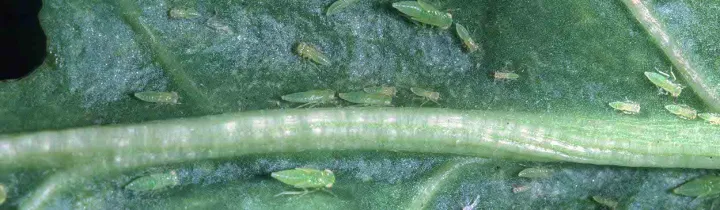
Description
How to identify
Empoasca distinguenda is a small insect belonging to the order Hemiptera and the family Cicadellidae (leafhoppers). Adults are characterized by their bright green coloration, which provides excellent camouflage on the undersides of leaves.
The adult body is slender and elongated, measuring approximately 3–4 mm in length. The head is smoothly rounded, and the eyes are well-developed. The wings are transparent with a faint greenish hue, pressed tightly against the body when at rest.
Nymphs resemble adults but are significantly smaller and lack developed wings. They are highly mobile and exhibit quick lateral movement across the leaf surface when disturbed.
A distinctive feature of this species is the high jumping ability of both adults and nymphs, which makes visual inspection and mechanical collection challenging in field conditions.
The eggs are tiny and elongated, typically inserted by females directly into the plant tissue—within leaf veins or petioles—making them difficult to reach with many contact-based pesticides.
What it damages
This pest is a polyphage and causes damage to a wide range of agricultural crops. Vegetables from the Solanaceae and Fabaceae families, as well as various fruit crops, are particularly susceptible.
Host crops include potatoes, tomatoes, cucumbers, beans, and various ornamental plants and grapevines. The pest can also survive on weeds during periods when primary crops are not present.
The primary damage is caused by both adults and nymphs feeding on plant sap, which disrupts physiological processes and weakens the plant's overall immunity.
In addition to direct mechanical damage, leafhoppers are known vectors of phytopathogenic viruses and mycoplasmas, which trigger dangerous diseases such as stolbur or leaf curl.
Mass reproduction of this pest in large fields can lead to significant yield losses and poor quality of harvested produce, causing direct economic damage to agricultural enterprises.
When it appears
Empoasca distinguenda is most active during the warm season. Its life cycle is closely linked to temperature; higher temperatures significantly accelerate the development of all life stages.
Adults typically overwinter in plant debris, under fallen leaves, or in the upper soil layer. In spring, with the onset of sustained warmth, they emerge from diapause.
Population density peaks in the second half of summer when weather conditions are optimal for feeding and reproduction. The species can produce multiple generations within a single season.
The first individuals usually appear in late May or early June. Generations often overlap, meaning one can find nymphs of different ages alongside adults in the field simultaneously.
In autumn, as temperatures drop and day length decreases, insects migrate to hibernation sites; however, if the autumn remains warm, the pest may continue to cause damage late into the season.
Signs of infestation
The primary sign of a leafhopper infestation is the appearance of light spots («mottling») on the leaf surfaces, which results from sap-sucking, causing cells to lose chlorophyll.
Under heavy infestation, leaf edges begin to curl, turn yellow, and eventually brown and dry out. The plant's growth slows down, and photosynthetic activity decreases.
Exuviae (shed skins) of nymphs, which look like small translucent scales, can be found on the undersides of leaves, serving as a reliable indicator of an active pest colony.
When inspecting crops, it is important to watch for plant reactions: when a plant is shaken, adults will jump away suddenly, confirming the presence of a colony.
If the plants are infected with viruses carried by the leafhopper, signs of specific deformation appear, such as curled tips, vein yellowing, or stunting.
Control measures
Controlling Empoasca distinguenda requires a comprehensive approach integrating agronomic, biological, and chemical methods to effectively mitigate pest populations.
- Systematic removal of weeds from fields and borders, as they serve as reservoirs for both the pest and transmitted infections.
- Timely deep autumn plowing to destroy overwintering habitats.
- Utilizing resistant crop varieties and hybrids that recover more effectively from damage.
Chemical control using systemic insecticides is the most effective approach when economic damage thresholds are exceeded. Products from the neonicotinoid, pyrethroid, or organophosphate groups are commonly used.
It is crucial to rotate insecticides with different active ingredients to prevent the development of resistant leafhopper populations, a common issue with prolonged use of a single pesticide.
Biological methods, such as the application of entomophages or biopesticides based on fungal pathogens, can be highly effective in greenhouse environments or under low-level field infestations.
Taxonomy
- Latin name
- Empoasca distinguenda
- Order
- Hemiptera (bugs, aphids, leafhoppers)
- Family
- Cicadellidae
- EPPO code
- EMPODI
Discussion
No discussions yet — be the first.