
Reticulated cobweb spider
Emblyna reticulata
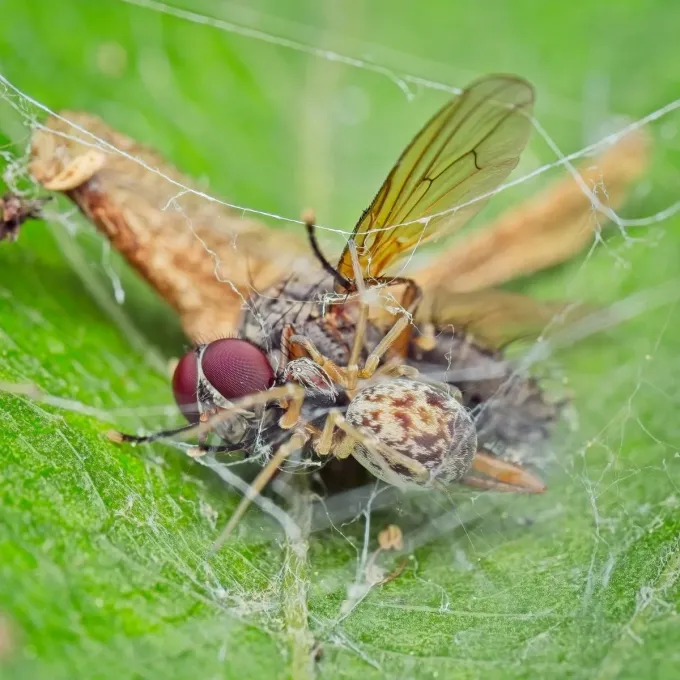
Description
How to identify
The reticulated cobweb spider (Emblyna reticulata) is a member of the Dictynidae family, within the order Araneae. These are small spiders that inhabit dense plant canopies and foliage.
They are best identified by their unique, dense, and often fuzzy web structures that cover the surfaces of leaves and stems in a lattice-like pattern.
Due to their minute size, they are frequently overlooked by growers, often being confused with spider mites until significant webbing is present.
The specific epithet 'reticulata' refers to the intricate, net-like pattern found on the abdomen, which is a key diagnostic feature for arachnologists.
They prefer sheltered, humid environments, using these conditions to maintain the structure and stickiness of their webs for capturing prey.
What it damages
While often considered beneficial in natural ecosystems, Emblyna reticulata can become a nuisance in agricultural settings, particularly in greenhouse cultivation.
The spiders damage crops by webbing over young, tender growth, which inhibits light penetration and interferes with the normal respiration of the plant.
Heavy webbing on leaf surfaces physically disrupts photosynthesis, leading to reduced vigor and stunted growth in affected vegetable and ornamental plants.
Furthermore, the dense webs trap moisture and dust, creating a micro-environment that is highly conducive to the development of fungal infections.
In cases of severe infestation, the cosmetic damage to ornamental plants can render them unsellable, posing a direct economic threat to commercial nurseries.
When it appears
The activity of Emblyna reticulata is highly dependent on ambient temperatures and humidity levels within the growing environment.
Populations typically begin to emerge and increase during the spring, reaching peak density during the warm, humid months of mid-summer.
The life cycle progresses through eggs, nymphs, and adults, with reproduction accelerating significantly in controlled, protected environments like greenhouses.
As the weather cools in autumn, the spiders seek out protected areas such as bark crevices, soil debris, or plant stalks to enter a state of diapause.
The absence of natural predators in intensive agricultural systems can lead to rapid population spikes, necessitating careful monitoring throughout the growing season.
Signs of infestation
The most evident sign of infestation is the appearance of thick, irregular webs that stretch across leaf tips and between nodes.
Infested plants may exhibit signs of mechanical stress, such as leaf yellowing or minor curling, caused by the continuous tension of the web against the tissue.
Tiny egg sacs hidden within the webbing or curled leaf edges serve as a primary indicator of an established, reproducing population.
The accumulation of environmental debris and dust particles within the webs often makes the infestation appear much more extensive than it actually is.
Slowed growth and a lack of vegetative vigor, despite optimal irrigation and fertilization, often suggest that a spider infestation is suppressing the plant's health.
Control measures
Effective management requires an integrated approach that focuses on altering the microclimate to be less favorable for spider habitation.
Improving air circulation through adequate pruning and increased greenhouse ventilation is the most effective cultural control method available.
In cases of localized infestations, mechanical removal and disposal of web-covered plant parts can prevent further spread across the crop.
For chemical control, specialized acaricides are required, as general insecticides are frequently ineffective against this particular species of spider.
- Introduction of biological control agents, such as predatory mites (e.g., Phytoseiulus persimilis).
- Sanitization of growing areas by removing weeds and plant debris during off-seasons.
- Regular scouting for web development using hand lenses for early detection.
Taxonomy
- Latin name
- Emblyna reticulata
- Family
- Dictynidae
- EPPO code
- DICNRE
Discussion
No discussions yet — be the first.