
Emblyna
Emblyna
Description
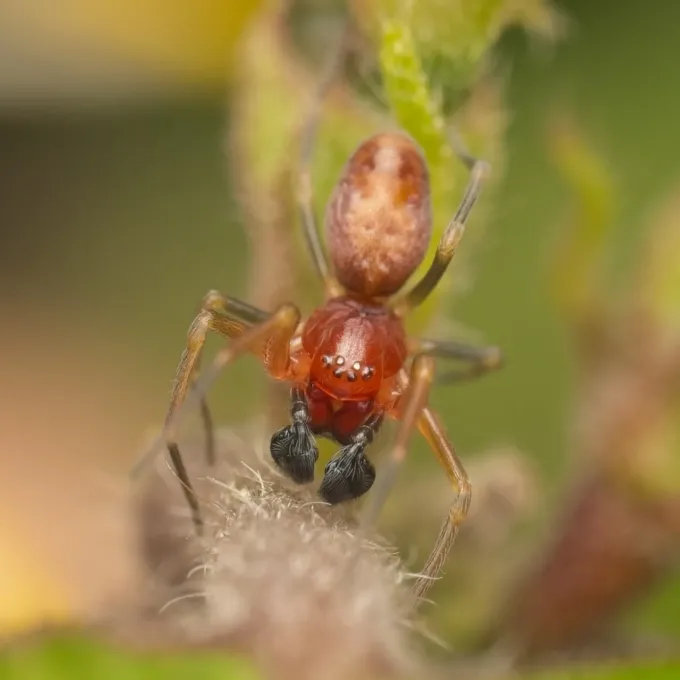
How to identify
Emblyna is a genus of spiders belonging to the family Dictynidae, commonly found across various habitats including agricultural fields.
These spiders are characterized by their small size and specific web-spinning behavior, which allows them to create tangled retreats on foliage.
Identification to the species level is complex and usually requires an examination of the genitalia under a high-magnification microscope.
They exhibit cryptic coloration, which typically includes shades of brown and gray, allowing them to remain camouflaged against plant stems.
Emblyna spiders are common inhabitants of many crops, often overlooked by farmers due to their small size and inconspicuous nature.
What it damages
It is important to emphasize that Emblyna spiders are not plant pests and do not feed on crops or cause damage to plant tissues.
They function as generalist predators, playing a valuable role in keeping populations of true plant pests under natural control.
There is no evidence of phytophagy, meaning they do not consume leaves, roots, or reproductive organs of agricultural plants.
In some rare instances, the accumulation of their silk on flower heads might be perceived as a nuisance, but it causes no economic loss.
Their presence should be viewed as a positive indicator of a functional and balanced agroecosystem supporting natural pest suppression.
When it appears
Activity of Emblyna begins in the early spring, coinciding with the warming of the soil and the initial growth of crop foliage.
Peak population density usually occurs during mid-summer, when prey availability is at its highest due to active insect reproduction.
As autumn temperatures drop, these spiders seek shelter in plant debris, soil crevices, or under the canopy of crop residues to overwinter.
The life cycle involves multiple stages, with reproduction often synchronized with the seasonal availability of small insect prey.
Multiple generations can occur throughout the growing season, contributing to the stability of their presence in agricultural areas.
Signs of infestation
The most visible sign of Emblyna is the presence of irregular, sticky, silken webs spun across the terminal parts of plants or leaf clusters.
Upon close inspection, one can find the spider resting in the center of its web, waiting for potential insect prey to get entangled.
Crucially, plants hosting these spiders remain healthy, with no chlorosis, wilting, or bite marks indicative of pest infestation.
The appearance of spider webs without accompanying tissue damage is a strong diagnostic sign that the spiders are predators, not pests.
Small white egg sacs might also be found hidden within the web or tucked away in protected areas of the plant structure.
Control measures
There is no need for control measures against Emblyna, as they are considered beneficial arthropods in agricultural settings.
Broad-spectrum insecticide applications are discouraged, as they eliminate these beneficial predators and often lead to secondary pest outbreaks.
Integrated Pest Management (IPM) practices recommend favoring selective pesticides that minimize the impact on non-target predatory spiders.
Promoting habitat diversity around fields, such as wildflower strips, can help maintain healthy populations of these natural enemies.
Farmers are encouraged to recognize these spiders as allies in their efforts to reduce the reliance on chemical pest management tools.
Taxonomy
- Latin name
- Emblyna
- Family
- Dictynidae
- EPPO code
- EMBLSP
Discussion
No discussions yet — be the first.