
Lace web spider
Brigittea civica
Description
How to identify
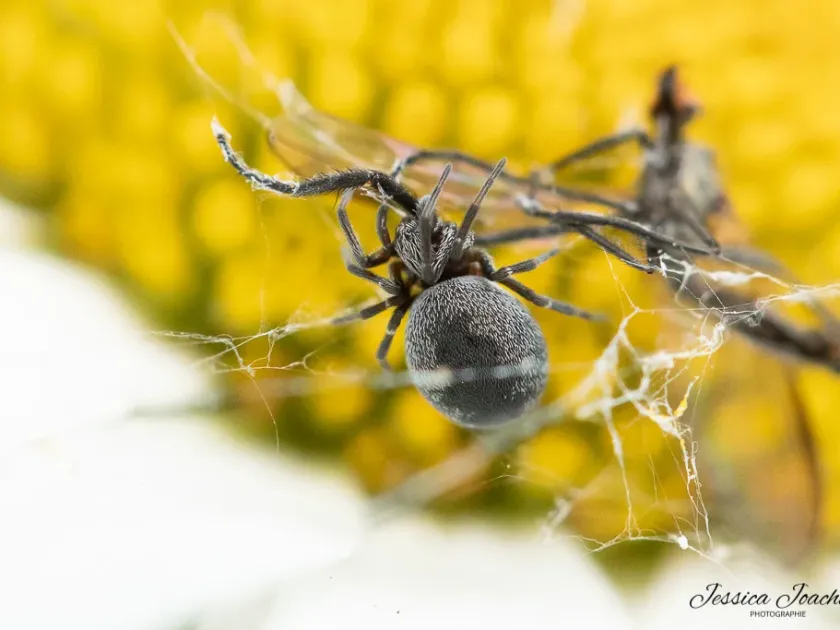
The lace web spider (lat. Brigittea civica) belongs to the family Dictynidae. These are small spiders typically measuring between 3 and 5 millimeters in body length.
They are characterized by a dark cephalothorax and a greyish abdomen with a distinct pattern. A hallmark of this species is its ability to spin dense, funnel-shaped webs in tight spaces.
As a synanthropic species, it commonly inhabits human dwellings. You can frequently find their characteristic webs in corners of window frames, door crevices, or nestled within the foliage of potted plants.
Classified under the order Araneae, these spiders are predators rather than plant-feeders. Despite being beneficial in nature, their presence indoors often causes aesthetic concern for plant owners.
The spider is highly cautious and sensitive to vibration, making it a elusive inhabitant that typically avoids human interaction and stays hidden within its funnel retreat during the day.
What it damages
Technically, the lace web spider is not a phytophagous pest. It does not feed on plant tissue, sap, or chlorophyll, meaning it does not directly cause diseases or wilting in your plants.
The primary damage is purely aesthetic. The dense, sticky webs accumulate household dust and debris, which makes the plant look unkempt, dirty, and neglected.
In cases of heavy infestation, the webs can partially obstruct the plant's leaves. This may slightly interfere with gas exchange and photosynthesis by covering the stomata on the leaf surface.
Additionally, the webs serve as collection points for prey remains and spider droppings, which can occasionally create a microenvironment conducive to fungal or bacterial growth on leaves.
The presence of these spiders is often an indicator of other small insect populations in your home, as they will only colonize areas where there is a steady supply of prey.
When it appears
The activity of Brigittea civica in indoor environments is not strictly seasonal. The stable microclimate of a modern home allows for year-round survival and reproduction.
During the winter months with central heating, their metabolic activity may slow down, but they remain present in their secluded retreats, waiting for favorable conditions or prey movement.
Spring and summer are periods of increased activity due to warmer temperatures and the opening of windows, which facilitates the arrival of new individuals from the outside environment.
The lifecycle is adapted to indoor conditions, meaning there is no major developmental phase that would make them disappear naturally without human intervention.
Increased web construction usually correlates with the active growing season of indoor plants, as more foliage provides better structural support for their hunting webs.
Signs of infestation
The most prominent sign of infestation is the presence of dense, funnel-shaped webs. These are much more robust and structured compared to the fine, wispy webs of spider mites.
Look for these webs in sheltered areas such as leaf axils, the junctions of stems, or corners of the plant pot where the spider feels safe from drafts.
Upon closer inspection, you may see the spider itself hiding deep within the funnel structure. They are shy and will retreat further into the web if disturbed.
Accumulation of dust and debris on the webs is a clear signal that the trap has been in use for a significant amount of time.
Tiny black spots on the leaves, which are spider waste, serve as further proof of their residence on your houseplants.
Control measures
Mechanical removal is the most effective way to deal with these spiders. Simply wiping away the webs with a damp cloth or a soft brush is usually sufficient to discourage them.
Regularly showering your plants (if they tolerate it) is an excellent preventative measure. A steady stream of water will wash away webs and knock the spiders off the plant.
It is important to check the areas around your plants, such as window sills and curtain rods, as the spider often uses the plant as a secondary hunting base while living elsewhere.
The use of chemical insecticides or acaricides is unnecessary and not recommended, as these products are not formulated for spider control and may be toxic to household residents.
Maintaining a clean home environment and vacuuming dark corners or crevices around your plants will deprive the spider of the necessary shelter to build its traps.
Taxonomy
- Latin name
- Brigittea civica
- Family
- Dictynidae
- EPPO code
- DICNCI
Discussion
No discussions yet — be the first.