
Darkling beetle species Eleodes suturalis
Eleodes suturalis
Description
How to identify
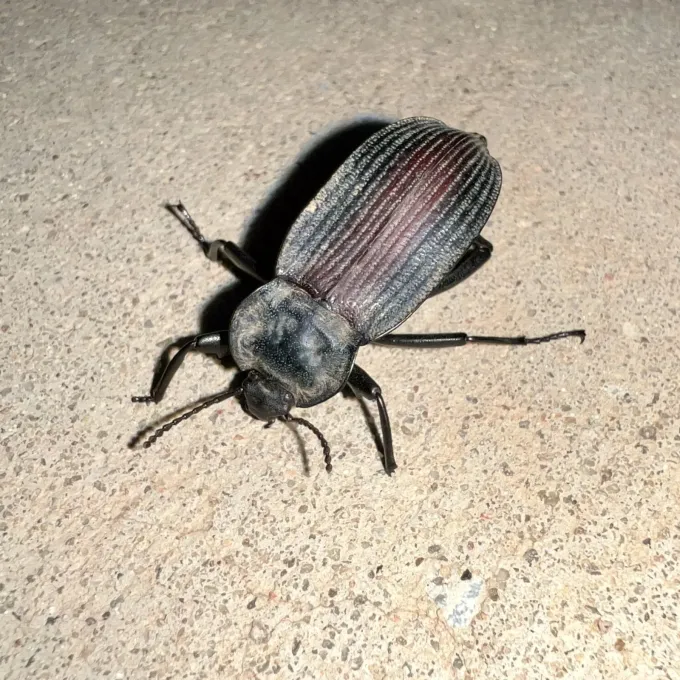
Eleodes suturalis is a species of the family Tenebrionidae, commonly known as darkling beetles. This flightless beetle is easily recognized by its rounded, highly convex black body and a distinctive light stripe along the margins of its elytra.
The adults exhibit a unique defensive behavior known as "headstanding"; when threatened, they raise their abdomen in the air and release a pungent, foul-smelling secretion to deter potential predators.
The larvae, often referred to as false wireworms, possess a cylindrical, heavily sclerotized body that is yellow-brown in color. They are typically more robust than true wireworms and have well-developed mandibles.
The life cycle includes the egg, larval (multiple instars), pupal, and adult stages. The larval stage can last for an extended period, contributing to the insect's remarkable resilience in diverse environmental conditions.
These beetles are primarily found in arid regions, favoring untilled grasslands and abandoned fields, which serve as reservoirs before they migrate into adjacent agricultural land.
What it damages
The damage is primarily caused by the larvae, which live within the soil profile and feed on the subterranean parts of various plants. Eleodes suturalis is a polyphagous pest with a broad host range.
Affected crops include cereal grains such as wheat and barley, as well as corn, millet, and various vegetable crops, particularly those grown in arid and semi-arid agricultural zones.
Larvae consume the seeds during germination by hollowing out the embryo, which leads to reduced crop density and often necessitates the costly replanting of entire fields.
As the larvae mature, they feed on the roots and the subterranean portions of young stems, causing plants to wilt, turn yellow, and eventually die due to the destruction of the vascular system.
While adult beetles can occasionally feed on the aerial parts of plants, such as young shoots or foliage, the economic impact of this activity is generally negligible compared to the root damage caused by the larvae.
When it appears
The activity of adult Eleodes suturalis beetles peaks in the spring and summer months, which is when mating occurs and females deposit their eggs into moist soil.
Larvae are most destructive during the spring season, as their peak feeding activity coincides with the germination and early seedling growth stages of the crops.
During the intense heat of summer, these insects migrate vertically into deeper layers of the soil to escape dehydration, making surface-level control efforts less effective.
A secondary increase in adult activity may be observed in the autumn before the beetles enter dormancy, moving deeper into the soil to survive the winter period.
The species overwinters as both adults and larvae at depths of 20 to 30 centimeters, a strategy that ensures high survival rates even in regions with significant frost.
Signs of infestation
The most evident sign of an infestation is the presence of thinning patches in the field where seedlings appear weak or have perished despite the absence of foliar diseases.
Upon examination, the subterranean damage is distinctive: seeds appear hollowed out, and roots show irregular, coarse gnaw marks, which helps distinguish this damage from pathogen-related decay.
The physical discovery of false wireworms in the root zone within the top 15 centimeters of soil serves as definitive confirmation of an Eleodes suturalis infestation.
Adult beetles are frequently spotted on the soil surface during the evening or immediately following rainfall, providing a visual cue for farmers to begin field scouting.
The detection of a strong, specific odor upon disturbing the soil is another indicator of a high population density, as the beetles release their defensive chemicals when threatened.
Control measures
Deep autumn plowing is a highly effective control measure, as it physically disrupts the soil, exposing the larvae to predators like birds and inducing mortality through desiccation.
Implementing a proper crop rotation strategy, alternating cereal crops with non-host plants or legumes, can significantly reduce the build-up of beetle populations over time.
Seed treatment with systemic insecticides is considered the most efficient method to protect emerging seedlings from false wireworm attacks during their most vulnerable stage.
Weed management on both the fields and the field margins is essential, as these areas provide both shelter and alternative food sources for the larvae throughout the growing season.
Targeted chemical applications to the soil based on monitoring and economic threshold calculations should be used only when infestation levels threaten the overall crop yield.
Taxonomy
- Latin name
- Eleodes suturalis
- Order
- Coleoptera (beetles)
- Family
- Tenebrionidae
- EPPO code
- ELEOSU
Discussion
No discussions yet — be the first.