
Eleodes quadricollis beetle
Eleodes quadricollis
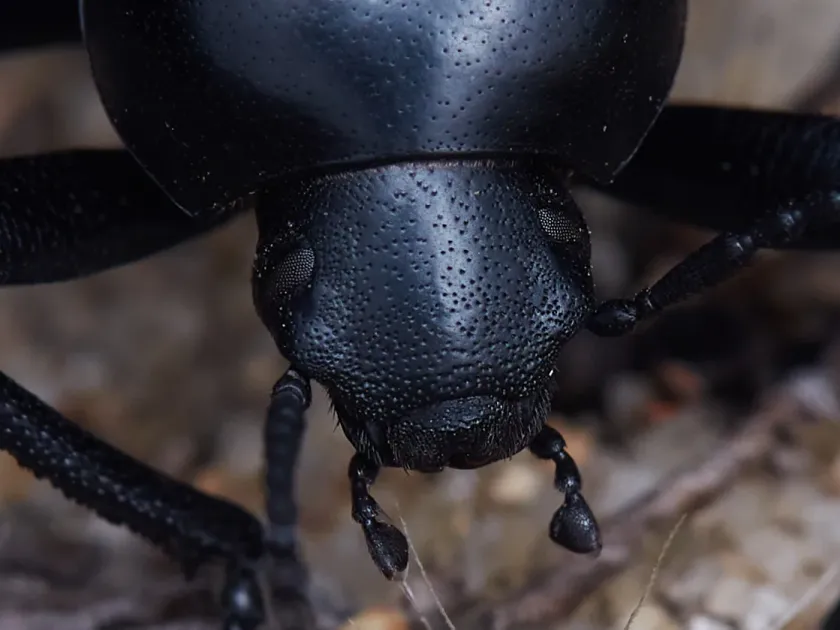
Description
How to identify
The beetle Eleodes quadricollis is a member of the Tenebrionidae family, often referred to as darkling beetles. These insects are characterized by a robust, dark-colored exoskeleton that provides resilience in arid environments.
Adult beetles are easily recognized by their defensive behavior: when threatened, they elevate the posterior portion of their abdomen. This distinct posture is a classic trait for the Eleodes genus.
The body shape is generally oval or elongated, adapted for crawling over sandy or compact soil surfaces. They are typically flightless, which limits their dispersal to ground-based movement.
The larvae, known as false wireworms, are cylindrical, heavily sclerotized, and exhibit a brownish color. Their morphology is specifically adapted for burrowing and feeding within the soil horizon.
Identification of the larvae requires close inspection of the terminal segments and head structure, which helps distinguish them from true wireworms (Elateridae family).
What it damages
The larvae are the primary cause of crop loss. They feed on planted seeds, germinating seedlings, and the underground root systems of various cereals, corn, and vegetable crops.
Damage typically manifests as stunted plant growth, wilting, and in severe cases, the total destruction of the stand. Seedlings often die shortly after emergence if the roots are severed.
Plants weakened by larval feeding are highly susceptible to secondary pathogens, including root rot fungi, which further degrade the crop's health and reduce potential yield.
Fields with a history of permanent pasture or fallow land are at higher risk of infestation, as these conditions favor the accumulation of darkling beetle populations.
In high-density populations, the cumulative damage to root systems can result in significant gaps in crop rows, often necessitating replanting efforts.
When it appears
The life cycle of Eleodes quadricollis is protracted, often spanning over a year. The beetle spends most of its existence in the soil as a larva, progressing through several growth stages.
Adults become active as temperatures rise in the spring and can persist throughout the growing season. Eggs are deposited in the soil, where moisture levels play a critical role in survival.
Pupation occurs within small, earthen chambers constructed by the mature larvae in the soil profile. The timing of adult emergence is influenced by seasonal weather patterns and soil humidity.
Winter is typically spent in the larval or adult stage, burrowing deep enough into the soil to avoid extreme temperatures and desiccation.
The multi-year nature of their life cycle makes it difficult to eradicate a population in a single season, requiring sustained management efforts over time.
Control measures
Cultural practices are the primary method of management. Crop rotation with non-host plants and thorough tillage can help disrupt the life cycle and expose larvae to environmental stresses.
Mechanical cultivation serves to physically destroy soil-dwelling larvae and adult beetle chambers, providing effective suppression of population densities before planting.
Chemical control is largely focused on the use of insecticidal seed treatments. These treatments protect the seed and initial root zone during the most vulnerable early growth stages.
Field monitoring, using pitfall traps or baiting, is essential for determining pest presence and guiding the timing of necessary control interventions.
- Implementation of crop rotation cycles.
- Deep plowing to expose larvae to natural predators.
- Utilization of systemic insecticide seed treatments.
- Effective weed control to reduce alternative food sources.
Taxonomy
- Latin name
- Eleodes quadricollis
- Order
- Coleoptera (beetles)
- Family
- Tenebrionidae
- EPPO code
- ELEOQU
Discussion
No discussions yet — be the first.