
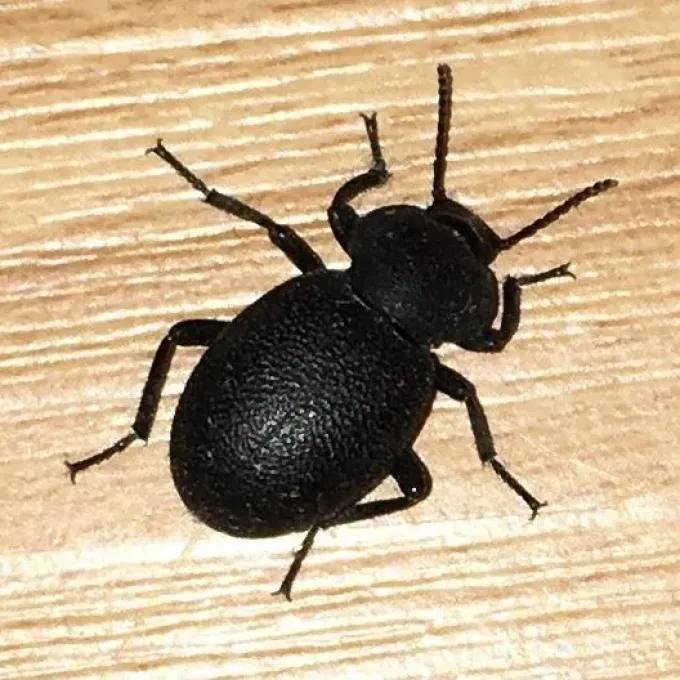
Eleodes pimeloides beetle
Eleodes pimeloides
Description
How to identify
The beetle Eleodes pimeloides belongs to the family Tenebrionidae, commonly known as darkling beetles. These insects are characterized by their robust, black, and often matte-textured exoskeleton, which provides protection in arid environments.
The adults are oval-shaped and possess long, sturdy legs adapted for crawling across dry soil surfaces. They are typically nocturnal, avoiding the intense heat of the day by sheltering in soil crevices or under debris.
The larvae are known as false wireworms. They have a cylindrical, highly sclerotized body that is yellowish-brown, making them extremely durable and resistant to mechanical pressure and variable soil moisture levels.
Development follows a complete metamorphosis, including egg, larva, pupa, and adult stages. Most of the life cycle occurs within the soil profile, where the insect remains protected from most environmental stressors.
These beetles are particularly well-adapted to semi-arid climates, where they can survive on sparse vegetation and organic matter, making them difficult to eradicate once they establish in a field.
What it damages
Larval stages are the primary cause of agricultural damage. They reside in the soil and feed extensively on germinating seeds, roots, and underground stems of various crops.
Crops most susceptible to these pests include cereals like wheat and barley, as well as corn and various vegetable crops, where the larvae can hollow out tubers and root systems.
Damage to the root system often causes young plants to wilt and die, leading to reduced stand density and significant yield losses if not managed during the early growth phases.
Adult beetles may occasionally feed on seedlings or foliage, but this damage is usually minor compared to the root destruction caused by the larvae, which can compromise the entire plant's health.
Infestations are often exacerbated during dry years, as the lack of soil moisture forces the larvae to consume more of the plant's root system to obtain necessary hydration and nutrients.
When it appears
Adult Eleodes pimeloides typically emerge in late spring and early summer, coinciding with the warming of the soil, which triggers their mating and egg-laying activities.
The larvae are present and active in the soil throughout the growing season. They are most destructive during the spring when they actively feed on newly planted seeds and developing root systems.
During the peak heat of mid-summer, both adults and larvae may migrate to deeper soil layers where temperatures are cooler and moisture is more stable.
The overwintering phase occurs in the soil, with the insect surviving as either a mature larva or an adult beetle, depending on the climatic conditions of the specific region.
Monitoring should be most intensive during the planting window in spring, as this is the period when the crop is most vulnerable to soil-borne pest attacks.
Signs of infestation
One of the most noticeable signs is the appearance of bare patches or gaps in crop rows where seeds failed to emerge or young plants suddenly wilted due to root severance.
Excavating the soil around affected plants usually reveals the characteristic yellowish-brown, rigid larvae of the false wireworm within the root zone.
Vegetables or root crops may exhibit deep, irregular feeding cavities or tunnels, which are often the entry point for secondary pathogens that cause further decay.
The presence of adult beetles during evening inspections, or finding them in pitfall traps set throughout the field, indicates a breeding population is active in the area.
Empty seed hulls found during soil inspections are a strong diagnostic indicator of high larval pressure during the early stages of crop development.
Control measures
Crop rotation is the most effective cultural practice to disrupt the life cycle of the darkling beetle, as it prevents the buildup of larval populations in the soil.
Deep fall tillage is recommended to expose larvae to the surface, where they become susceptible to predation by birds and mortality due to rapid temperature and moisture changes.
Chemical control often involves the use of insecticide seed treatments, which provide an essential protective zone around the seed and young seedling during the critical germination phase.
In cases of severe infestation, granular soil insecticides can be applied at the time of planting to protect the root zone from larval feeding.
- Maintain weed-free fields to reduce alternative food sources and shelter for adults.
- Ensure proper seedbed preparation to promote rapid germination and early growth.
- Use entomopathogenic fungi as a biological control measure in integrated pest management programs.
- Perform regular field scouting using light or pitfall traps to monitor population spikes.
Taxonomy
- Latin name
- Eleodes pimeloides
- Order
- Coleoptera (beetles)
- Family
- Tenebrionidae
- EPPO code
- ELEOPI
Discussion
No discussions yet — be the first.