
Eleodes opaca
Eleodes opaca
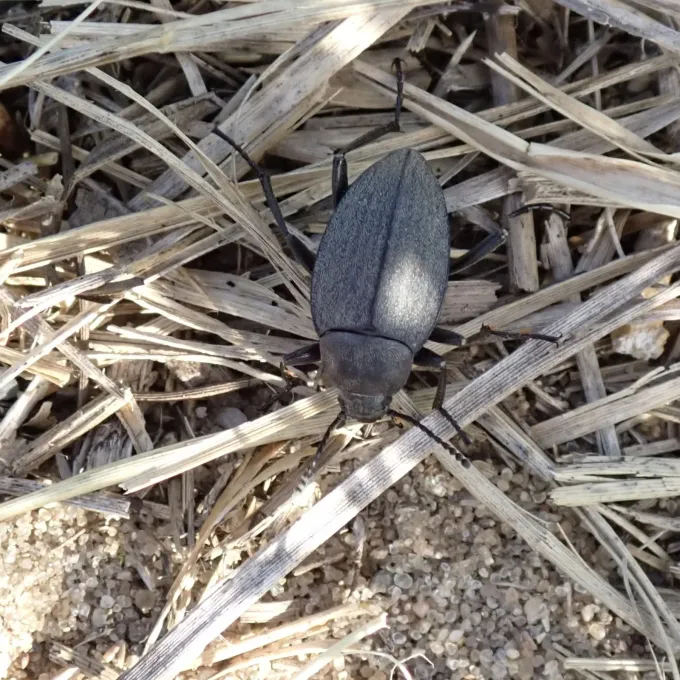
Description
How to identify
Eleodes opaca belongs to the Tenebrionidae family, commonly known as darkling beetles. These insects are characterized by their flightless nature, as their elytra are fused together, rendering them strictly ground-dwellers.
The larvae, often referred to as false wireworms, possess a cylindrical and heavily sclerotized body. They are visually similar to true wireworms but can be distinguished by their specific mouthpart anatomy and abdominal segment structure.
Adult beetles exhibit a unique defensive behavior: when disturbed, they stand on their hind legs, tilting their posterior upwards. This distinct posture is a classic trait of the Eleodes genus.
These beetles prefer arid environments, where they are nocturnal, spending the daylight hours hiding under soil debris, rocks, or crop residues.
The life cycle undergoes complete metamorphosis, including egg, larva, pupa, and adult stages. The larval stage is the most critical period, as it is the primary feeding phase causing significant damage to agricultural lands.
What it damages
Eleodes opaca is recognized as a serious threat to grain crops, particularly in semi-arid regions. It primarily impacts wheat, barley, and other cereals during the critical germination and seedling stages.
Larvae feed directly on the planted seeds, often consuming the embryo entirely. This results in a drastic reduction in field emergence and thinning of plant stands.
Besides seeds, the larvae can attack the underground portions of young stems, leading to stunted growth, wilting, and often the death of the developing seedling.
Infestation severity is frequently amplified by dry spring conditions, which force seedlings to grow slowly, thereby extending their vulnerability window to soil-dwelling pests.
The economic threshold for these pests depends on population density per square meter, making regular soil sampling an essential practice for integrated pest management.
When it appears
Adult beetle activity peaks during the spring and summer months. Females lay their eggs in the upper soil layers, especially in areas with organic matter or near the roots of host plants.
Feeding activity of the larvae is most intensive in the spring when soil temperatures reach the optimal range for the species' physiological processes.
During periods of extreme drought or cold, larvae migrate deeper into the soil profile to find stable microclimates and avoid unfavorable environmental stressors.
The life cycle can be quite prolonged, sometimes spanning more than one year, which turns this insect into a chronic issue for crop rotation programs in infested areas.
As autumn approaches, larvae prepare for overwintering by burrowing deeper into the soil, becoming less accessible to surface-based management tactics.
Signs of infestation
The most evident sign of infestation is the presence of patchy or thin stands in fields where seedlings fail to emerge or appear significantly stunted after sprouting.
A closer inspection of damaged plants reveals chewed seeds with hollowed-out embryos, along with distinct grooving on the underground stems.
The presence of adult beetles on the soil surface at dusk or under debris serves as a precursor indicator of potential larval damage in the subsequent planting season.
Soil excavations in affected areas will typically reveal the presence of false wireworms, which can be distinguished from click beetle larvae by their slower, less energetic movement.
General crop malaise, such as delayed development that cannot be attributed to moisture stress or nutrient deficiencies, is a strong indicator of underground pest pressure.
Control measures
Effective management relies on diverse crop rotations, which disrupt the beetle's life cycle and prevent the build-up of larval populations over consecutive seasons.
Proper soil tillage practices, including deep plowing, can disrupt the soil environment and expose larvae to avian predators and parasitic insects.
The use of insecticide-treated seeds is the most effective chemical measure, providing necessary protection during the initial germination phase when plants are most vulnerable.
Strict weed management reduces the availability of sheltered habitats and food sources for the adult beetles, significantly lowering the overall pest potential.
Monitoring populations using pheromone or pitfall traps provides essential data for timing agricultural interventions and preventing large-scale infestation outbreaks.
Taxonomy
- Latin name
- Eleodes opaca
- Order
- Coleoptera (beetles)
- Family
- Tenebrionidae
- EPPO code
- ELEOOP
Discussion
No discussions yet — be the first.