
Darkling beetle species Eleodes militaris
Eleodes militaris
Description
How to identify
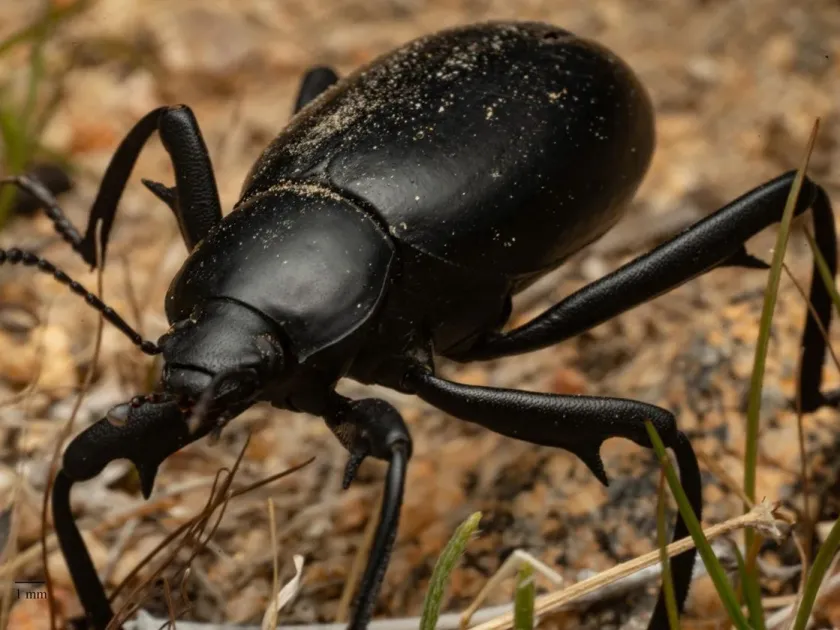
Adult Eleodes militaris beetles belong to the Tenebrionidae family and are characterized by their coal-black coloration and distinctively convex elytra.
The adult body is oval-elongated, typically measuring between 15 and 25 millimeters in length. The cuticle surface is often matte or slightly shiny, exhibiting a granular or punctate texture.
These beetles possess a unique defensive mechanism: when threatened, they perform a characteristic "head-stand" posture, raising their abdomen and emitting a sharp-smelling chemical secretion.
The larvae, known as false wireworms, feature a cylindrical, yellow-to-brown body with distinct segmentation and highly sclerotized cuticles, providing resistance against mechanical damage.
Development involves several larval instars, and pupation requires a prolonged period of active feeding within the soil profile.
What it damages
The primary damage is caused by larvae that dwell in the upper soil layers and feed on the underground parts of young plants, leading to reduced crop density.
This pest is particularly dangerous for cereal crops, including wheat, barley, and rye, but it can also infest seedlings of various row crops and vegetables.
Adult beetles may also feed on the aerial parts of young plants, though their direct economic impact is generally considered secondary to the larval stage.
In arid regions, where Eleodes militaris populations can reach high densities, the pest is capable of destroying significant portions of crops during early vegetative stages.
Damaged seedlings often die due to the destruction of the root system, forcing farmers to perform reseeding on affected acreage.
When it appears
Adult activity of Eleodes militaris is typically observed during the spring and summer, when beetles emerge to the surface for mating and egg-laying in the soil.
Larvae remain hidden within the soil throughout the entire growing season, concentrating in the root zone while searching for food sources.
Peak larval feeding activity occurs during seed germination and early root development, which typically aligns with the early spring period.
The life cycle of this insect can span multiple years, with larvae entering prolonged diapause periods in response to moisture deficits or low temperatures.
Overwintering occurs primarily at the late larval or adult stage, seeking shelter at depths safe from freezing.
Signs of infestation
The first sign of infestation is mass wilting and seedling death; affected plants are easily pulled from the soil due to the absence of a root system.
During soil examination around dead plants, false wireworm larvae are often found curled up or moving actively within moist soil layers.
The presence of adults on the soil surface during morning or evening hours serves as an indicator for population density monitoring.
Evidence of larval activity includes consumed seeds, which are often found destroyed in the soil before any sprout emerges.
General thinness of the stand, localized in patches across the field, is a strong indicator of the focal distribution pattern of Eleodes militaris.
Control measures
The primary control method involves strict crop rotation, avoiding continuous cereal cropping which facilitates the buildup of the pest in the soil.
Effective deep autumn plowing is crucial, as it exposes larvae to the surface, where they become vulnerable to predation and harsh climatic conditions.
Seed treatment with systemic insecticides is the most effective approach to protect seedlings from larval damage during the critical early growth phases.
In cases of high population density, applying granular soil insecticides during planting creates a protective barrier around the root system.
- Utilizing seeds with high germination energy to shorten vulnerable growth stages.
- Rigorous management of weed species that provide alternative food sources for adults.
- Consistent monitoring of population density using soil traps to guide timely management decisions.
Taxonomy
- Latin name
- Eleodes militaris
- Order
- Coleoptera (beetles)
- Family
- Tenebrionidae
- EPPO code
- ELEOFE
Discussion
No discussions yet — be the first.