
Desert false wireworm
Eleodes extricata
Description
How to identify
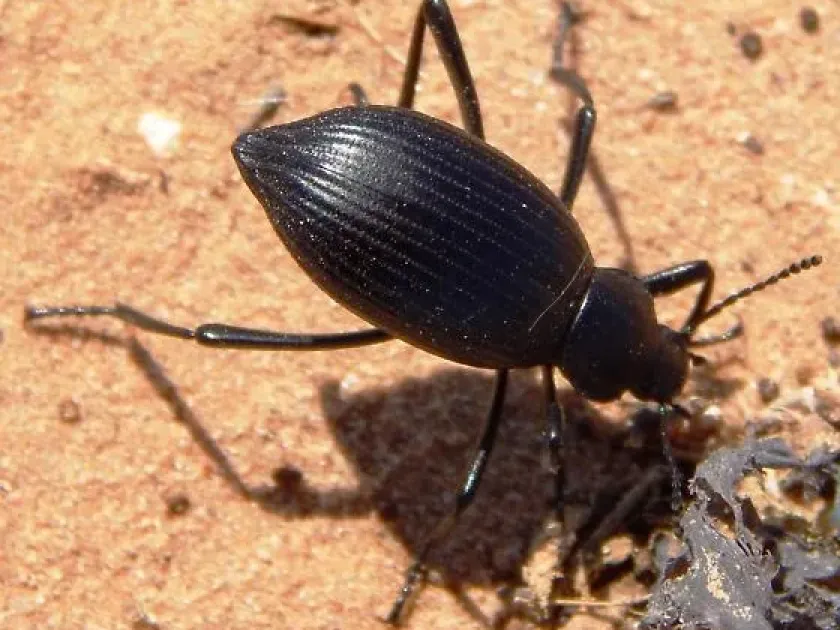
The desert false wireworm (Eleodes extricata) belongs to the Tenebrionidae family, commonly known as darkling beetles. Adult beetles are characterized by their black, often matte or slightly shiny cuticle, adapted to arid environments.
The adults possess a hard exoskeleton that helps in water retention. They have a standard beetle morphology with 11-segmented antennae and are known for their distinct defensive behavior of elevating their abdomen when threatened.
The larvae, known as false wireworms, are cylindrical, heavily sclerotized, and have a yellow-to-brownish color. They possess strong mandibles, which they use to feed on both decaying matter and living plant tissues.
These insects are primarily nocturnal. During the day, they remain sheltered under debris, rocks, or deep within the soil profile to avoid high temperatures and low humidity.
Their life cycle duration varies significantly depending on soil moisture and ambient temperature, often requiring one to several years to complete development from egg to adult.
What it damages
As polyphagous pests, desert false wireworms attack a variety of crops, with a clear preference for cereals such as wheat, barley, oats, and rye. Corn is also susceptible to their feeding damage.
The primary damage is caused by the larvae in the soil. They feed on germinating seeds, destroying the embryo and preventing crop establishment. This leads to poor germination rates and patchy fields.
Larvae also consume the roots and the underground portion of the stems. This feeding behavior weakens the plants, causing them to wilt or die prematurely during the early growth stages.
Adult beetles may feed on the foliage or reproductive parts of plants, though this damage is usually considered secondary compared to the subterranean impact of the larvae on seedling health.
Heavy infestations can cause significant economic losses, especially in dryland farming regions where stressed plants have limited capacity to recover from root system damage.
When it appears
Adult activity peaks during the spring and summer months when mating occurs and females oviposit in the soil. High temperatures generally trigger the emergence of adults from their overwintering sites.
Larval activity is highest when soil moisture is optimal for development. During prolonged droughts, larvae typically migrate deeper into the soil profile to find suitable humidity conditions.
The most critical window for crop damage is the period following planting, specifically during germination and the seedling stage. During this time, the larvae are most aggressive in their feeding.
Pupation typically occurs within the soil during the summer. Depending on local climate conditions, the new generation of adults may emerge in late summer or remain dormant in the soil until the next season.
Environmental factors, especially winter and spring moisture, play a crucial role in population dynamics, as increased moisture generally leads to higher survival rates for younger larval instars.
Signs of infestation
The primary sign of infestation is the presence of gaps in the crop stand. Patches of the field may appear thin, with seedlings wilting or failing to emerge entirely.
Digging in the soil near damaged plants usually reveals the presence of larvae. Baiting techniques, such as burying grain traps, are effective for assessing the population density before planting.
Adult beetles can be detected at night using light traps. During the day, inspection of field edges, under stones, or beneath crop residues can confirm the presence of the pest.
Uneven crop development across a field often points to larval activity. Plants that survive early feeding damage may show stunted growth and poor tillering compared to healthy plants in non-infested areas.
The presence of small holes or severed roots in seedlings is a diagnostic indicator that identifies soil-dwelling insects like false wireworms as the cause of the crop failure.
Control measures
Effective tillage practices, such as deep plowing, disrupt the larval habitat and expose them to surface predators like birds, as well as to lethal desiccation from sun exposure.
Crop rotation is an essential management strategy. Rotating host crops with non-host plants can break the pest's life cycle and reduce the population density in a specific field.
Seed treatment with systemic insecticides is the most effective approach for protecting emerging seedlings from larval feeding. This provides a chemical barrier during the most vulnerable growth phase.
Sanitation practices, including the removal of weeds and crop residues, help eliminate hiding spots for adults and reduce the overall suitability of the field for the pest.
Integrated pest management strategies often involve monitoring population levels and using biological agents like entomopathogenic fungi to suppress larval numbers where chemical use is restricted.
Taxonomy
- Latin name
- Eleodes extricata
- Order
- Coleoptera (beetles)
- Family
- Tenebrionidae
- EPPO code
- ELEOEC
Discussion
No discussions yet — be the first.